At ten o’clock one night in 1999, Randy Altschuler was still in his Blackstone office in New York. Across the Atlantic, his friend Joe Sigelman was also working late. In London, it was three in the morning. Both needed presentations prepared for clients. Both were dissatisfied with the support available to do it. Their conversation contained the beginnings of OfficeTiger, a business built around the proposition that the right person for a job might be a very long way from the person who needed it done.
It is an appropriately unromantic opening for Altschuler’s career as a founder. There was work waiting, talent elsewhere, and a connection that ought to exist. A quarter of a century later, the materials have changed. Documents have given way to custom parts. The recurring question has survived: why should a customer’s options end where their personal address book does?
Two friends, two time zones, one complaint
Altschuler and Sigelman belonged to Princeton’s class of 1993. They had met before college through a mutual friend, then became close as freshmen in Mathey College. Both went into finance and attended Harvard Business School. Their late-night complaint became a decision to leave well-paid jobs and start a company. OfficeTiger was founded in late 1999 and began operating in 2000, linking business clients with support services, including operations in Chennai.
Behind the finance résumé was a less predictable education. Altschuler studied German literature at Princeton, then went to the University of Vienna as a Fulbright Scholar. He later earned his MBA at Harvard. Investment banking at Donaldson, Lufkin & Jenrette and real estate private equity at Blackstone supplied another kind of schooling: a close view of how businesses bought services and how much inconvenience they tolerated in the process.
His older personal biography describes a childhood with a single mother raising two sons, and grandparents who had immigrated to the United States. Those are the experiences he has chosen to foreground when explaining his interest in work and opportunity. The polished list of institutions tells one part of his story. The family account gives his concern with making a living a more ordinary point of reference.
OfficeTiger grew into a global business employing 4,500 people. RR Donnelley acquired it in 2006. In 2008, Altschuler co-founded CloudBlue, which handled recycling services for electronic equipment. Ingram Micro acquired that company in 2013. He had now helped build businesses around office work and discarded electronics. Neither subject required much assistance from glamour. Both required somebody to notice a complicated job that customers would gladly pay to have handled properly.
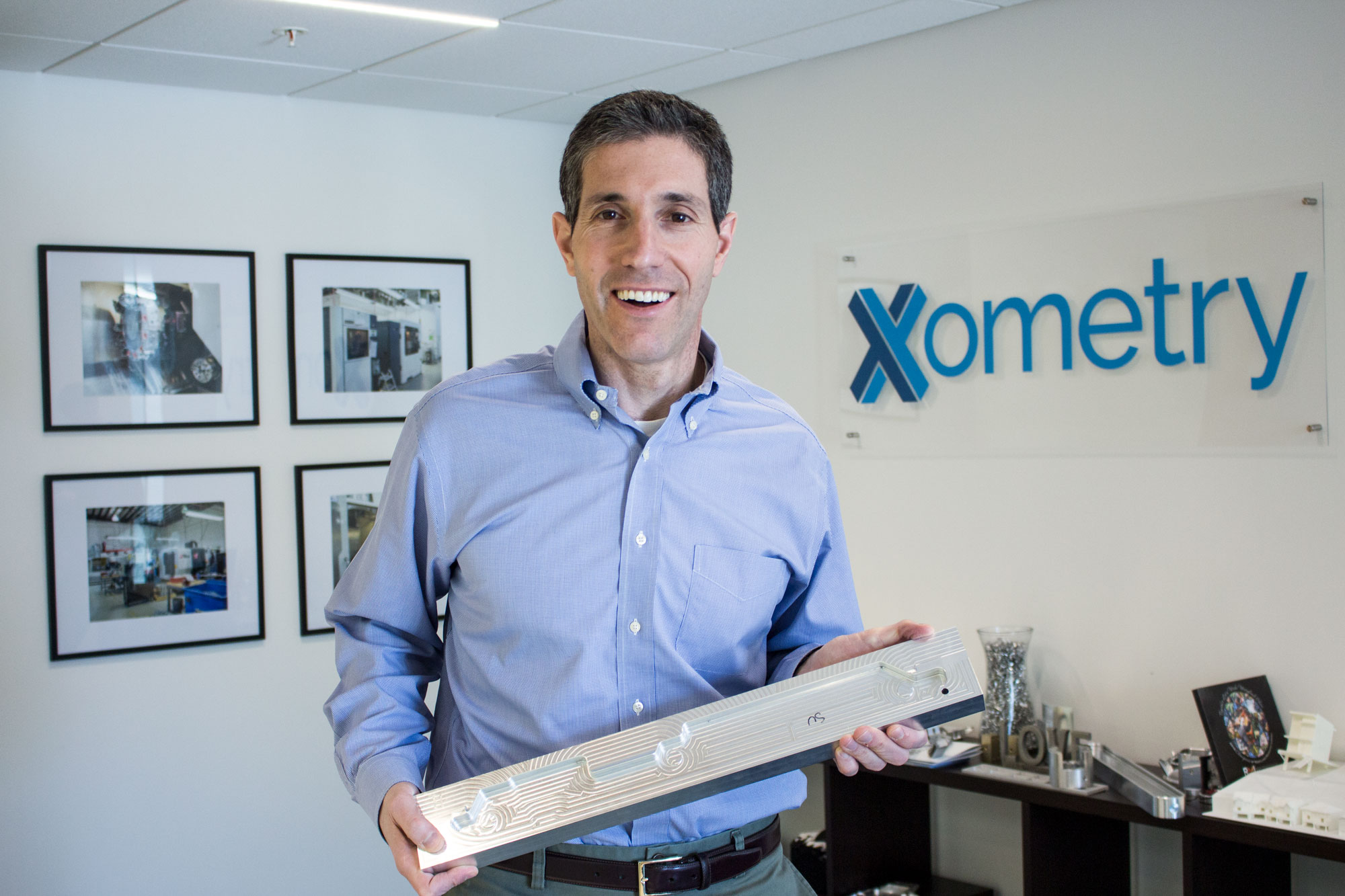
The literature graduate visits the machine shop
In 2013, Altschuler co-founded Xometry with Laurence Zuriff. Their interest in 3D printing opened a wider inquiry into custom manufacturing. A buyer could need a part; a manufacturer could possess the equipment and skill to produce it. Yet discovering one another, agreeing on a price and getting the work under way remained laborious. The Internet had made shopping feel immediate. Commissioning a custom component could still involve a substantial exercise in patience.
Altschuler was candid about his preparation. His academic specialty had hardly been machine tools. He acknowledged that mechanical work did not come naturally to him and that learning the industry took effort. This makes his story more interesting than a tidy account of expertise becoming a company. He entered an unfamiliar business and had to recruit, listen and learn before he could credibly offer to simplify it.
The founders’ ambition had an everyday logic. Their joint letter before Xometry’s public offering asked why the convenience of an online marketplace for books could not extend to products people make and use. The comparison was inviting; the practical work was harder. Custom parts do not arrive with the standardized descriptions and established prices of books. A marketplace had to accommodate differences in design, manufacturing process, materials and delivery.
Xometry opened for business in 2014. Altschuler later described its construction in increments of employees, customers and computer code. His team combined software and mechanical engineering with customer service and operations. That combination matters to the personal story: the literature graduate’s contribution depended on gathering people whose knowledge differed from his own. A convincing website would be little comfort if the part arrived wrong.
A machine cannot earn money by waiting
The supplier side explains much of his enthusiasm. Small manufacturers could be highly capable and still depend on a narrow circle of local customers. Their machinery and knowledge were valuable, but difficult for distant buyers to discover. Opening a wider market promised more opportunities to put that capacity to work. For Altschuler, the attraction lay in improving the chances of a useful match on both sides of the transaction.
Xometry also built a small machine shop and 3D-printing operation of its own. Altschuler explained that it served as a laboratory: a place to generate data, test ideas and understand suppliers’ experience. Employing actual machinists gave the company a practical basis for conversations with the businesses on its network. There is something reassuring about a software company discovering that a workshop can be a useful place to think.
By 2017, engineers could upload CAD files, compare materials and quantities, and see prices change. Xometry’s services already extended across CNC machining, 3D printing, sheet metal and urethane casting. The breadth was deliberate. Customers needed different production methods for different jobs. Asking them to organize their buying around a single favored technology would have made the marketplace less useful.
“It’s inefficient because it requires the customer to do a lot of work to get a quote.”
Randy Altschuler, 2020
That complaint sounds almost too modest to carry a public company. But the time spent getting a quote is part of the cost of getting something made. Reducing it changes what an engineer can explore before ordering and how quickly a supplier can receive suitable work. Altschuler’s business sits in that gap between possessing a capability and being able to sell it.
The year the marketplace met the stock market
Xometry went public in 2021 under the Nasdaq symbol XMTR. The offering closed in July at $44 a share, including the underwriters’ full option exercise. For a founder who had previously sold companies to larger businesses, the public listing supplied a different route forward. Xometry could continue building with public shareholders watching the results.
That December, it acquired Thomas, the industrial sourcing business behind Thomasnet. The announced cash-and-stock transaction was valued at $300 million; it closed on December 9. Thomas added a business built around helping industrial buyers find suppliers. The purchase expanded Xometry’s reach beyond the immediate act of ordering a custom part into the broader business of discovery.
Scale also brought obligations that a founding idea cannot settle by itself. Xometry’s filings described the difficulties and risks of integrating Thomas. Bringing companies together takes resources, and expected benefits can arrive slowly or fall short. That is part of the account, too. Altschuler’s method involves finding useful connections; making them work inside an expanding organization is an ongoing management task.
Thirteen years, then a different chair
In February 2026, Xometry announced a succession plan. Sanjeev Singh Sahni, who had joined as president in January 2025, would become CEO on July 1. Altschuler would become executive chairman, remaining involved in strategic growth and corporate partnerships. Fabio Rosati would continue as lead independent director. The new arrangement gave the founder a defined role alongside his successor.
His farewell to the CEO position included an unusually revealing hiring brief. He wanted a successor with technical fluency and operating discipline, but also kindness and fairness. He credited Sahni with meeting that standard. After thirteen years of leading Xometry, Altschuler was handing daily leadership to someone he had already worked beside. The transition made room for continuity without requiring the founder to retain every responsibility.
A May 2026 partnership with Siemens showed where the company wanted to go next. The plan was to bring Xometry’s manufacturing, pricing and sourcing intelligence directly into Siemens’ engineering software. Siemens accompanied the agreement with an approximately $50 million minority investment. The proposed connection moved the marketplace closer to the moment when engineers make design decisions.
For Altschuler, this was familiar territory in a new setting. The customer already had work to do inside an established workflow. Putting useful manufacturing information there could shorten the journey to production. His executive-chair remit gives him time to pursue partnerships of this kind while Sahni runs the company. A title change can sound ceremonial. This one came with a specific set of jobs.
The cost of staying in Maryland
Another chapter opened in July 2026, when Altschuler launched the Maryland Affordability Project. The initiative focuses on the cost of living and doing business in the state. He has made taxes, electricity costs and housing central to its agenda. These are his policy arguments, and they now occupy space alongside his work in manufacturing.
Politics had appeared earlier in his career. He was the Republican and Conservative Party nominee for New York’s 1st Congressional District in 2010 and 2012. His 2010 race against Tim Bishop ended with a concession after weeks of uncertainty. The Maryland project describes itself as nonpartisan. Its founder arrives with both business experience and an established political history.
In August, he explained the project through his experience building a company in Maryland and wanting families and employers to be able to remain there. In October, he published commentary on the state’s electricity costs and energy policy. The geography of opportunity had become a personal question again: what makes a place somewhere people can afford to build a future?
The connection to his companies is a recurring concern with the conditions around work. OfficeTiger began with a task that needed doing. Xometry grew around the difficulty of finding the right shop. His Maryland initiative asks what makes it possible to stay and build. Across those different settings, Altschuler keeps returning to practical obstacles that are easy to overlook until the bill arrives.
Follow the next connection
More from Altschuler, conversations worth watching, and the milestones behind this story.