Amit Chadha once kept a scratch pad beside his bed. Before sleep, he would record what had gone well and what he could have done better. He says he still makes the assessment mentally. A chief executive can acquire an impressive collection of people who evaluate him. Chadha has retained one particularly inconvenient reviewer: himself.
He has described an occasion when that review led to a call at 5:30 the following morning. He had been too harsh with a colleague the previous day and wanted to acknowledge it. There is something refreshingly practical about an executive anecdote whose decisive action is an apology. The corner office, apparently, does not confer immunity from having to ring back.
That small ritual offers a useful way into a career often presented through much larger numbers. Chadha leads L&T Technology Services, the engineering research and development business known as LTTS. His work involves persuading clients, engineers and investors that a company can become more ambitious while remaining willing to correct itself.
A long apprenticeship in other people’s problems
Chadha joined the L&T engineering business in 2009. A contemporary regulatory account describes his starting position as area vice-president in the Integrated Engineering Services division. He transferred to L&T Technology Services in April 2014, becoming business head for North America and Asia. The route matters: his rise ran through customers and markets before it reached the chief executive’s desk.
In February 2015, he joined the board. Sales and business development became a substantial part of his remit. Those titles place him at the junction between what engineers can build and what customers will pay to have built. A technically elegant answer still needs a buyer with a sufficiently urgent question.
By the time he became deputy CEO, his responsibilities extended across delivery, operations, sales and marketing. He took charge as CEO and managing director on April 1, 2021, succeeding Keshab Panda. This was an internal succession after years of accumulating responsibility, with ample opportunity to discover where the attractive strategy diagram met the less accommodating working day.
Learning to hear the orchestra
His technical education was in electrical and electronics engineering at BIT Mesra. Later came an advanced management programme at INSEAD and an executive programme with Harvard Business School Publishing. BIT Mesra recognised him with its distinguished alumni award in 2022; the Indo American Chamber of Commerce named him Corporate Leader of the Year in 2023.
Chadha also reads biographies and fiction, and encourages employees to read. It is an apt combination for someone whose daily problem is coordinating people: biographies offer the decisions after the consequences are known; fiction supplies characters who have inconvenient motives of their own. Neither promises that the next meeting will proceed according to the agenda.
In a 2018 essay co-authored with compliance executive Thomas Loesler, he argued for managing from the centre. The leader belonged among the people doing the work, helping them agree on purpose and understand their roles. Their musical analogy was the conductor, whose contribution depends on hearing the instruments around him.
The essay also made room for reverse mentoring, with younger colleagues helping older ones understand new technology. That is a fairly direct challenge to the assumption that knowledge rises automatically with rank. For an engineering employer, the useful question is who understands the problem. The organisation chart cannot answer it on its own.
“go deeper to scale.”
Amit Chadha, on LTTS’s growth approach
Before the top job, the public market
One important chapter predates his appointment as CEO. Chadha was part of the leadership team that brought LTTS to the Indian public markets in 2016, listing the business on the National Stock Exchange and Bombay Stock Exchange. The company’s engineering work acquired a second audience: shareholders expecting an account of its progress.
The IPO connects two sides of his career. He had spent years helping explain engineering services to customers; a listed business must also explain its choices to owners. Investment, delivery and financial returns become parts of the same conversation. The explanation has to survive a quarterly result, when adjectives receive rather less attention than arithmetic.
That history helps explain why his current public appearances move readily between product development, customer spending and the shape of the business. He occupies the space between the laboratory and the earnings call. Both have demanding audiences, though only one routinely asks when the margin will improve.
A bigger map requires a closer view
Chadha’s formulation for expansion is concise: “go deeper to scale.” LTTS organised itself around Mobility, Sustainability and Tech, with distinct operating priorities. The intention is to build more knowledge within particular industries while sharing capabilities such as embedded software and digital manufacturing across them.
The geography is equally concrete. LTTS opened an engineering design centre in Plano, Texas, in June 2025. It began with capacity for 100 engineers and announced an ambition to create more than 350 skilled jobs. Its demonstrations included railway track inspection and vehicle technologies, putting examples within reach of customers rather than leaving them on presentation slides.
An earlier Toronto expansion followed a similar logic. Chadha spoke about the attraction of nearby customers, engineering talent, universities and an established industrial ecosystem. The planned work included railway engineering, sensors and digital asset management. For a global services company, being close to the customer can mean understanding the local machinery as well as the local time zone.
These choices give his growth story some useful texture. Expansion appears as a series of capabilities in particular places: a rail problem here, manufacturing expertise there, a customer who needs engineers within travelling distance. A map filled with office pins becomes meaningful only when there is a reason for each pin.
The factory has a vote
Artificial intelligence is the next test of that approach. Chadha calls the convergence of AI, digital technology and engineering “Engineering Intelligence.” The phrase carries a very physical ambition. Intelligence is to become part of how products and industrial systems are designed, built and operated.
His argument is that industrial deployment requires validation, defined responsibility and limits on autonomy. A system making recommendations and a system controlling equipment raise different questions. His proposed progression moves through assistance and bounded execution before autonomy in controlled settings. The appeal lies in making a deployment answerable to the environment where it must work.
The old engineering disciplines become particularly relevant here. A factory has schedules, equipment and operating constraints. A persuasive demonstration still has to fit those conditions. Chadha’s emphasis on accountability puts attention on the handover between software capability and industrial responsibility, a point where enthusiasm alone is a poor operating procedure.
The ambition also depends on whether customers can absorb the technology. Their existing systems, internal skills and decision processes influence the pace of adoption. That makes the engineer’s task partly organisational: understand the setting, establish what can be trusted, and decide who remains responsible for the result.
From the research sandbox to the shop floor
LTTS joined the MIT Media Lab through a multiyear membership agreement announced in September 2025. The arrangement includes exchanges with researchers and innovators, alongside plans to host industry programmes and advisory gatherings. It gives Chadha’s organisation a place to explore ideas with people working beyond the immediate boundaries of a customer contract.
The membership is an input to the strategy, with exploration still required before any commercial outcome. Its interest lies in the meeting of different working habits: an engineering services business bringing customer problems into a research environment where unfamiliar combinations of disciplines are part of the appeal.
By October 12, 2026, another part of the plan had a factory setting. LTTS opened an Engineering Intelligence lab for manufacturing and operations in Bengaluru, using NVIDIA technologies for simulation and physical AI. The environment combines digital twins, machines, robotics and operational systems so customers can examine how the pieces interact.
One detail deserves attention: a verification gate checks actions generated by AI agents before those actions reach a machine. That is a small architectural description with a large implication. The proposed future includes an explicit place to check the instruction before the equipment obeys it. Chadha’s habit of review has found a distinctly industrial counterpart.
- 01Recommend
- 02Assist
- 03Execute within limits
- 04Operate in controlled domains
The next review is already scheduled
On October 19, 2026, LTTS reported quarterly revenue of ₹3,040.4 crore, up 12.1% from a year earlier, with an EBIT margin of 16.3%. Its workforce stood at 24,035 at September’s end. These are company measures, representing the work of thousands of people under Chadha’s leadership.
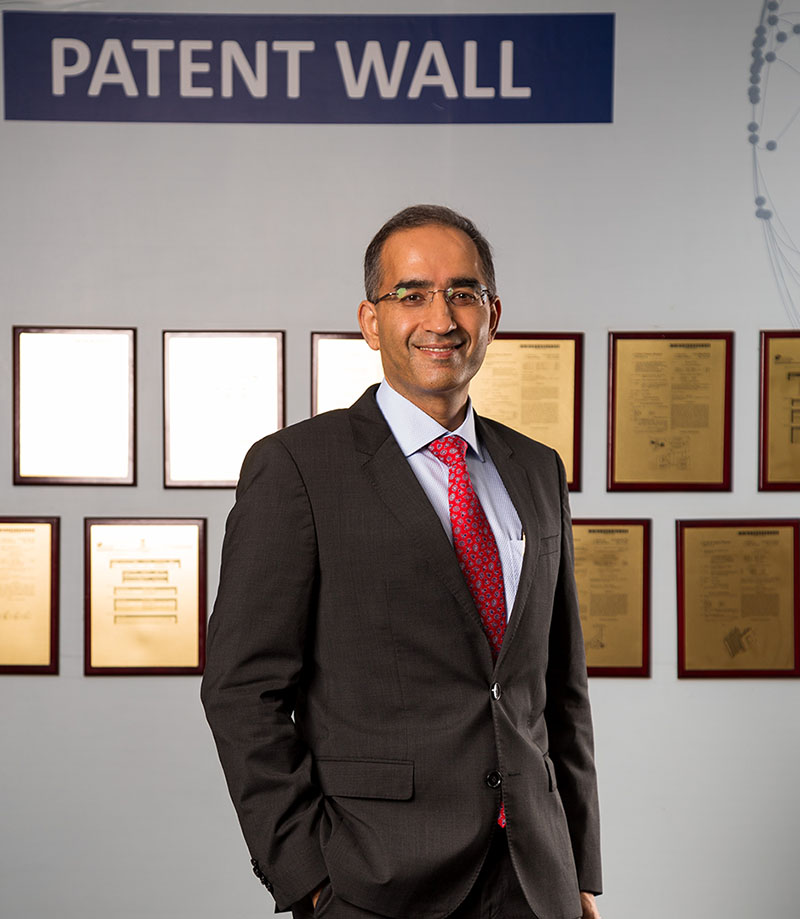
The same release recorded a portfolio of 1,808 patent filings, including 1,085 co-authored with clients. The distinction matters: a filing is a record of inventive activity, while a granted patent and a successful product are further steps. Even the photograph of Chadha beside a patent wall invites a question about what happens after the frame goes up.
His stated five-year aspiration is revenue growth of 13-15% a year, with EBIT margins in the 16-17% range. Those figures describe a target that subsequent results will test. They give the discussion of engineering intelligence a useful obligation: demonstrate that the new capabilities can support a durable business.
For Chadha, the challenge brings familiar parts of his career together: listening to specialists, explaining decisions, building customer relationships and accepting an outside verdict. The bedside scratch pad was small enough for one person’s working day. The questions he takes to it now have factories, contracts and thousands of colleagues attached.
30 September 2026
Q2 FY27