Rick Bates has a colleague with a diplomatic way of announcing that the boss may be mistaken. “You might be right, but…” It is a small phrase with a substantial job: opening a conversation that a chief executive could otherwise close simply by sounding certain. Bates has described the expression himself. He understands the translation. Somewhere beyond that polite opening, the company needs to work something out.
For the co-founder of SingleCare and the founder and CEO of its parent company, RxSense, this is useful operating equipment. He came to entrepreneurship after years in senior corporate roles, carrying experience that could help him recognize a business opportunity. The same experience could also persuade him that he already knew how customers would respond. His career contains examples of both possibilities.
“I never realized how often I was wrong,” he said in 2023. There are more flattering sentences available to an executive discussing his leadership. This one offers a better starting point. It leads to a delayed product decision, a return to his business school, and an expanding company whose founder keeps encountering reasons to reconsider his own assumptions.
A long apprenticeship in the operating seat
Bates studied political science and history at Williams College, then earned his MBA at Wharton in 1996. His professional education continued inside established businesses: Oxford Health Plans, Cigna, UnitedHealth Group and Coventry. Before founding RxSense, he was president and chief operating officer of Catalyst Health Solutions. Strategy, growth and the practical work of running business units sat together in his remit.
That combination matters. A strategy can look elegant while the machinery underneath refuses to cooperate. Bates had worked on revitalizing divisions and underperforming assets, an assignment that brings a leader into close contact with the distance between an attractive plan and a workable operation. The opportunity he eventually pursued grew out of that exposure to older technology and its limitations.
In 2015, he founded RxSense. The company dates its first product, SingleCare, to that year as well. He assembled people with experience in the established industry alongside people from consumer technology. It was a deliberate mixture: knowledge of how a market operates, joined to experience building and marketing products for ordinary customers. Familiarity and fresh eyes would have to share a desk.
Wharton MBA
RxSense founded
EY regional award
Wharton AI advisory board
The company behind the familiar name
SingleCare gives Bates a consumer-facing identity. RxSense gives the story another dimension. Beneath the recognizable brand is a business selling enterprise technology and analytics. In a 2023 conversation, he compared its position to Intel inside: other businesses can run on the platform while remaining recognizable to their own customers. The analogy is economical. The supporting company need not become the name on every door.
That arrangement asks its leader to think about two audiences. A consumer product needs a clear proposition and an understandable experience. An enterprise customer needs infrastructure it can use within its own operation. Bates has pursued both through one organization, with a shared technical foundation. A decision about the underlying software can consequently affect businesses with rather different relationships to the people using it.
In May 2020, Parthenon Capital announced an investment in RxSense to support growth initiatives. The announcement also brought two additions to the board: Jeffery Boyd, formerly CEO of Priceline and Booking Holdings, and Great Hill Partners co-founder John Hayes. Their backgrounds joined consumer commerce and technology investing to the company’s existing expertise. The boardroom, like the original team, drew from more than one professional world.
The dashboard he held too close
A revealing test arrived with RxIQ, the company’s business-intelligence product. Bates saw value in keeping the analytics dashboard attached to the broader platform. In his account, the combination was compelling enough that he resisted letting one part stand separately. Customers could have reasons to want a different arrangement. A founder’s preferred package does not automatically become a customer’s preferred purchase.
By the time he discussed the decision publicly, Bates thought the standalone offering should have reached the market eighteen months earlier. His assessment was specific. He had been persuaded by the strength of the combined products and had underestimated the opportunity for the analytics tool on its own. Changing the packaging meant changing a decision in which he had considerable confidence.
How much earlier Bates said the standalone analytics product should have launched.
His retrospective assessment in 2023For anyone selling software, the episode has an uncomfortable familiarity. Building the product is one task; discovering the unit in which someone wants to buy it is another. A platform can be coherent to its creator and inconvenient to a prospective customer. The useful question becomes how quickly the organization can recognize that difference and give the smaller proposition a chance.
“I have an enormous appetite for risk.”
Rick Bates, discussing leadership
Leaving room for the other person’s decision
Bates has paired that appetite with a recognition that customers often have less of it. He can see a route forward and still misjudge another person’s willingness to follow. The adjustment requires some humility, a quality with an unusually practical use here. It allows the company to change direction before the chief executive has finished defending the old one.
He has also described giving direct reports more authority to make decisions. That moves work away from a single executive’s queue. It also creates more opportunities for other people’s judgment to shape what happens. The arrangement requires a boss who can tolerate decisions arriving with fingerprints other than his own. Otherwise, delegation becomes an elaborate way of scheduling another approval meeting.
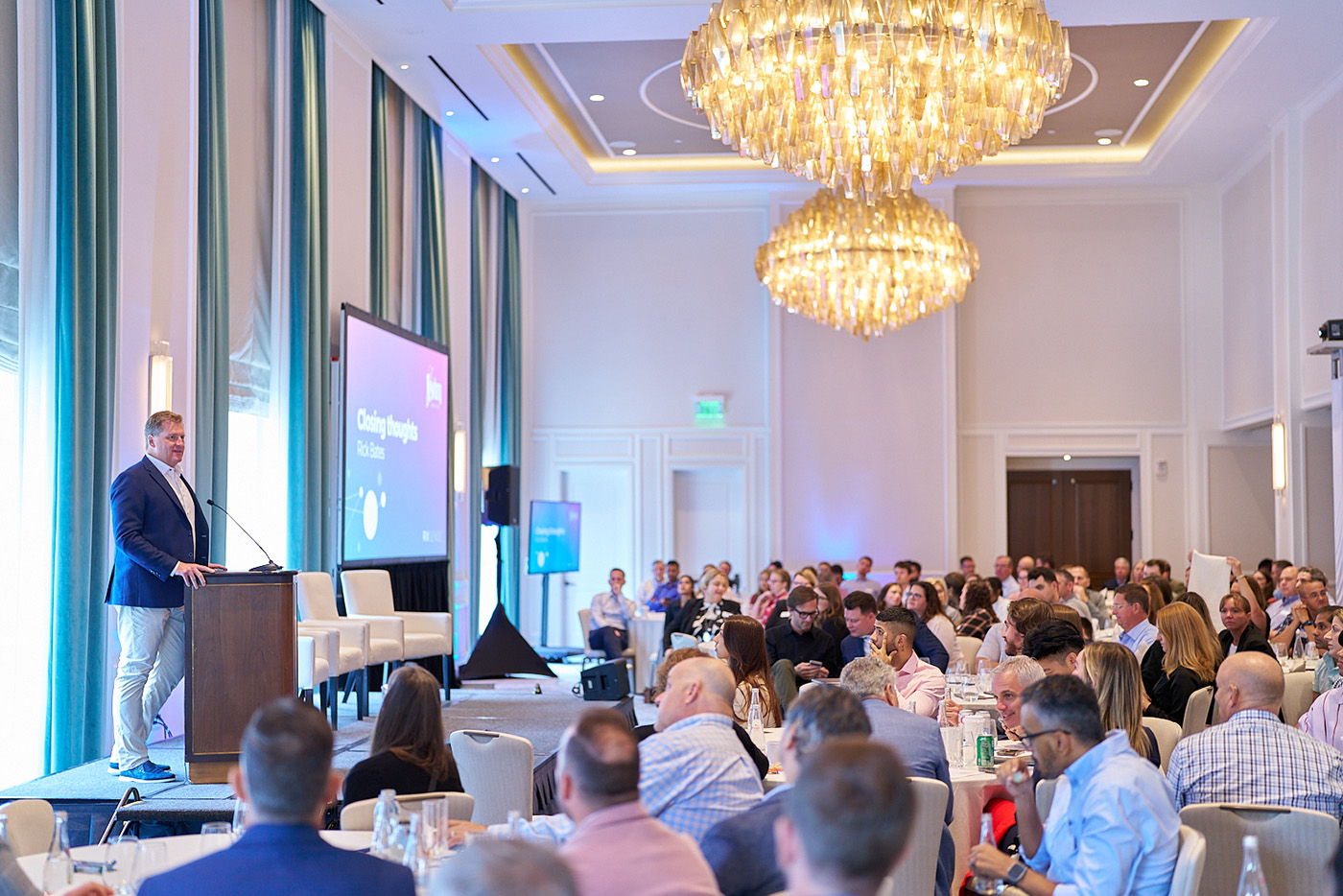
The organization has made listening part of its employment practices too. Following employee feedback, RxSense added a company retirement-plan match of up to four percent. It also implemented an annual review process and training for managers to give feedback as work happens. These are modest, concrete mechanisms. A culture statement becomes more interesting when it reaches somebody’s retirement account.
Back to Wharton, with unfinished homework
In 2025, Bates returned to Wharton with business problems for the AI & Analytics Accelerator. “We were stuck,” he recalled. His company already had an analytics team. What it needed was another approach to work that was consuming time and technical effort. Two student teams spent eight weeks exploring the challenges, with weekly contact with the company’s people.
The format gave the outsiders enough contact to understand the work while preserving room for unfamiliar methods. Bates and his team deliberately avoided over-directing them. At the final presentations, he noticed how comfortably employees and students discussed the projects together. The collaboration had developed beyond the stiffness of a formal presentation. The participants had acquired enough shared understanding to work through the questions.
One project examined client onboarding, using historical records to infer configuration details. The resulting prototype predicted six important fields with more than ninety percent accuracy in the student project. Validation and integration remained next steps. That distinction matters: a promising model has further work ahead before it becomes dependable routine. Bates had brought students a working problem, complete with the untidy transition from experiment to operation.
- 01Define the business problem
- 02Give outside teams room to investigate
- 03Validate and integrate the work
Eight weeks of student work, with weekly company check-ins.
A separate forecasting project explored more than ninety-five million anonymized records across three organizations. Its team evaluated seven statistical and machine-learning models, tested forecasts against actual results, and delivered reusable components. Those details give the AI work a useful scale and texture. There were records to clean, models to compare and assumptions to test. The future had arrived carrying a considerable amount of data preparation.
The sequence makes an interesting companion to the dashboard decision. In one case, Bates had held a product inside a preferred arrangement too long. In the other, he invited people outside the company to examine established problems. The parallel suggests a practical response to experience becoming too comfortable: keep arranging situations in which someone else can see something you have missed.
A bigger map, and another seat at the table
The team-building continued across the Atlantic. In December 2025, RxSense announced its first European office in Dublin, with plans to hire seventy-five full-time engineering and product staff over two years. Bates emphasized the city’s talent and its fit with the company’s collaborative working culture. The announcement described an investment supporting the scale of its US operations, with engineering, product and design working together.
In July 2026, Wharton named Bates among seven new members of its AI & Analytics Initiative advisory board. Its remit includes strategic guidance, program development and connections between academia and industry. For a 1996 MBA graduate who had recently brought his company’s questions into the school’s student projects, it extends an existing relationship into a formal advisory role.
He also has a regional entrepreneurial award in his history: EY recognized him in New England in 2018. Accepting it, he shared the credit with his team. Awards naturally attach to a person’s name. Much of the work described across Bates’s career depends on groups: experienced operators, consumer technologists, direct reports, students, and new engineering colleagues an ocean away.
That leaves the colleague’s tactful opening doing useful service. A growing organization will supply its chief executive with more questions than one person can answer. Bates’s willingness to recount his mistakes gives the people around him an invitation to participate in the next decision. “You might be right” is a courteous beginning. The consequential part is whether the boss stays for the rest of the sentence.