At 9:15 on a Monday morning in June 2024, Raj More had twenty minutes to explain where his company was going. The conference agenda gave him the vision and the roadmap. Less than two hours later, it put him back on the programme for a product overview, a demonstration and the business of moving customers from their existing systems. There is a pleasing economy to this arrangement. The person announcing the destination also has to discuss the luggage.
More is the founder, chief executive and chief architect of RxLogix. That last title is the interesting one. He has held the executive and architectural roles since the company began in 2010. In the 2024 programme, the combination becomes tangible: strategy early in the morning, adoption and migration before lunch. The large idea and its inconvenient details have the same name beside them.
His career makes that pairing easier to understand. Before he founded a software company, he spent years helping organisations put software to work. His route to ownership ran through Relsys and Oracle, through implementation projects and services leadership. The business he eventually started grew out of an industry he already knew from the inside.
Before the company, the installations
More studied Industrial Engineering and Management at RV College of Engineering in Bangalore. His education dates on LinkedIn run from 1993 to 1997. Engineering and management would both find their way into his working titles, although the journey between college and chief executive included plenty of work on other people's systems.
At Relsys, he worked on the Argus software suite from version 1.0. His responsibilities expanded, eventually reaching vice president of services and strategy. His implementation work included projects for Pfizer, Amgen, Quintiles, Astellas and Genentech, among others. These were deployments inside established organisations, where a product had to fit an existing operation.
In March 2009, Oracle announced its agreement to acquire Relsys. The announcement described a combination of applications, analytics and specialist expertise. Its accompanying questions and answers also addressed something more ordinary: customers would still need training, and the existing management and employees were expected to continue within Oracle. Acquisitions have grand announcements. Someone still has to answer the telephone afterwards.
More became a senior director at Oracle before starting RxLogix the following year. The sequence gives his founding story its particular shape. He had experienced a specialist vendor and a much larger software organisation. When he started again, he brought a background in delivering systems as well as discussing their future.
- RelsysImplementation
to strategyRose to VP, Services & Strategy - OracleInside a larger
software companySenior Director after the acquisition - 2010 onwardsFounder, CEO
& Chief ArchitectRxLogix
A small beginning, with witnesses
RxLogix began with the confidence of a small group. More described teammates and early customers taking a chance on the concept. The company bootstrapped its beginnings, with those initial relationships helping it get moving. In his telling, the early business depended on people willing to entrust work to a new organisation.
“It has certainly been a roller coaster ride with ups and downs,” he said. It is an unusually serviceable description of founding a company. Roller coasters, at least, have scheduled maintenance and a visible track. A new business has customers, colleagues and a succession of decisions whose consequences arrive on their own timetable.
“It has certainly been a roller coaster ride with ups and downs.”
Raj More, on building RxLogix
The early-customer detail matters because it puts other people into a founder's story at the beginning. More's account includes the teammates who joined and the customers who tried the offering. Their confidence was part of the practical machinery of starting. A concept needs people prepared to let it become an operating business.
His public writing offers a glimpse of how he argued for that confidence. A June 2016 LinkedIn article carried the title “Trophies and tested methodologies from the front line!” Its opening asked readers to consider a consultant's polished methods alongside an expert's experience. It was a sales argument with a practical subject: the basis on which someone should be trusted to do a difficult job. The vocabulary belonged to a person selling experience as well as software.
By March 2017, he was writing about the company's innovation conference and reporting that attendance had exceeded expectations. The customer gathering was already part of the way RxLogix presented its work. Read together, those two pieces put a little texture on the years after the founding: the effort to explain why experience mattered, followed by the effort to bring people together around the products. The conference format visible in 2024 had an earlier life.
Twenty minutes for the future. Then the demo.
Return to that June 2024 programme at the Princeton Marriott at Forrestal. More's opening slot covered the platform's vision and high-level roadmap. Later, he shared a session with Bhavishya Saluja that included a demonstration, benefits, adoption and migration. The next day paired him with Nitin Chandok for production case studies and questions.
The programme also made room for customers to describe their projects. A Lundbeck executive had a session on a go-live journey. Executives from Eli Lilly were scheduled to discuss programme objectives, their choice of RxLogix and progress to date. Elsewhere, a partner discussion brought together TCS, Accenture, Infosys and other firms.
As a snapshot of More's working world, the arrangement is useful. His platform roadmap sits beside other people's accounts of using the platform. The agenda moves from plans to demonstrations to production experience. An audience can hear a proposal and then encounter the people responsible for making it function inside an organisation.
Questions and answers are a modest conference convention with a valuable side effect: they leave a little space that the presentation cannot completely control. For a founder who also carries the architect title, that is a revealing place to appear. The product discussion has room for practical questions alongside the larger plan.
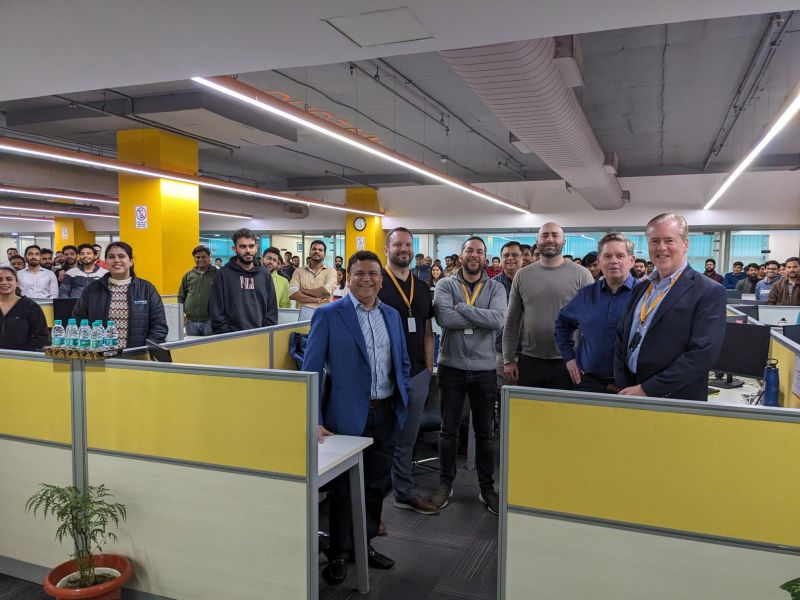
A different company gathering offers a less formal picture. At the end of 2023, RxLogix brought colleagues from its US, European and Indian teams together in Noida. The office photograph has the familiar furniture of a working business: desk partitions, water bottles, overhead lights and people fitting themselves into the available space.
The company's accompanying message emphasised connecting teams and exchanging ideas across regions. Set beside More's account of a few teammates at the start, it provides a concrete change of scale. The early group has become an organisation whose colleagues work across continents and occasionally need to occupy the same room.
The argument follows him to Basel
By March 2025, More was taking the integration argument to Basel. His DIA Europe schedule included a session about consolidating multiple systems into a single platform. The following morning brought another appearance, this time on analytics, AI and automation. The pairing joined a structural question with a technical one: how the applications fit together, and what intelligence can do within them.
The first session's promised discussion included transparency, security, collaboration, scalability and cost. Those are useful clues to the kind of buyer More addresses. A system has to be understandable to the people using its data, manageable by the people responsible for it and capable of accommodating a larger operation.
There is also a continuity with his earlier work. Implementation asks how software enters an organisation. Consolidation asks how several pieces of software can become a more coherent arrangement. More's public presentations keep returning to that relationship between a technical design and the work surrounding it. The architecture has a business audience.
How much work disappears
when the systems work together?
An AI announcement in the past tense
On 23 April 2026, RxLogix announced PVOne.AI, described as the fourth generation of its product with agentic AI capabilities. The announcement focused on coordinating work across applications, using domain-trained models and retaining human review controls. It placed the new release within a sequence of earlier AI development.
More's statement began with that history: “Artificial intelligence at RxLogix is not new.” He then pointed to clients already using AI capabilities in production. In a launch announcement, the past tense does useful work. It directs attention towards an existing operation as well as the next release.
The distinction between a release and a working installation has followed him through the career. At Relsys, he helped deploy systems. At RxLogix, his conference appearances include migration and production case studies. In the 2026 announcement, the new capabilities are intended to work across the existing product suite. The next chapter arrives with the previous chapters still open on the desk.
The number, and the job behind it
RxLogix's 2026 Inc. 5000 entry supplies a compact measure of the company's progress: number 3,932, with 63 percent growth over three years. The entry lists both Shalini Modi and Raj More under leadership. It is a company recognition, shared across an organisation and the people who built it.
RxLogix's 2026 Inc. 5000 listing
No. 3,932
A growth percentage compresses a great deal of work. It offers a useful public milestone for a business founded in 2010, but More's combined title supplies another way to read the years. He remains the chief executive and chief architect. The commercial organisation and the design of what it sells continue to meet in his role.
That is the thread running from the early installations to the conference programme and the AI release. More's story has accumulated a larger company, international colleagues and new technical vocabulary. It has also retained a very recognisable assignment: explain the plan, then return for the questions about how it will work.