Patrick O’Connor has spent years arguing that a signed contract leaves an enormous amount of business unfinished. The document may be settled. The supplier can still change, the spending can drift, and the person who remembers why a particular clause exists can leave. A signature has excellent ceremonial properties. It is less reliable as a filing system for the future.
That unfinished business became Gatekeeper. O’Connor, its founder and CEO, came at software through procurement consulting, where agreements had to be managed on behalf of clients. His company’s subsequent journey includes years of bootstrapping, an investment from Vista Equity Partners and a move into AI agents. Through those changes, he has kept returning to the same question: what happens to the relationship after the paperwork is done?
The signature was only the beginning
The origins have two dates worth keeping distinct. O’Connor’s public biography puts Gatekeeper’s founding in 2010. The company’s history places the creation of its software inside procurement consultancy Cinergy Group in 2012. The consultancy used it to track contracts and vendor performance for clients. A working instrument became a business in its own right.
That beginning matters because it places O’Connor close to the consequences of an agreement. Procurement concerns the organisation on the other side of the table, the price, the service and the continuing obligation. A contract records part of that relationship. Tracking performance requires the business to keep paying attention after the negotiators have finished.
By the time Gatekeeper announced a partnership with third-party management specialist Vendor Centric in 2020, it described software that had stood alone for five years and served more than 250 customers around the world. Its functions included tracking milestones, storing documentation and helping customers oversee vendor portfolios. The consultancy’s working problem had acquired an international customer base.
There is something pleasantly unromantic about that origin. No consumer habit needed inventing. Businesses already had suppliers and agreements; somebody already had the job of keeping track. O’Connor’s opportunity sat inside work that existed, mattered and could become difficult to coordinate. The product followed the administrative burden.
A PDF has no purchasing department
In December 2021, he gave his argument a succinct title: You Don’t Contract with a Contract. He criticised approaches to contract management built around the legal department alone, arguing that the wider business needed ownership of stages in the agreement’s life. The title made the counterparty impossible to overlook.
His objection concerned the distribution of work. If contracts become synonymous with legal, lawyers inherit questions and administration that require other departments’ knowledge. A supplier’s obligations, commercial performance and renewal decisions involve people beyond the team that reviewed the language. His preferred approach brings those responsibilities into the same view.
Four connected views of one business relationship.
This gives his public writing a recognisable point of view. He keeps asking whether the information describes a living business relationship or merely preserves a transaction. The distinction is practical. A renewal date is useful when somebody knows who owns the decision and what has changed since the previous one.
It also explains why his story resists the usual dividing line between a document product and a procurement product. O’Connor has spent years questioning that boundary. His business makes a commercial case for putting contracts, suppliers and risk together. The persistence of the argument is part of the founder’s story, well before AI enters it.
March, October, and the price of independence
In March 2023, O’Connor was making a pointed argument about the companies selling contract software. He warned customers about providers dependent on venture funding and presented Gatekeeper’s self-funded, profitable position as a reason to trust it. His language was combative. Buyers, he argued, should care about the financial resilience of the business holding their contract information.
Then, on October 17, Gatekeeper announced its first external investment, from Vista Equity Partners. The sequence deserves to remain visible. Earlier in the year, independence had featured in the sales argument. By autumn, O’Connor was explaining a partnership intended to accelerate product innovation and expand the company’s commercial operations.
Venture dependence and an investment in an established business have different implications. The record supports a change in Gatekeeper’s ownership and funding position, alongside a continued product thesis. It does not require a private explanation from O’Connor to make the chronology interesting. Founders can defend the way they built a company and still choose new resources for its next stage.
“Our vision is rooted in the convergence of vendor, contract and third-party risk management.”
Patrick O’Connor · October 2023
The announcement said Gatekeeper supported more than 300 customers. Vista’s Endeavor Fund made the investment, and René Yang Stewart, its co-head, praised the founder-led business while setting out the plan to support further expansion. For O’Connor, the public case centred on bringing related disciplines together. The capital changed; the sentence describing the job remained familiar.
Books before bruises
Asked what he wished he had known at the start, O’Connor offered a recommendation with a modest purchase price: business books. His advice to new founders was to read established titles before accumulating mistakes that other people had already explained. He put a dollar price and a few hours against the lesson, treating reading as an investment calculation.
His other recommendations were equally direct. Choose work you care enough about to continue through a long and difficult journey. Understand your strengths and weaknesses. Hire people who complement the latter rather than spending all your effort trying to become good at everything yourself.
Business books to read before charging ahead.
A recommendation, not a reading tallyThe recommendations reveal what he chooses to emphasise when addressing other founders: preparation, commitment and the composition of a team. They are also refreshingly economical. A founder’s reading list has the advantage of requiring neither a funding round nor a commemorative launch party.
In an AgentIQ Procurement conversation with Andrew Daley, O’Connor applies a related discipline to buying software. He urges teams to define the problem and establish measurable outcomes before letting the selection process become complicated. His emphasis falls on what the organisation hopes to achieve and whether the participants agree on that destination.
The discussion also makes the implementation problem tangible. A vendor onboarding process can involve forms, supporting documents and fields that need checking. O’Connor and Daley discuss giving agents specific administrative tasks while people retain the decisions and context. It is a narrower, more accountable proposition than an invitation to automate an entire department.
“Ultimately, you’ve got to be laser-focused about what you’re trying to achieve,” he says. It is advice a buyer can use against any vendor’s demonstration, including his own. A feature list offers plenty to discuss. An agreed outcome gives the discussion somewhere to go.
The team behind the agents
O’Connor’s company has also developed across geography. In a public community introduction in September 2019, he described himself as based in Koh Samui, Thailand, while Gatekeeper’s team was global. His current professional profile lists Saint Peter, Jersey. Distributed work belongs to the company’s history, rather than arriving as a recent embellishment.
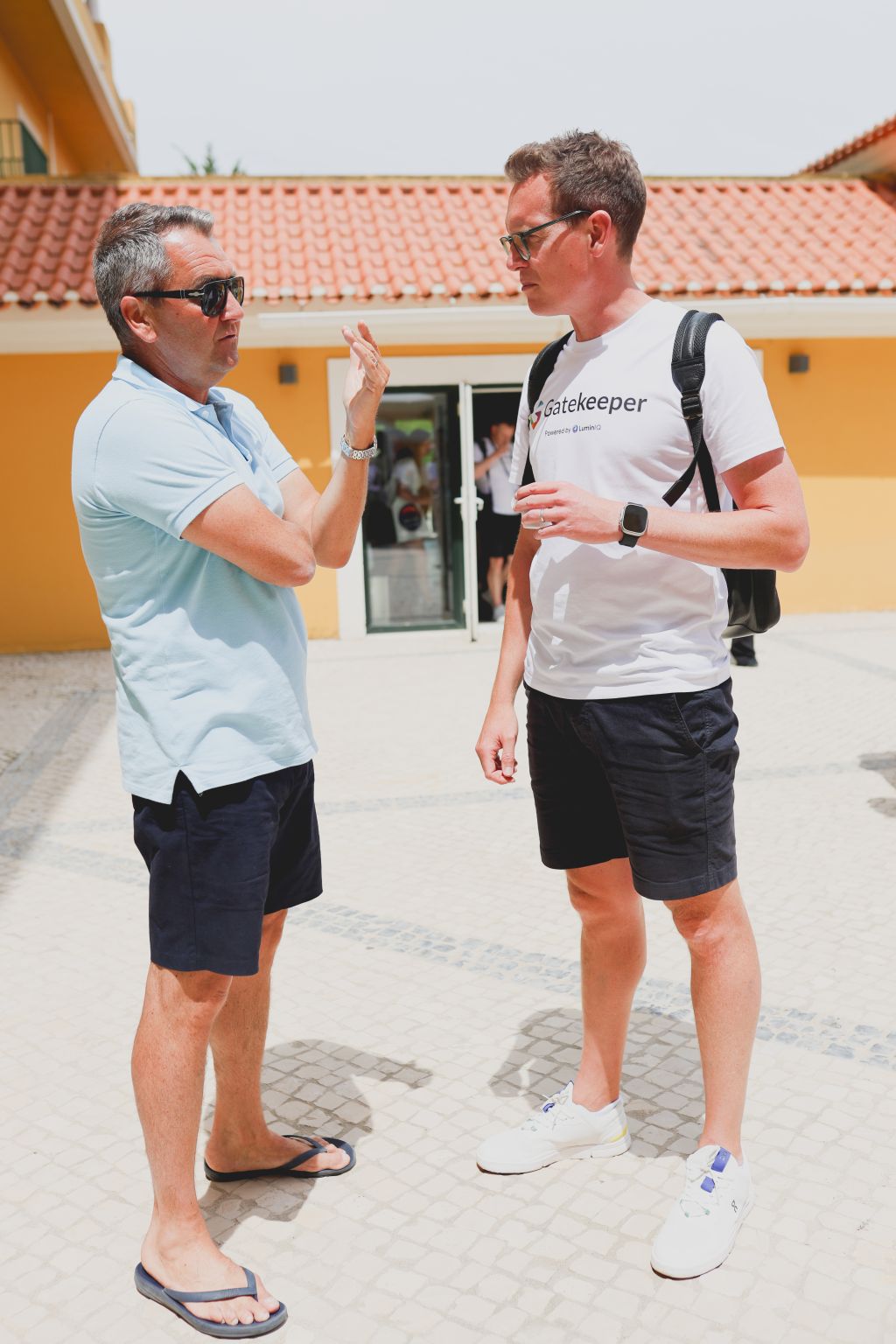
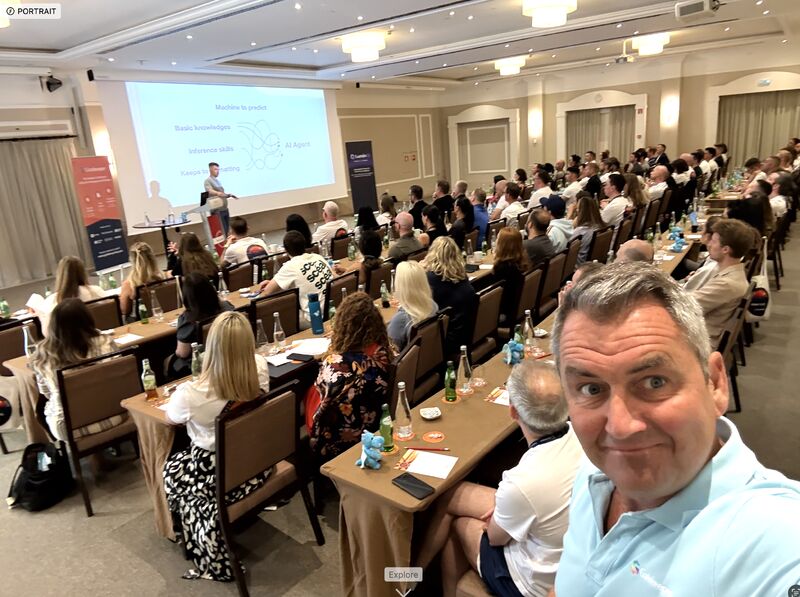
In 2025, he shared photographs from a team gathering in Portugal and described work on Gatekeeper’s agent roadmap. He thanked colleagues, customers and partners, and acknowledged Vista’s Jessica Cash for joining the gathering. His account placed LuminIQ, the company’s AI-agent offering, at the centre of the next stage.
The photographs supply details that a corporate roadmap cannot. In one, O’Connor talks with a colleague outside, wearing sunglasses and flip-flops. In another, he takes a selfie while a presentation carries on behind him. The distributed company has become a room full of people, with bottles on the tables and a slide on the wall.
When Gatekeeper received Vista’s Endeavor Fund Gen AI Innovation Award, O’Connor publicly directed the credit toward the team and the customers who had built with it. The recognition gave him another occasion to emphasise practical impact. In his account, the value of the work came from what customers were getting done, and the award belonged to the people delivering it.
His stated ambition extends beyond automating an isolated task. In September 2025, he predicted that within five years businesses would cease managing contracts and third-party risk separately. That remains a forecast. It gives the roadmap a direction, and makes clear which longstanding problem he expects the new technology to help resolve.
The supplier changed. Did the file?
By 2026, his writing was confronting the complications of that ambition. In January, he discussed data sovereignty, calling attention to the difference between where information is stored and where AI processes it. His concern was whether a business could trace what happened to its information, including through other providers.
In July, he turned to the records underneath enterprise agents. His argument was that contracts, vendor details and risk assessments scattered across systems leave an agent without the connected context a business question requires. He urged buyers to examine whether their existing software had done the structural work before adding automation.
September’s essay, The Contract Never Mentioned AI, moved the question into the supplier relationship itself. A product that a customer previously approved can acquire AI capabilities later. O’Connor asked businesses to revisit supplier permissions, investigate processing arrangements and make responsibility for changes explicit. Approval at the start of a relationship could age badly.
This is where the founder’s story returns to its beginning. O’Connor started with the work of tracking agreements and the organisations behind them. He now describes technology that can change the relationship without a new signature marking the occasion. The filing cabinet has become more sophisticated. Somebody still has to notice what changed.
Follow the conversation
Patrick’s writing, interviews and the company he founded.