A supplier contract can be surprisingly good at keeping itself alive. Miss the notice deadline, and a service nobody particularly wants gets another term on the company tab. Funding Circle knew the problem: as its vendor roster grew, contracts and due-diligence records became harder to manage in Google Drive. Renewal dates slipped. The paperwork survived; the opportunity to cancel did not.
Gatekeeper’s September 2023 account of the project says the lender eventually terminated unwanted contracts worth roughly £1 million. That is a specific customer result, not a savings promise for everyone. It is also a useful introduction to this company: the commercial prize can be hiding in a notice period, rather than in a dramatic new negotiation.
Funding Circle chose Gatekeeper after comparing functional requirements, cost and scope for innovation. A shared repository, due-diligence workflows and automatic notifications gave the procurement team a way to act before deadlines passed. What failed first was the coordination around a growing supplier book. The purchase followed a search for better control.
Approximate value of unwanted contracts Funding Circle reported terminating. Customer case study, September 2023.
The supplier is the main character
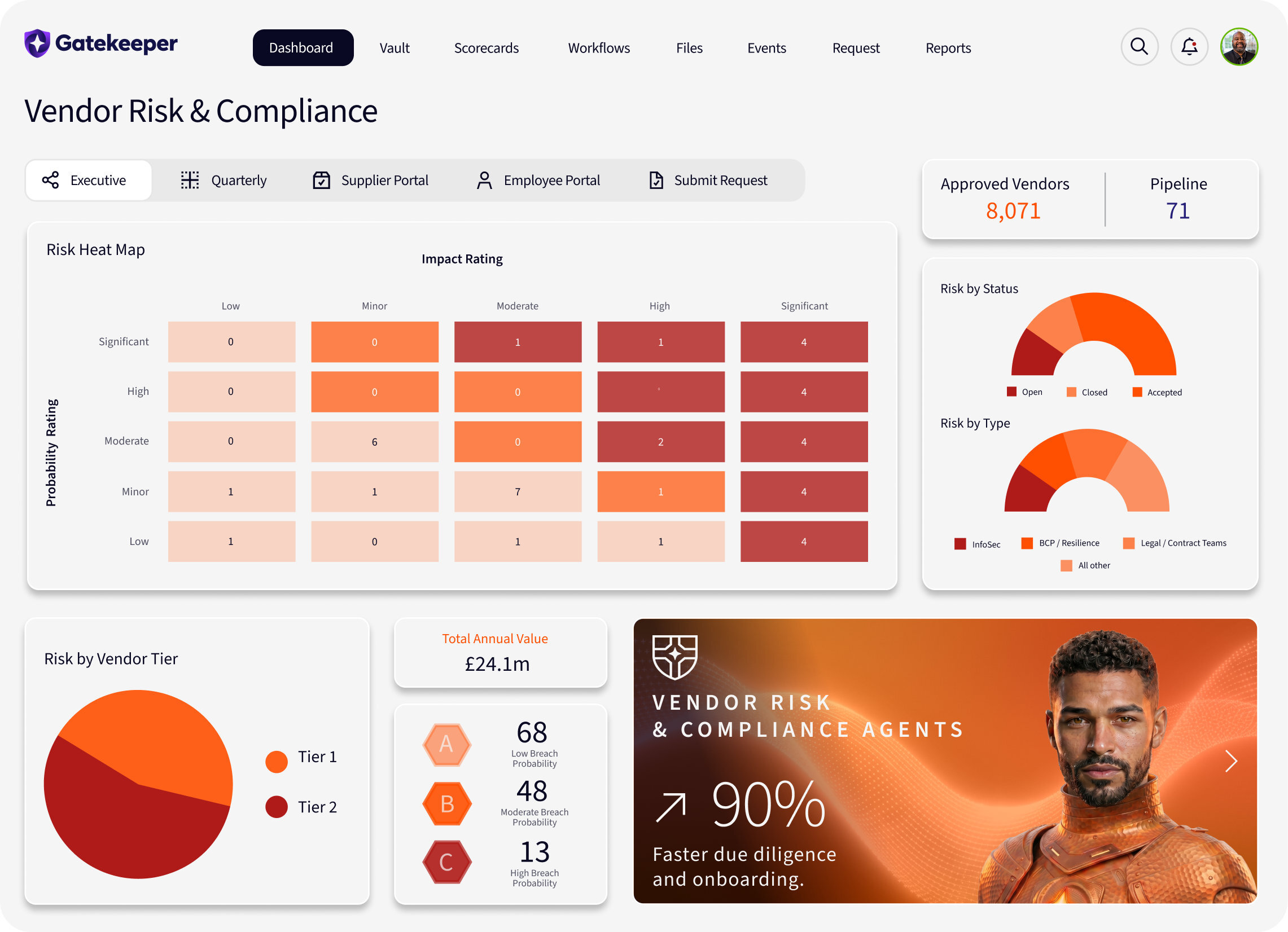
Gatekeeper sells cloud software for managing the relationship around a contract. Its platform connects the agreement to the vendor, the approvals, the risk checks and the spending. Finance, procurement and legal can work from connected records while handling different parts of the job. The customer list crosses industries, with published stories about Mailchimp, Canstar, The Telegraph and insurers as well as financial services businesses.
The distinction matters because an agreement has several lives. Before signing, somebody must check the supplier and negotiate the terms. After signing, somebody must follow the obligations, watch performance and make the next decision. Gatekeeper’s brand story puts the philosophy plainly:
“You don’t contract with a contract, you contract with a third party.”Gatekeeper’s founding principle
That is the company’s strongest positioning argument. A beautifully organised PDF still cannot explain, by itself, whether the supplier is performing well or whether its financial condition has changed. Putting those questions beside the agreement gives a renewal review more substance. It also gives the company’s AI something useful to work with beyond isolated passages of text.
From a consultant’s problem to Vista’s portfolio
Founder and CEO Patrick O’Connor came to the business through procurement. Public profiles date Gatekeeper’s founding to 2010; the company’s own partnership history dates the software’s creation inside procurement consultancy Cinergy Group to 2012. The distinction separates the business’s origins from the product’s development.
In Fortune’s account of its investment, the consultancy’s accumulation of contracts helped prompt the search for software. The team found existing options underwhelming. That background helps explain the product’s commercial emphasis: contracts matter because they describe relationships, costs and responsibilities that somebody has to manage.
In October 2023, Gatekeeper announced its first external capital, a strategic growth investment from Vista Equity Partners. The stated purpose was faster product innovation and expansion of its sales and marketing operations. Fortune reported that Vista bought a majority and that the deal valued the business above $100 million, citing people close to the transaction. That reported valuation describes the deal, not cash raised or today’s worth.
An approval queue gets a budget check
The product includes familiar contract-management equipment: a repository, templates, a clause library, Word-compatible redlining and electronic signatures. Employee and vendor portals collect requests and information. Configurable workflows move the work between stages. The platform’s components are intended to keep those steps connected, so the record grows as the work proceeds.
The AI proposition becomes clearer in CompSource Mutual’s October 2025 case study. Its three-person procurement team sat under legal, while finance reported separately. Contract reviews bounced between functions, with manual extraction and late discoveries creating more work. The insurer placed a Gatekeeper agent in the finance-review phase.
Extraction supplied contract values and budget allocations. The agent compared submissions with approved limits, rejected over-budget requests with the overage calculated, and flagged other issues. Summaries helped procurement address problems before finance’s review. The rollout included internal quality assurance, user acceptance testing and refinements.
CompSource reported a 95% reduction in executive review time per contract and approximately 636 hours saved annually. Those measures concern review work and estimated capacity, not the elimination of the entire contracting process. The interesting design choice was to give automation a defined checkpoint, a spending rule and a destination for exceptions.
Three hundred renewals, three hundred research jobs
Redwood Logistics offers a different test. Its July 2026 customer account describes roughly 1,200 vendors and about 300 renewals a year. Each renewal could require up to an hour of preparation: opening the agreement, recovering the commercial context, identifying the internal owner and drafting the next conversation.
A Contract Renewal Agent now prepares a structured brief before the procurement team opens the card. Gatekeeper describes hundreds of hours returned to the function. The account also says the team plans to add spending data to the brief, a useful detail: the workflow is still being developed, and a proposed enhancement should not be mistaken for an existing feature of that deployment.
The lesson is narrow enough to copy. Find a repeated preparation task with recognisable inputs and an accountable recipient. Measure the time spent on it. Test the output before expanding the automation. Redwood’s account says seeing the first renewal result encouraged the team to consider other workflows. Confidence followed a working example.
- 01 / ScreenCollect vendor details and evidence.
- 02 / ContractReview terms and route approvals.
- 03 / MonitorTrack obligations, risk and performance.
- 04 / DecideRenew, renegotiate or terminate.
Editorial schematic of Gatekeeper’s vendor lifecycle, not a prescribed configuration.
The bill follows the vendor book
Gatekeeper’s current plan structure is built around third-party capacity and workflows. Pro covers up to 250 third parties, Enterprise up to 750, and Enterprise Plus more than 750. All three list unlimited contracts, users, electronic-signature licences and agents. Workflow allowances vary, while MarketIQ Full is usage based.
For buyers, that shifts the sizing conversation toward the number of relationships and processes the system must handle. A tailored quotation is the basis for a budget. The implementation calculation also needs internal time for data preparation, workflow decisions, testing and integration. Those are practical purchasing considerations, not a claim about any customer’s invoice.
Gatekeeper occupies overlapping markets: contract lifecycle management, vendor management and third-party risk. Ironclad and Icertis also sell AI-enabled contract platforms. Gatekeeper’s emphasis is the connection between the supplier relationship and the agreement. Buyers should test that connection with their own workflow; the presence of AI alone offers little basis for choosing among them.
NetSuite is a more concrete point of evaluation. Gatekeeper offers a Built for NetSuite-certified SuiteApp linking vendor, contract and spending information. Its integration documentation specifies required permissions and field mapping, and warns that vendor names must match for records to link correctly. A convincing demonstration should include those operational details alongside the dashboard.
The risk side brings in outside information. Gatekeeper’s documented integrations include Creditsafe for financial information and screening, and SecurityScorecard for cyber risk. Those feeds give teams signals to investigate alongside their own assessments. Portals handle another part of the evidence trail: asking the vendor for information and keeping it attached to the relationship. Neither a score nor a completed form makes the commercial decision on its own.
Day-to-day usability also depends on being able to investigate a number. The May 2026 release added drill-down to custom dashboard widgets and placed successful and failed NetSuite synchronisations on the third party’s timeline. These are modest-sounding changes with a clear purpose. A reviewer can move from a summary to the underlying records, while an administrator can see whether a transfer actually happened. That is the sort of detail worth bringing into an evaluation.
The old contracts need attention, too
The August 15, 2026 release addresses an unglamorous problem: fields added after contracts were uploaded could remain empty in older records. Gatekeeper Enrich applies extraction retrospectively, filling eligible empty fields from existing master documents. In the documented beta, an administrator can process up to 100 contracts at a time.
Enrich preserves populated values, requires a supported PDF or Word master document and provides a record of what the AI found or skipped. The release instructions explicitly call for reviewing the populated results. That combination of automation and inspection is more informative than treating extraction as a finished answer.
The conditions for useful automation are visible here. Missing documents, unsuitable fields or inconsistent vendor records restrict what a system can do. An alert also needs a person with authority to act. For a team with only a handful of simple agreements, the effort of configuring a connected platform may outweigh the coordination problem. That is an assessment of fit, rather than a universal argument for buying software.
A company that has opinions about interruptions
Gatekeeper’s distributed working culture has some unusually direct language. Its published values, updated in January 2026, protect focus time, favour documented processes and include a “no assholes” rule. The company asks employees to consider whether AI can solve a problem before adding headcount or complexity. These are stated working principles, not an independent audit of everyday life inside the business.
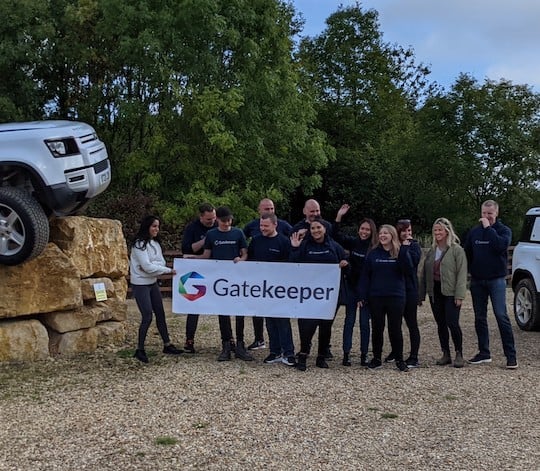
Its charitable programme adds a tangible detail: Gatekeeper for Good offers up to $1,000 per employee each year in fundraising match funding. The company also describes supporting a digital learning project in Sierra Leone. A software business organised around records and responsibility has carried some of that preference for explicit commitments into its account of how it works.
For the prospective customer, the useful question remains close to the original problem: who will make the next supplier decision, with what information, and before which deadline? Gatekeeper puts a system around that question. The value arrives when somebody uses the answer to change what the business does next.