Jian Chen has a claim to his company that fits rather awkwardly on a business card. Founder, president, CEO: those titles are familiar. Architect of the metadata repository is more revealing. It places him inside the machinery of EDETEK, concerned with the definitions and rules that allow a software platform to do useful work. Before the company could talk about artificial intelligence, somebody had to decide what its information meant.
A repository sounds like a place where things go to become someone else’s problem. Chen’s version occupied the center of CONFORM, EDETEK’s data platform. The underlying idea has an appealing economy: preserve the rules, make them reusable, and stop treating every new project as an excuse to forget the previous one. For an entrepreneur, there are less glamorous things to sell than institutional memory. There are also fewer things an organization spends so much effort accidentally losing.
Chen founded EDETEK in New Jersey in 2009. Based in Princeton, he had already been co-founder and chief technology officer of Q-Square Business Intelligence. His education joins an MS in biostatistics and biomedical engineering at the Medical College of Virginia with an MBA in finance and strategy at Columbia. Statistics, systems, and business occupy the same résumé. The combination helps explain why his company sells software alongside the specialist work required to make it useful.
Chen establishes EDETEK in New Jersey.
A software architect becomes a company builder.
Rules with a working life
The important object in this story is a rule that can travel. A definition held in somebody’s head is fragile. A definition written into one program is harder to lose, but can be awkward to reuse. A managed definition, with a version and an approval history, gives a team something it can carry into the next assignment. That is the practical attraction of metadata, a word with the unfortunate distinction of needing an explanation almost every time it enters a conversation.
CONFORM’s Intelligent Metadata Hub gives users tools for managing standards, transformations, and validation rules. It includes a graphical designer and controls for versions, approvals, and the effects of changes. Those details help locate Chen’s architectural contribution. His early repository belongs to a business organized around making knowledge executable. A rule is supposed to govern what happens to incoming information, rather than sit politely in a document while the actual work takes another route.
At the 2017 DIA annual meeting, EDETEK introduced its Information Hub and announced a Clinical Data Lake. The lake was expected later that year; it was a plan, rather than an accomplished delivery at the time of the announcement. Chen described the additions as strengthening the platform at both ends. The distinction matters to his story: building a repository was one step, and building a business around the movement and use of information required more.
A company requires people, too
The same month, June 2017, brought an expansion of the leadership team. Tom Guinter joined as vice president of product services, with responsibility for training, implementation, support, and client processes. Mark Gee joined as senior director of product business development. Their jobs covered two stubbornly human parts of the software business: helping people use a product, and persuading them to buy it.
Guinter brought long experience with industry data standards, including work on the Study Data Tabulation Model. Gee brought business development experience. In welcoming them, Chen emphasized the arrival of experienced people. The announcement captures a recognizable founder’s transition. A working design needs an organization around it, with colleagues who can explain, implement, support, and sell what the architect has built.
By October 2024, Chen was adding another layer of leadership. Shakthi Kumar became chief strategy and business officer, reporting to Chen and the board. His remit included global strategy, business development, client success, product innovation, and investor relations. Kumar had previously held senior roles at Amazon Web Services and Capgemini. Chen’s welcome singled out his experience in scaling companies and his attention to customers. The founder was assembling commercial reach around a technical core.
The conversation beside the booth
There is a useful counterweight to all this architecture in the photograph from DPHARM 2023. Chen stands with colleagues beside an EDETEK exhibition table. Behind them, CONFORM is written in large orange letters. In front are brochures, mugs, and the familiar furniture of a business asking strangers to stop for a conversation. Even a company devoted to information flow must occasionally rely on a tablecloth.
EDETEK identified the group as Chen, Munther Baara, Peter Smilansky, and Kevin Prizeman. The occasion places the founder among product strategy and business development colleagues. It is a small, public scene, but an instructive one: the person who designed the repository also appears on the conference floor, where the useful question is usually whether the thing will work with somebody else’s existing systems.
Chen’s own response to SCOPE in 2023 dwelt on the value of gathering with others in the industry. He wrote that “we have the opportunity to share, to learn” when people meet. In a later company account of a visit to the Beijing office, he praised the team after presentations on AI, data orchestration, and visualization. These are specific glimpses of his working life: conferences, colleagues, demonstrations, and an interest in what other people have built.
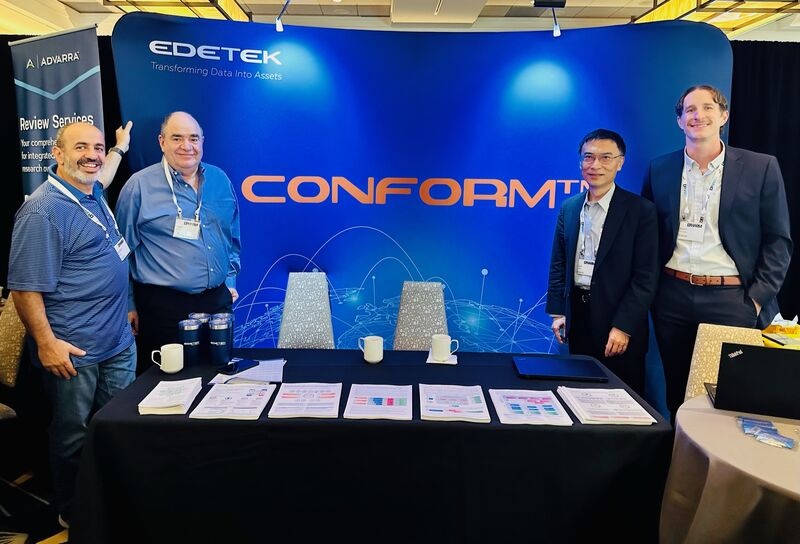
The architecture meets the tablecloth. Chen, second from right, with EDETEK colleagues. Company event photograph.
An open door in the architecture
In November 2023, EDETEK announced an enterprise partnership with Medidata. It connected Medidata’s Rave electronic data capture system with CONFORM for data review, cleaning, and standardization. EDETEK also makes its own data capture software. The partnership therefore offers a useful clue to Chen’s commercial approach: another company’s application can have a place inside the solution his company sells.
For buyers, that arrangement addresses a familiar source of friction. Existing systems come with trained users, established processes, and decisions somebody has already defended in a meeting. Integration has to accommodate that history. The Medidata agreement gives Chen’s platform strategy a concrete example, with two named products and a defined set of tasks between them. Cooperation here has a technical address.
The R&D Cloud launch in January 2025 extended that approach. Built on CONFORM and eClinical, the offering allowed clients to select capabilities and integrate third-party products. Its announced design covered information management, statistical work, and workflows across organizations. Chen presented adaptability as a central feature. For the founder who had helped design the underlying repository, the growing product family retained an old concern: let information move between the people and systems that need it.
- 2009EDETEK founded
- 2023Medidata partnership announced
- 2025R&D Cloud and BioStat.AI launched
- 2026Ensemble introduced
AI, with someone responsible
September 2025 brought BioStat.AI, an offering intended to bring data management, biostatistics, and statistical programming into one platform. The launch described automation for analysis planning, dataset generation, and validation. Chen’s stated ambition was faster decisions while preserving quality and control. These were product aims, and the distinction between an aim and a measured result deserves to survive even the most enthusiastic launch announcement.
His public agenda also included the practicalities of adoption. A September 2025 SAPA conference program listed Chen as the speaker for a session on operationalizing AI. Its advertised subjects included governed pipelines, retrieval-based assistants, traceable metadata, and validation. The syllabus was concerned with what happens after an impressive demonstration, when a tool acquires users, recurring obligations, and a place in an actual working day.
In January 2026, EDETEK introduced Ensemble, its AI managed services offering. Chen described AI as “a managed capability that blends technology with deep functional expertise.” The offering combined models, automation, hosting, and specialists, with human review of outputs before use. It placed responsibility inside the operating arrangement. A model might produce an answer; an organization still had to decide how that answer entered its work.
The sequence is revealing. First came reusable rules and data infrastructure. Later came tools intended to generate and analyze more of the work. Services provided a way to connect the two. Chen’s entrepreneurial problem had widened, but the question remained recognizable: how do you make a technical capability dependable enough for other people to build their routines around it?
“A managed capability that blends technology with deep functional expertise.”
Jian Chen, on Ensemble · January 2026
What survives the next project
By the 2026 Bio-IT World meeting, Chen was writing about durable institutional knowledge that could be reused across studies. He credited his colleagues’ work on a neuro-symbolic approach and welcomed the chance to exchange ideas with peers. The phrase names a combination of AI methods; his emphasis on reusable knowledge gives the reader a plainer way to understand the ambition. A company should keep learning from work it has already done.
In July 2026, EDETEK announced a sponsor partnership program built around its R&D Cloud and continuous data visibility. The program assigned the technology and supporting services to EDETEK while sponsors retained responsibility for their own work and engagement with regulators. Once again, the proposed advance depended on both infrastructure and a clear division of responsibilities. Faster movement was useful only if people could still follow what had happened.
Read together, these decisions suggest a particular kind of founder’s persistence. Chen has moved from a repository to a platform, from a platform to an ecosystem, and into managed AI services. The recurring object is the knowledge between projects: definitions, rules, transformations, and the context that makes a result intelligible. His technical work and his executive decisions keep returning to the cost of rebuilding that knowledge.
There is a modest pleasure in the thought that a company’s future might depend on its capacity to remember. It makes room for the people who maintain definitions, approve changes, and make yesterday’s work useful tomorrow. Chen’s career gives those tasks a founder’s attention. The next project will arrive with its own demands. His continuing proposition is that the organization should have something ready when it does.