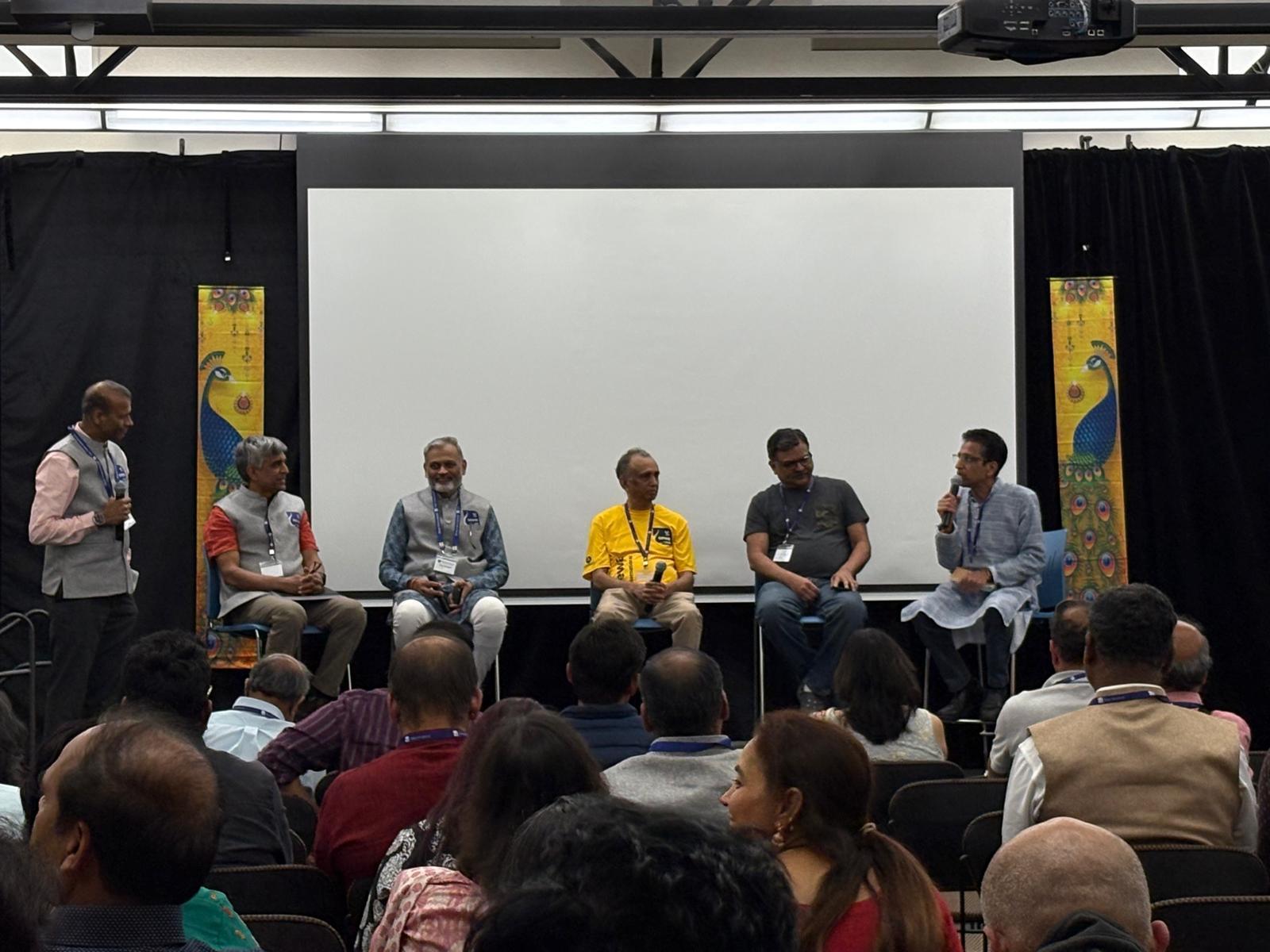
In May 2025, Srikanth Konda sat at the far right of a row of five Sewa International USA presidents in San Francisco. He held a microphone. The other presidents listened. Behind them was a large, blank projection screen, an unusually restrained backdrop for a conversation about building an organization. The photograph has the pleasant untidiness of an actual gathering: audience members in the foreground, cables near the chairs, people turning toward the speaker.
Konda was there as Sewa’s founding president. His turn in the job ran from 2003 to 2005, well before he founded Sparity, the technology company he now leads as CEO. At the conference, he recalled the early mechanics of getting Sewa going: opening chapters, finding local funding, making arrangements with limited resources. The vocabulary was practical. Someone had to organize things.
This is a useful place to begin a story about an entrepreneur whose present business includes artificial intelligence. AI comes with a generous supply of grand predictions. Chapter formation comes with a list of people to call. Put those two parts of Konda’s career alongside each other and a more interesting question appears: what happens before an ambitious idea becomes something other people can use?
The five presidents on that stage offered one answer simply by being there. Konda had helped begin an organization that continued through successive leaders. By the time he returned for that conversation, his own professional life had moved through software, operations, company leadership and another founding. The first chapter was still capable of convening a room.
A programmer before the corner office
Konda’s education connects Hyderabad and Alabama. He undertook undergraduate studies at Jawaharlal Nehru Technological University in Hyderabad from 1984 to 1988, then attended Auburn University from 1991 to 1994. His postgraduate work was in computing and engineering. The progression places his technical training years before the current fashion for describing almost every business decision as an AI strategy.
From 1994 to 1996, he worked as a programmer at Universal Business Solutions. By 1999, he was vice president and chief operating officer at Semafor Technologies, a role he held through 2006. Programming and operating a business impose different obligations. Code must behave; a company must coordinate people, customers and delivery. His résumé contains both kinds of responsibility.
The next appointments carried him further into enterprise software. Between 2007 and 2010, he led the portal and content management division at Idhasoft. He was also CEO of Enterpulse from September 2008 to June 2010. Those overlapping dates matter: the route to Sparity passed through existing organizations and their operating demands, rather than beginning with a single isolated founding moment.
Portal and content management may sound like a distant province of the internet. In Konda’s chronology, it belongs close to the center. His later company would work on applications, data and cloud systems, all areas where the useful thing a customer already has must somehow meet the useful thing a customer wants next. An established business rarely offers its technologists the luxury of an empty desk.
- 1994Programming
Universal Business Solutions - 1999Operations
Semafor Technologies - 2003Volunteer leadership
Sewa International USA - 2010A company begins
Sparity
June 2010, another beginning
Konda founded Sparity in June 2010. The business grew around software development and the related work of helping organizations change their technology. Today its services include application engineering, cloud modernization, data engineering, analytics and AI. Its locations span the United States, India and Australia; Konda is based in the Atlanta metropolitan area.
The company’s current leadership roster also gives the story some necessary company. Harish Cholleti is chief operating officer. Sunil Kumar Batchu is chief technology officer. Rama Murthy Prabhala leads growth and strategy; Manish Kumar Pankaj leads delivery. Dwayne Little works on engagement and development. These are distinct jobs around the founder, each with a different piece of the customer relationship or the work itself.
That division of responsibility is worth pausing over. A founder’s biography can make an organization look like a solitary performance. Sparity’s work involves engineering teams, delivery oversight, technical architecture and customer discussions. Konda’s place in the story is substantial, but the cast is plainly larger than one. The company has to work on the days when its founder is elsewhere.
The earlier Sewa chapter provides a parallel, rather than a tidy explanation of everything that followed. Both organizations required people to join in and take responsibility. Their purposes differ. Their economics differ. What makes the comparison useful is the ordinary work visible in each: relationships, coordination and the gradual construction of something that can continue.
The spreadsheet has a memory
One of Sparity’s current products has a revealingly specific task. BIPort helps migrate business intelligence from Tableau and SAP BusinessObjects to Microsoft Power BI. A second migration framework moves Alteryx workflows toward Microsoft Fabric. This is a business concerned with the contents of existing systems, including the logic people have accumulated inside them.
A report is easy to underestimate. It arrives as a chart or a table, looking reasonably innocent. Behind it can sit calculations, filters, permissions and dependencies. Rebuilding the picture is only part of the job. The business expects the figures to retain their meaning. A prettier chart that changes the answer has achieved an unfortunate kind of innovation.
In April 2026, Sparity announced an engagement to move an unnamed international airline’s Tableau reporting estate onto Microsoft Fabric. The announced scope included roughly two thousand workbooks and data measured in multiple terabytes. The airline’s identity was withheld. The scale, however, makes the problem intelligible: this was a collection of working reports and business logic, rather than a demonstration assembled for a conference.
The airline announcement described a planned modernization program. Its expected benefits included more unified data and faster access to operational and commercial information. Those were objectives of the engagement, not a published final scorecard. Konda’s business was being hired to carry an existing reporting estate into a new environment while keeping it useful to the people who depended on it.
workbooks
& validation
Fabric
A badge, and the people behind it
In July 2026, Sparity announced that it had earned Microsoft’s Solutions Partner designation for Data & AI on Azure. The designation sat alongside its investment in Microsoft Fabric, Power BI and migration tools. For a company pursuing that part of the enterprise market, it was a concrete development in its relationship with the technology platform around which much of its current work was organized.
Konda marked the news with a short public acknowledgment: “Proud of our team for this one.” The sentence is modest enough to survive being removed from a social feed. It assigns credit to a group. His accompanying message connected the recognition with expertise and trust developed with customers and partners.
“Proud of our team for this one.”
Srikanth Konda, on Sparity’s Microsoft designation
By September, Sparity’s migration accelerators were being highlighted during a Microsoft Fabric adoption session at FabCon Europe in Barcelona. The company’s explanation of its approach paired automation with human expertise: tools can repeat tasks, while teams still need to understand business logic, dependencies and the surrounding data environment. That combination gives Konda’s present work its particular shape.
There is a practical limit to the magic implied by the word automation. Someone still has to decide what should move, what the old calculation means and whether the new result is right. Sparity’s proposition includes that work. The founder who began as a programmer now leads a business selling help with the awkward middle of technological change.
A map for the next person
Konda’s public activity also includes invitations to learn. In July 2026, he promoted a free Think Big Techies and Sparity masterclass introducing a 22-session AI engineering course. The introductory event was scheduled for 45 minutes. It offered a route through the curriculum before participants committed to the longer journey.
The course outline moved from foundations through practical use, systems, production and a capstone project. The examples included a retrieval assistant, an autonomous agent and a production deployment. The invitation addressed students and people coming from analyst or quality assurance work. It was specific about who might be trying to find a way into the subject.
The distinction between a short introductory session and a longer engineering course was sensible. Forty-five minutes can explain a route; it cannot supply the experience at the destination. The outline treated learning as a sequence with a build at the end. For an executive whose company sells implementation, the emphasis on doing something with the material fits the business.
There is also a small continuity with that earlier programmer’s job. The technologies have changed substantially since the 1990s. The need to get from an explanation to a working result remains familiar. In Konda’s public career, education appears first as something he pursued and, later, as an activity he helps bring to other people.
What lasts beyond a launch
Back in the San Francisco photograph, Konda is one of five seated presidents, rather than the sole subject of a portrait. That arrangement is the point. A founding title records an individual contribution; a row of successors makes continuation visible. Sewa’s later history belongs to other leaders and volunteers as well as to its first president.
His connection continued after his presidency. His public professional profile lists service on Sewa International’s board of advisors beginning in January 2005. The conference return in 2025 therefore belonged to a longer association. It was a chance to revisit the first arrangements after two decades of other people adding their own work.
Sparity presents a different version of the question of continuity. Its customers want to move into newer systems while preserving the calculations and knowledge that already matter. Its engineering work has to make a transition possible without treating the previous years as disposable. The founder’s current business and his earlier service role meet, loosely but recognizably, around that concern.
Konda’s story contains several beginnings: technical study, a programming job, executive appointments, a volunteer organization, Sparity. The less theatrical work comes after each beginning, when an idea needs people, structure and repeatable effort. His present job places him among companies preparing for AI. His history supplies a useful reminder of how much has to be built before the next thing can begin to work.
Follow the work
Continue with Sparity, Konda’s LinkedIn profile and the Sewa presidents’ gathering.