A report can look like a picture and behave like an heirloom. There are the visible parts: the bars, the labels, the cheerful green arrow. Then there is everything somebody taught it to do over the years. Which customers count. When a sale becomes revenue. Who may see the answer. Replacing the picture is easy to imagine. Moving its accumulated knowledge is where the trouble begins.
Sparity works in that trouble. The technology services company builds software, modernizes applications, moves data and cloud infrastructure, and implements AI. Its most distinctive current offer is BIPort, a business-intelligence migration accelerator. The broader proposition is practical: businesses can change platforms while retaining the useful work already embedded in their systems.
- What it sells: engineering and implementation, with proprietary tools for repeatable migration work.
- Who it helps: enterprises and growing businesses wrestling with legacy applications, fragmented data, or costly reporting.
- What to copy: inventory first, automate the repetition, and make people check the business logic.
The report has a memory
Consider the Australian retailer in Sparity’s August 2025 case study. Its Tableau environment was struggling to integrate current point-of-sale information. Reporting had become expensive to support, dashboards were backlogged, and access controls limited the circulation of useful information. A retail business needs to understand what is selling while there is still time to do something about it. Yesterday’s beautifully arranged numbers have impeccable manners and poor timing.
Sparity describes connecting the retailer’s POS systems to Power BI, rebuilding calculations in DAX, cleansing data, testing compatibility, and training the internal team. BIPort handled report conversion, dependency mapping, and validation tasks. The company reports a 50% reduction in operating costs for the engagement. That is a result from a particular implementation, rather than a forecast for every retailer.
The instructive detail is the combination. A new visualization platform alone would not have trained the employees or repaired their data. The work included the pipes feeding the reports, the rules inside them, and the people expected to use them.
“Power BI started as an experiment for one project.”
Australian retailer testimonial, published by Sparity
That anonymous testimonial describes a familiar source of hesitation: the older platform was deeply embedded across teams. The attraction of a quicker experiment had to survive contact with everyday reporting. Sparity’s answer was to recreate models and validate results before the change went live. Changing a tool is a decision; making the change tolerable is a project.
A cloud bill with a plot twist
A September 2026 EdTech case study offers a more concrete set of numbers. The client operated three applications: an ERP system, a job portal, and a training platform. They ran on Google Cloud with a distributed architecture using Next.js, NestJS, MongoDB, and PostgreSQL. Sparity describes mounting maintenance complexity and an opportunity to simplify the stack.
The team audited the environment and rebuilt all three applications, standardizing around React, Python, and PostgreSQL while moving the platform to AWS. The published comparison puts the earlier infrastructure bill at approximately $2,000 a month for one client application or instance. The rebuilt environment reportedly cost approximately $1,000 a month while supporting two client instances.
Company-reported comparison. Infrastructure spend, not total project cost; figures are approximate.
The project changed the architecture as well as the cloud provider. That makes it a poor basis for declaring one cloud universally cheaper. Its useful lesson is narrower: reducing complexity and choosing an appropriate deployment can lower the bill. The reported savings concern infrastructure; evaluating a rebuild’s economics also means counting engineering, transition work, and ongoing support.
The case supplies an answer to what strained first: operational complexity and maintenance overhead. It also shows why a straightforward relocation would have missed the point. Sparity chose a rebuild because the stated objective included a more maintainable platform. Moving an expensive arrangement intact would have preserved its expensive habits.
The migration is in the mathematics
BIPort addresses a different form of accumulated complexity. A Tableau workbook can contain calculations and relationships that do not translate neatly into another system. Sparity’s tool analyzes those assets and assists their conversion into Power BI, including the underlying expressions. An engineering team surrounds the automation with assessment and review.
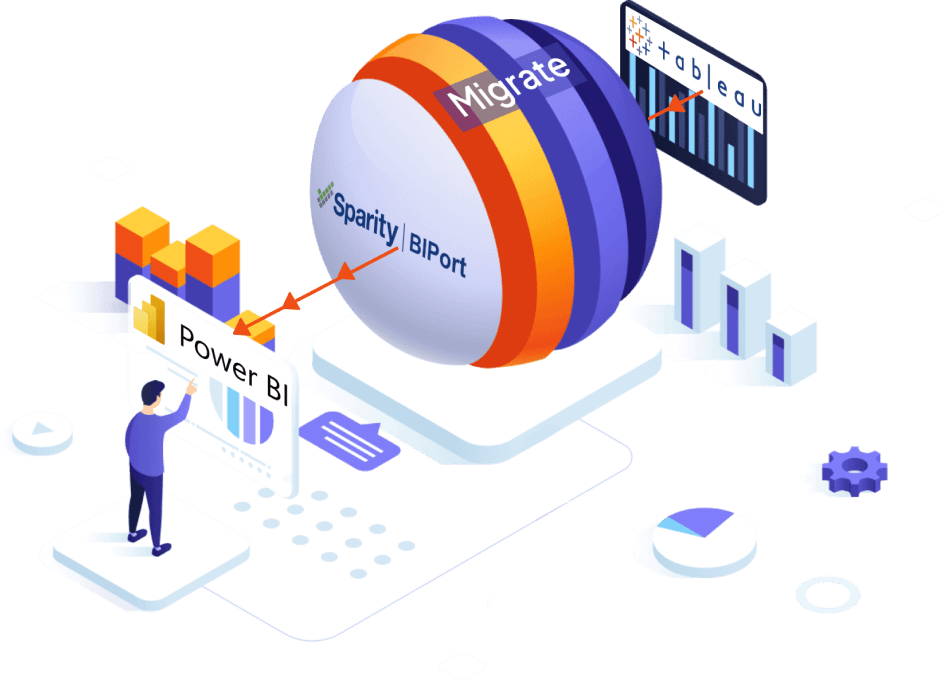
The distinction matters because visual familiarity is a weak test of correctness. Two dashboards might look alike while calculating a measure differently. In its September 25 migration guidance, Sparity identifies fragmented metric definitions across departments as a bottleneck. It also points to security mapping, mismatched interactions, unavailable reviewers, and capacity problems after launch. Those are organizational issues wearing technical clothes.
The company’s September 30 guidance on SAP BusinessObjects is refreshingly specific about the trade-off. Automation helps with discovery, dependency analysis, and repeatable conversion. Highly specialized reports and broader redesigns may require manual work. The sensible boundary follows the shape of the job: more repetition favors automation; unusual logic favors judgment.
- 01InventoryFind active reports and their dependencies.
- 02TranslateMove calculations, models, and permissions.
- 03ChallengeCheck the numbers with the people who use them.
The AI that kept the old software
Sparity’s May 2024 Tennessee logistics case begins with software that already worked. The procurement system was efficient, according to the company’s account, but the growing supplier network generated more information than the team could comfortably analyze. Manual contract review, supplier evaluation, and communication became bottlenecks.
The proposed intervention complemented that system. Sparity deployed a generative AI engine in a private cloud, used optical character recognition to extract information from documents, and added contract analysis, supplier recommendations, and chatbot support. It reports a 60% improvement in procurement-team productivity. The example concerns a particular workflow, not an all-purpose promise about AI.
For buyers, the appealing idea is selective intervention. A useful system can remain in place while a difficult activity receives new assistance. Contracts, clauses, supplier histories, and internal reports are rather less photogenic than a talking robot. They are also where procurement teams spend their afternoons.
A consultancy with tools of its own
Sparity occupies the space between platform vendors and internal delivery teams. Microsoft and AWS supply technology; a customer still needs someone to connect it to an existing business. Sparity’s portfolio spans product engineering, data engineering, cloud migration, security assessment, and managed IT. Its managed-services offering extends to backups, helpdesk support, and Apple environments, a reminder that ordinary operational care remains part of the business.
Its commercial model combines consulting and implementation with reusable accelerators. The Alteryx-to-Microsoft Fabric migration offer, for example, advertises fixed-cost delivery and automated workflow conversion. BIPort gives a services engagement a repeatable technical component. That combination is the meaningful competitive pitch: a tool for recurring work, and engineers for the work that refuses to recur politely.

At FABCON 2026, Sparity demonstrated BIPort to an audience already interested in Microsoft’s data platform. Its own positioning stresses Microsoft Data & AI expertise. Yet the client-facing work reaches beyond a single analytics product: retailers need sales visibility, insurers need reliable infrastructure, and education platforms need applications they can afford to run.
Alternatives include an internal team, a specialist analytics consultancy, or another software engineering firm. Sparity’s case is strongest when the job mixes repetitive migration with broader implementation work. A small set of unusual reports or a deliberate redesign may call for a different balance. Its own BusinessObjects guidance acknowledges that distinction.
Start by deciding what deserves to move
The part a reader can copy comes before the purchase. Audit usage. Find duplicate reports. Establish who owns each important metric. Give business reviewers time to compare outcomes, and test access rules along with numbers. Sparity’s bottleneck guidance makes clear that moving every old workbook can waste effort and carry unresolved disagreements into the new environment.
That is the quieter opportunity in this company’s work. An upgrade creates a moment to ask which old decisions still deserve their place. The dashboards may become faster and the infrastructure cheaper. The greater service is giving the people using them a system whose answers they understand.
Website · BIPort & demo request · Customer cases · Engineering blog · FABCON recap
LinkedIn · X · Instagram · Facebook · YouTube channel