The revealing moment came after the prepared examples. In a July 2026 interview, Synergycom founder Sridhar Guduguntla described a financial company with 128 APIs to migrate and a year to move. Rising licensing costs had made the existing arrangement unattractive. His team had four weeks to demonstrate an AI-assisted approach. They converted six APIs. Then they asked the customer for a seventh, live.
- The work: enterprise software, IT operations and technical staffing.
- The AI bet: apply automation to specific business workflows.
- The useful lesson: test an unfamiliar example before expanding the project.
According to Guduguntla, the demonstration worked. Further refinement took another six to eight weeks, and human validation remained necessary. The pilot became a project. These are the founder’s reported results, rather than an independently measured benchmark. But the sequence offers a useful buying question: what happens when the demonstration runs out of rehearsed material?
A business built around the installed base
Synergycom occupies a busy stretch of the technology market: the space between buying software and getting useful work out of it. Its customers need applications connected, older systems modernized, infrastructure maintained and specialists recruited. A new platform can create as much coordination work as it removes. Someone has to understand the interfaces, the permissions and the peculiar way a department actually operates.
The company’s platform roster includes Microsoft, Salesforce, SAP, Oracle and ServiceNow. Those names describe different corners of an enterprise. Microsoft work includes Dynamics 365, Azure and workplace collaboration. Salesforce work covers CRM design, migration, integration and support. SAP engagements reach into finance, procurement and supply chains. ServiceNow brings service and operational workflows into the picture. The expertise being sold is partly technical and partly organizational: making the chosen system fit the business.
This makes Synergycom relevant to an IT leader facing a migration, an operations team losing time to manual handoffs, or a business that needs technical capacity without building every capability internally. Its custom development practice adds web and mobile applications, platform extensions and legacy modernization. Buyers can commission something specific to their workflow when configuration alone leaves an awkward gap.
People, projects, then the daily running
There are several ways to buy that help. Staffing supplies individuals through contract, contract-to-hire and permanent arrangements, spanning IT, engineering and AI roles. Project delivery supplies a team and a defined body of work. Managed services support continuing operations. Synergycom offers augmented, co-managed and fully managed arrangements, covering infrastructure, applications, analytics and automation.
That combination is the commercial logic of the company. A customer may need a scarce specialist today, an integration team next quarter and continuing support after launch. Synergycom can compete for each assignment. The handoff between those assignments deserves attention: the team that knows why a system was built can be useful when someone has to maintain it. That continuity is a reasonable buying consideration, alongside price, specialist depth and delivery accountability. The alternatives include specialist recruiters, platform consultancies, larger systems integrators and the customer’s own engineering department. Its breadth creates convenience; a buyer still needs to decide which responsibility the supplier should actually own.

The careers material gives a glimpse of the organization behind those assignments. It emphasizes inclusion, collaboration and development, and lists training, paid leave, health coverage and retirement benefits, subject to employment model. Those are published employer commitments. For a services business, the connection is practical: retaining people helps retain the knowledge a customer would otherwise have to explain again.
The factory floor keeps showing up
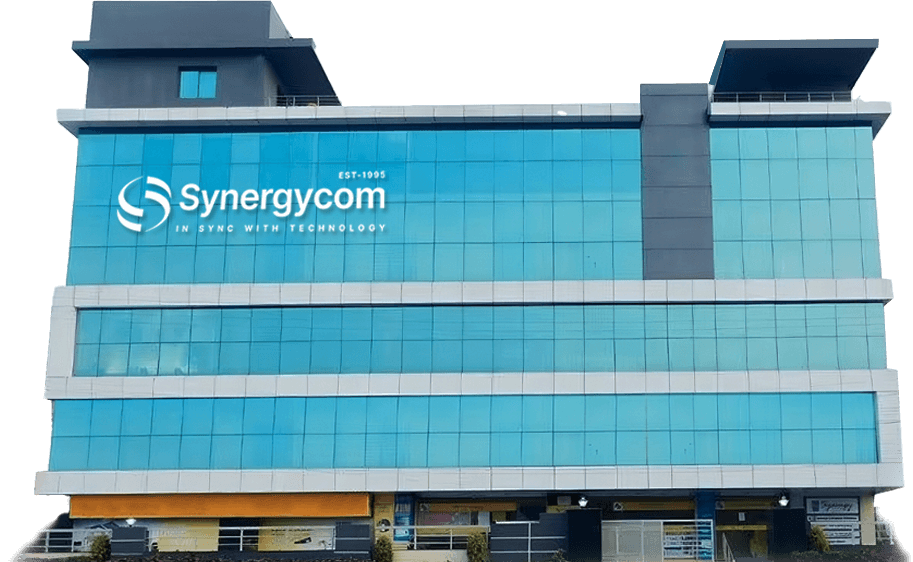
Synergycom’s history explains its industrial accent. Guduguntla founded the business in Detroit in 1995. A Hyderabad development center followed in 2003. The company says its 2022 Canadian and Mexican offices supported Stellantis; its timeline records an IT services relationship with Stellantis Financial Services the following year. Automotive work sits alongside healthcare, pharmaceuticals, finance and alternative energy.
Look through its older tools and the same preoccupation appears. CIS turns continuous improvement forms into searchable information and reports. The Data Pairing Tool moves related subsets of data into environments used for testing and debugging. These are wonderfully unglamorous problems. Forms accumulate. Databases become unwieldy. People waste time finding the piece they need. The tools aim to make those ordinary tasks manageable.
AI meets the work already waiting
The newer AI portfolio extends that interest. The current website names CompassAI for engineering drawing intelligence, Linguify for document intelligence and INVITION for industrial inspection. It also describes InfinitiX as an enterprise AI application platform. These offerings sit alongside custom implementation services. Their stated uses make the proposition concrete: extract information from drawings, interpret documents, inspect equipment and connect results to operational decisions.
“We need to understand the nuances of the business logic”
Sridhar Guduguntla · RevGenAI interview
Synergycom calls its approach Outcome AI. Its framework moves through data foundations, industry knowledge and decision workflows, with governance and human review included. Read that as a delivery philosophy. A sensible evaluation would specify what the output must do, who checks it and how success will be measured. An engineering drawing assistant and a document-processing workflow should face different tests.
Make the next example count
The lesson a reader can borrow is modest enough to use tomorrow. Pick one bottleneck. Establish the current effort. Bring the people who understand the business rules into the pilot. Hold back a fresh example. Agree on acceptance criteria before celebrating the demonstration. Then allow time for integration, refinement and review.
That approach depends on access to usable data, knowledgeable people and a workflow with a result someone can judge. Without those ingredients, a convincing demonstration has little to anchor it. Synergycom’s appeal lies in bringing enterprise delivery experience to that practical middle ground. The seventh API gives the idea a memorable shape: the next piece of work is where the promise gets interesting.