During a migration of historical data, a SenecaGlobal developer noticed something odd: the count of monthly tracked users had jumped. That count determined fees paid to an outside vendor. The developer traced the anomaly to a database issue, corrected it and alerted the client. In the company’s account, the intervention saved thousands of dollars. Nothing about this episode required a spectacular new application. It required someone to recognize that a number was wrong, understand why it mattered and follow it through.
The useful bits
- Build new software, modernize old applications and keep both running.
- Dedicated US and India teams serve software vendors and middle-market businesses.
- The proposition: retain product knowledge while improving delivery, cloud costs and support.
That small incident is a useful introduction to SenecaGlobal. Software services are often sold through lists of technologies. The more interesting question is what happens after a team learns a client’s business. Does it simply finish the tickets? Or does it notice the expensive thing nobody thought to put in a ticket?
A dinner, then a long relationship
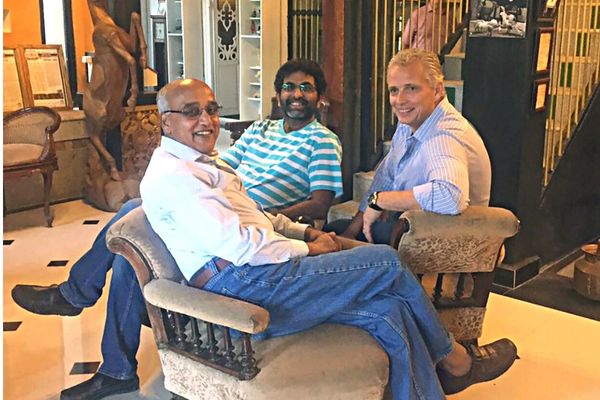
The company’s origin was a conversation over dinner in Chicago. Ed Szofer and Rao Tummalapalli wanted an IT services business that combined technical work with a people-first culture. Swaminathan Mani joined them, and the three founded SenecaGlobal in 2007. They had worked together before. Szofer had been president and chief operating officer of Whittman-Hart; Tummalapalli brought experience running offshore development.
There was a harder piece of experience behind the idea, too. In a 2021 Greenbook interview, Szofer called watching Whittman-Hart go under his hardest professional experience, citing internal mistakes and poor market timing. That history gives the founding dinner some weight. The partners had seen a much larger operation from the inside. Their new company would have to make its own case for how to organize people and serve clients.
Their chosen territory was the middle market: businesses needing specialized engineers without necessarily having the scale to attract a giant consultancy’s attention. The operating model joined US client-facing expertise with engineering in India. That puts SenecaGlobal among outsourced product-development firms and technical consultancies, competing for a place alongside the customer’s own team.
Consider CyGlass, a network-security company. SenecaGlobal helped turn its early idea into a working product. An acquisition followed, then a founder buyback after the parent company changed strategy. The development relationship continued. In SenecaGlobal’s published case study, a 20-person team represented roughly 80% of CyGlass’s research-and-development engineering group.
The work covered interfaces, APIs, testing, releases and operations. Engineers also absorbed partially completed work from two other sprint teams. The case study reports 50% faster completion in key project areas, rather than across the entire business. The revealing detail is continuity: people who already understood the product could keep working through changes around it.
“Our daily call is always meaningful and collaborative.”
Naveen Rohatgi, CyGlass
Quoted in SenecaGlobal’s client case study
The machine still works. Who knows the code?
The same logic applies to older technology. SenecaGlobal supports IBM i, formerly AS/400, including applications written in RPG. Its service page identifies a specific tension: the platform remains reliable while the people needed to maintain and enhance its applications become harder to find.
Replacing such a system is one option. SenecaGlobal also evaluates technical debt, dependencies and security risks, then helps clients maintain, modernize or retire applications. It can support the old environment while a replacement is implemented. For a business that depends on those applications, this is a practical distinction: a migration plan must account for tomorrow morning’s operations.
Around that core sit product engineering, quality assurance, cloud enablement, DevOps and managed services. Customers include software vendors, healthcare technology companies, manufacturers, distributors and financial-services businesses. SenecaGlobal’s role can extend from building a prototype to monitoring the production environment. Its cloud practice identifies an AWS Solution Provider partnership.
When the training stopped working
A company selling continuity needs employees who keep learning. SenecaGlobal’s culture includes Kaizen, the practice of making ongoing improvements. The term becomes more persuasive when attached to a problem that actually needed fixing.
During the pandemic, recorded courses and learning-management systems became the default for training. In a 2022 company account, Akhila Ali described the missing ingredients: hands-on practice, collaboration and human interaction. Her response combined online learning with internal trainers, mentors and real implementation projects. Employees could develop skills by building automation tools and applications.
That work won a Platinum Kaizen Award in the Morale Stream at the 15th CII summit. The lesson is pleasantly concrete. A library of videos gives people access to instruction. A colleague, a working problem and time to practice give them somewhere to use it.
Buy the learning, too
The business model follows the work: companies buy engineering and advisory services, dedicated teams and continuing operational support. A buyer should evaluate the economics across development, maintenance and infrastructure. A low hourly rate tells only part of that story.
Illustrative index: 100 = prior pipeline cost
For a prospective customer, that means writing down the baseline before hiring the team: today’s infrastructure bill, release cycle, support workload or recurring failure. Then choose a result that can be checked. The pipeline example is useful precisely because it names a cost category. A percentage becomes more informative when everyone agrees what is being counted, over which period, and whether the saving has happened yet.
The current AI offering adds opportunity mapping, AI-assisted software development and adoption accelerators such as retrieval-augmented chatbots. The sensible entry point is a specific business problem with an observable result. Adding an AI feature does not remove the need to understand data, test behavior or operate the application afterward.
One client-review account offers a useful buying discipline: judge outside developers on learning acuity, work quality, delivery timelines and accurate communication. The client expected full onboarding to a complex product to take six months to a year. That makes this model easier to justify for sustained engineering work than a tiny, standard assignment. The reader can copy the scorecard immediately. Ask what the team has learned, what it has improved and which costs it has noticed. Those questions survive the next technology fashion.
Keep exploring