Marjella Lecourt-Alma once helped put a three-year business plan on a whiteboard, photographed it and shared it on social media. A perfectly understandable impulse: you have started a company, you have a plan, and the internet is conveniently open. The awkward discovery comes later. Plans change. Screenshots have rather less interest in changing with them.
The anecdote sits neatly inside the larger story of Datamaran, the software company she co-founded in 2014. Its chief executive has spent years working out what should be made visible, to whom, and at what moment. A business can accumulate an impressive quantity of information while remaining remarkably uncertain about what deserves a decision.
For Lecourt-Alma, that gap became a career. She moved from helping companies report on sustainability to building software intended to bring risks and opportunities into executive discussions. Along the way came reluctant markets, paying customers, institutional investment and a return to the Netherlands. Her subject is corporate attention. It turns out to be an expensive commodity.
A report could travel further than its author
Her preparation came at the Global Reporting Initiative, the organization behind widely used sustainability reporting standards. She joined its Amsterdam headquarters in 2007 and became its youngest female director at 30. The work placed her close to the machinery of corporate disclosure: the reports, the people producing them and the effort required to make their contents useful.
She led a technical team reviewing sustainability reports and later represented GRI in North America. American companies offered an education in persuasion. A worthy subject still needed a business argument. Executives wanted to know how an issue connected to the company they were responsible for running, and what would happen if they ignored it.
What troubled her was the distance between sustainability staff and the people with authority over strategy. Producing information did not guarantee an audience with the chief executive, finance chief or board. She began to see a role for technology in assembling evidence that could survive that journey through a corporate hierarchy.
Datamaran grew from that observation. Its name plays on catamaran and the idea of navigating lakes of data. Corporate disclosures, regulations and media coverage could be read together to show which issues mattered to a particular business. The nautical name is cheerful; the underlying problem involves rather more reading than most people would volunteer to do.
A pirate with a price list
Leaving a standards organization for a commercial venture introduced another question: why charge for work meant to improve business conduct? Lecourt-Alma has been unusually direct about this. People’s willingness to pay tells you something about whether they attach value to a service. A budget makes an abstract expression of interest considerably more concrete.
There is a further twist. An expensive purchase tends to require approval from someone senior. For a founder trying to reach decision-makers, the purchasing process itself could help open the door. That creates obligations, too. A substantial price needs a product that can justify the expense long after the sales presentation has ended.
John Elkington, the sustainability writer and entrepreneur, recorded a colleague’s affectionate description of her as “a great pirate.” It fits the move from an established institution to a new commercial category. She was prepared to test a different vessel while remaining concerned with many of the same questions.
Two books have informed her thinking: Geoffrey Moore’s Crossing the Chasm and Play Bigger, by Al Ramadan, Dave Peterson, Christopher Lochhead and Kevin Maney. Both concern the difficult business of making a market understand what it is being offered. A founder can recognize a missing piece of the world well before buyers have agreed on its name.
“It doesn’t matter what they call it.Marjella Lecourt-Alma, on the ESG label, 2024
The customers who bought a stake
By September 2022, Datamaran had an answer more tangible than a theory of purchasing behavior. Fortive and American Electric Power backed an £11.7 million Series B funding round. Both were already clients and long-standing partners. They had encountered the software from the customer’s side before deciding to invest in the company behind it.
Lecourt-Alma described that support as an endorsement of the product and the company’s plans. The money would support product development and expansion of the US team. It was a useful crossing of roles: organizations buying an external view of risk were now taking a financial interest in the supplier’s future.
The next substantial milestone arrived on September 19, 2024: $33 million in Series C financing from funds managed by Morgan Stanley Expansion Capital. The announcement said subscription revenue had more than doubled in the preceding 18 months. It identified growth in the United States and Europe, alongside generative AI initiatives, as uses for the proceeds.
Those figures belong to a specific announcement, rather than a claim about revenue today. They nevertheless mark a change in the founder’s circumstances. A company built around an emerging executive concern had attracted growth capital after a decade of operation. The question of whether anyone would pay had acquired a fairly legible answer.
Existing clients and partners
US, European growth + generative AI
Announced round sizes. These figures are neither revenue nor personal wealth.
The boardroom needs a shorter list
In a 2024 conversation with ESG News’ Matt Bird, Lecourt-Alma explained the value of identifying and prioritizing issues in the context of an individual business. That qualification matters. A software system earns its place by helping a company distinguish between a subject that attracts widespread discussion and one that could materially affect its own operations.
The practical appeal is easy to understand. Attention, staff time and investment are finite. A company cannot give every emerging issue equal weight. A useful assessment should make choices easier to explain and easier to revisit. That is the promise Lecourt-Alma has been bringing to executives: a basis for deciding where effort belongs.
Her December 2025 conversation at the London Stock Exchange Group studios extended the argument. She discussed continuous monitoring, executive oversight and the need to keep pace with changing external conditions. A completed assessment captures a moment. Management still has to decide whether the picture remains accurate when circumstances move.
For a chief executive selling this approach, the task continues beyond demonstrating a dashboard. Someone inside the customer’s organization must own the decision, explain its significance and keep watching. Lecourt-Alma’s recurring concern is who takes responsibility once the information has arrived. The software has a role; the organization still has work to do.
- 01 / ReadDisclosures, regulations and media
- 02 / PrioritizeRelevance to the individual business
- 03 / DecideExecutive ownership and action
- 04 / RevisitMonitor as conditions change
Friesland gets a seat at the table
Her own map has changed. She grew up in De Westereen in Friesland, moved to New York in 2011 and later to London. She credits New York with encouraging her to think more ambitiously about what she could do. In 2014, she and Jean-Philippe Lecourt moved to London, started Datamaran and married within a few months.
The founding team also included Jérôme Basdevant. Lecourt-Alma brought her sustainability experience and network; her co-founders brought complementary quantitative and technical expertise. The couple subsequently returned to Friesland. Datamaran opened an office in Leeuwarden, adding a northern Dutch address to London, New York and Valencia.
The location was a deliberate choice about opportunity. She wanted local talent to have access to international work without assuming that a career had to begin with leaving the region. Her return gave the business a connection to the place where she had once regarded herself as an underdog.
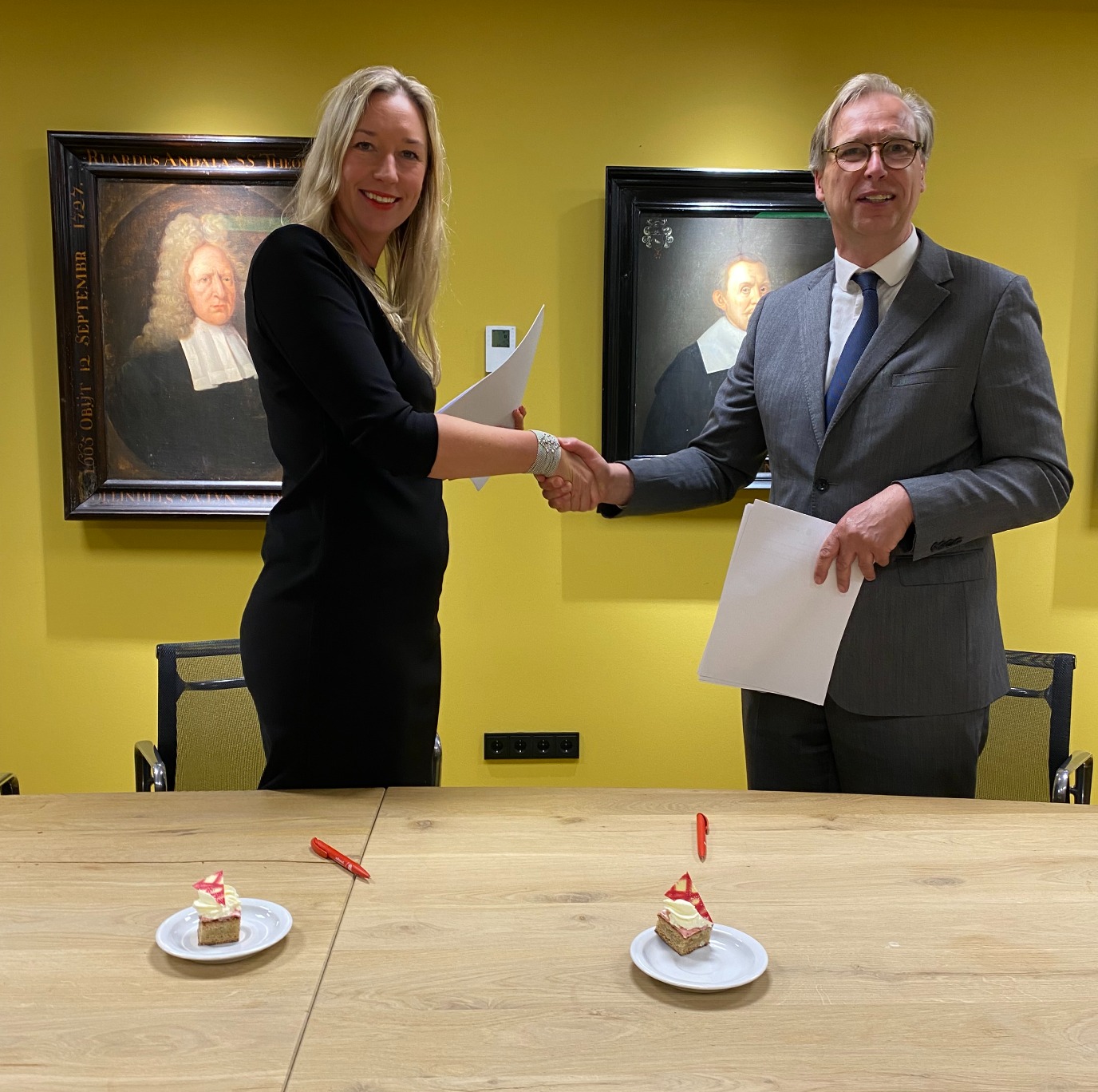
A June 2024 agreement with the University of Groningen’s Campus Fryslân gave that connection practical substance. The partnership provided for research access to available Datamaran data, cooperation in education and participation in program advisory boards. Lecourt-Alma linked the Leeuwarden office to the talent coming through the region’s educational institutions.
This is a quieter kind of company building than announcing a funding round. It involves the routes by which people acquire experience, meet employers and enter work that might otherwise appear distant. A regional office can change those routes. The partnership makes her interest in local opportunity visible in the workings of the business.
Faces before deliverables
In a January 2025 LinkedIn post about colleague Emilia Angova, Lecourt-Alma described seeing people behind the tasks on her to-do lists. Growth, she acknowledged, made it harder to retain that personal connection. She wanted the Leeuwarden office to combine ambition with inclusion, and praised Campus Fryslân for bringing talent to the north.
That admission gives the corporate story some welcome texture. Growing a company multiplies relationships as well as contracts. A founder who once knew the people behind each piece of work has to find other ways to stay connected. Her post shows her thinking aloud about the difficulty, with a particular colleague bringing the issue into focus.
Her public work has also expanded into conversation and film. In 2026, Datamaran launched Collective Impact, a documentary and podcast series she conceived. It follows business leaders working on sustainability inside their organizations, with examples including Duke Energy and Barco. The people making decisions are given room to describe how the work actually happens.
The podcast adds another setting for that interest. Lecourt-Alma hosts with rotating co-hosts; its opening conversation featured business leader Mindy Grossman and co-host Sandy Nessing. There is a consistent curiosity here about how people lead through uncertainty, and how an organization’s intentions translate into the choices its employees make.
“For us, it’s community first and software second.Marjella Lecourt-Alma, 2026
Twelve years in, another turn
In September 2026, Lecourt-Alma introduced Datamaran’s new brand identity with a reflection on how both her life and the business had changed. Returning to the Dutch countryside and becoming a mother of twins had sharpened her sense of responsibility and community. The company’s conversations, meanwhile, were extending further into risk, legal and executive teams.
She argued for concentrating on a few issues already affecting a business, supported by current evidence and a clearer route to action. The ambition is specific: help customers do something with what they learn. Her account also acknowledges the changing reception of ESG and the need to adapt how the company explains its work.
Twelve years after founding Datamaran, Lecourt-Alma is still trying to improve the passage from information to responsibility. The rooms have changed, as have the people she hopes to reach. The early whiteboard story remains a useful companion. Make a plan, certainly. Then leave enough room to discover what the business, and the person building it, will become.
Keep the conversation going
Read her writing, watch the conversations, or explore the work behind the story.