A clinical trial ends twice. There is the end people picture: the last visit, the last assessment, the last patient walking out of a clinic. Then there is the ending that occupies the people behind the screens. Records must agree with one another. Questions must be resolved. Analyses must be reproducible. The evidence must arrive in a form somebody else can examine.
EDETEK works on that second ending, and on the machinery that makes it less painful. Its proposition is straightforward: connect clinical systems, carry the rules along with the records, and give the people responsible for the evidence a shared place to work. The interesting part is how much of that proposition depends on decisions made before a statistician opens a dataset.
- What it sells: clinical trial platforms plus data management, statistics, programming, and related services.
- Who buys: life sciences sponsors and clinical research organizations.
- The distinguishing bet: reusable metadata and integrated workflows, with room for other vendors’ systems.
The rulebook travels with the data
Consider a simple, hypothetical problem. A site records a visit under one name. A laboratory returns a file using another identifier. A reviewer wants the patient’s results in order. A programmer needs the same information arranged for analysis. Every team can be competent, and the handoff can still be dreadful. A computer is quite capable of moving confusion at impressive speed.
EDETEK’s CONFORM platform addresses those transitions. Its Data Integration Gateway accepts information from multiple providers. An Intelligent Metadata Hub holds the definitions and rules used to configure studies. A Clinical Data Pipeline applies the specified transformations. Review and analytics tools give the resulting data an audience. These are the components in EDETEK’s published product architecture; the hypothetical lab example simply explains why their arrangement matters.
and incoming files
for the study
and standards
and report
The metadata hub is particularly revealing. EDETEK describes a graphical designer for transformation and validation rules that end users can configure without writing software code. The practical ambition is reuse: an approved definition should not have to be reinvented whenever the next study begins. A rule can be a small thing. A collection of rules, versioned and maintained, becomes institutional memory.
That is the architectural lesson a reader can borrow. Decide what the information means, who owns the definition, and how changes are approved. Automating a handoff becomes much easier to reason about once its terms are settled. This is an interpretation of EDETEK’s design, rather than a claim that purchasing the software settles those questions automatically.
A rival can be a useful neighbor
In November 2023, EDETEK announced an enterprise partnership with Medidata. The agreement linked Medidata Rave EDC with CONFORM for clinical data review, cleaning, and standardization, alongside biometrics and data science services. That is a useful detail in a market where vendors sell overlapping pieces of the same trial.
EDETEK has its own electronic data capture application. It also offers to work with another vendor’s. The commercial logic is easy to appreciate: a sponsor’s existing software is part of the problem to solve, and often part of the solution. Asking every participant to abandon familiar systems would make integration a rather expensive synonym for starting over.
The broader R&D Cloud follows this approach. It combines CONFORM and eClinical, lets clients select capabilities, and accommodates third-party products. The cloud’s published design covers trial conduct and the data continuum, with collaboration and workflow orchestration across organizations. Its appeal depends on how well those connections serve an actual study, rather than on how complete the suite looks in a brochure.
This places EDETEK among enterprise clinical technology providers. Oracle Clinical One also markets unified clinical data collection and trial supply capabilities. Medidata supplies a broad clinical platform. EDETEK’s distinctive emphasis is the combination of metadata-driven processing, configurable integrations, and functional services. Product overlap does not establish a winner; it tells a buyer where a comparison needs to begin.
Software with specialists attached
The services are consequential. EDETEK advertises clinical data management, biostatistics, programming, standards development, medical writing, study development, and eClinical operations. A sponsor can need a platform and still need people who understand what should happen inside it. Buying a kitchen does not settle who will cook.
The eClinical side supplies applications for trial operations and capture, including CTMS, EDC, patient diaries and assessments, risk-based quality management, and randomization and trial supply management. The suite description helps explain the split: eClinical supports the conduct of a study; CONFORM manages what happens to its accumulating information. R&D Cloud is the umbrella over both.
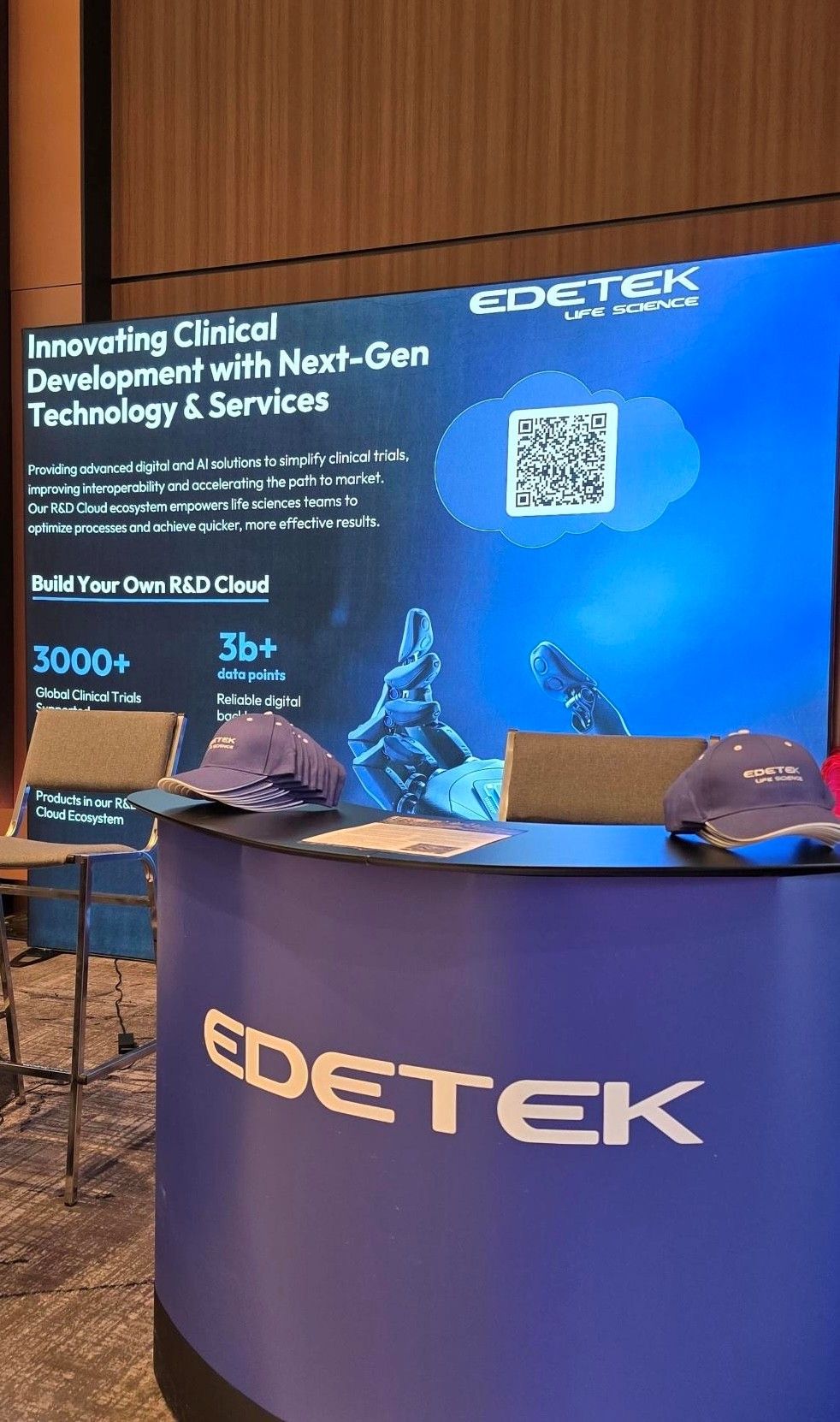
Its business model combines enterprise software with implementation and specialist work. For a buyer, the meaningful cost calculation extends beyond access to an application: it includes connecting systems, configuring studies, maintaining standards, and providing the people to review outputs. Those are budgeting considerations, not a published EDETEK price schedule.
There is a founder’s logic behind the combination. Jian Chen established the company in 2009. His published biography includes experience in information management and statistics, a previous role as co-founder and CTO of Q-Square Business Intelligence, and qualifications in biostatistics, biomedical engineering, finance, and strategy. It is a fitting background for a business that treats clinical evidence as both a scientific responsibility and an information-management problem.

AI gets an adult in the room
The newer chapters put AI into this existing machinery. In June 2025, EDETEK engaged Capgemini for digital transformation, AI capabilities, engineering, and global platform scaling. In September, it announced BioStat.AI, combining clinical data management, biostatistics, and statistical programming. Announced capabilities include statistical analysis planning, dataset generation and validation, and support for clinical study reports and patient narratives.
These are statements of product scope and intention. They should be read as such. The development worth following is the attempt to connect AI to the workflow that produces evidence, where an output must be reviewed, explained, and used by a responsible person.
“Our clients do not need another pilot; they need results.”
Dr. Shakthi Kumar · Ensemble announcement, January 2026
The January 2026 Ensemble launch makes that operating model explicit. EDETEK describes managed AI with model orchestration, domain experts, validation controls, and human approval before outputs are used. The offering joins technical infrastructure to people working in data management, statistics, medical monitoring, and regulatory affairs. The emphasis on approval is a significant product choice: responsibility stays visible.
Biopharma clients reported by EDETEK in its January 2026 announcement.
Company-reported scale, not an audited customer count.
The transferable lesson is to put the reviewer into the process design. Ask what the machine may propose, what a person must approve, and what history a later reviewer will see. A fluent answer is only the beginning of the work when the answer will influence clinical evidence.
The next handoff is to the regulator
In July 2026, EDETEK announced a sponsor partnership program to help organizations prepare for the FDA’s real-time clinical trials initiative. Its proposal uses near-real-time data visibility and predefined safety and efficacy signals. The division of labor is specific: sponsors retain their science, clinical strategy, FDA engagement, blinding decisions, and safety oversight; EDETEK supplies supporting technology and services. Participation is determined by the FDA.
This is where the architecture faces its most demanding question. Faster delivery is useful when the underlying records, rules, permissions, and review processes are dependable. Inaccessible source systems, ambiguous definitions, or absent reviewers would undermine that arrangement. These are practical dependencies of the model, not reported EDETEK customer failures.
The company’s story therefore comes back to the handoff. A patient’s visit produces a record. A record becomes something a team can review. Reviewed evidence becomes something a statistician can analyze and a regulator can examine. EDETEK sells machinery and expertise for that passage. The quiet achievement to aim for is that each person can understand what arrived, how it changed, and why it deserves attention.