A drug kit is a promise. Somewhere, a patient has agreed to enter a clinical trial. Somewhere else, a team has designed the experiment. Between them sits an operational question that sounds almost offensively ordinary: will the right treatment be available when it is needed? The science may be ambitious. The appointment is on Tuesday.
This is the territory occupied by 4G Clinical. Its software assigns patients to treatments, manages trial drug inventory and helps decide when supplies should move. Randomization and Trial Supply Management, or RTSM, is the industry’s name for this work. It has the glamour of a railway timetable and something of its power: when coordination fails, everything downstream feels it.
- Prancer RTSM connects treatment assignment with live drug supply management.
- 4C Supply lets teams model demand, manufacturing and distribution scenarios.
- The distinguishing idea: use written specifications to help configure the system, then keep planning close to actual trial activity.
- The buyer: a biotech, pharmaceutical company or CRO trying to run a study without avoidable operational delay.
Two men who understood waiting
David Kelleher’s impatience with delay had a history. In a 2016 essay, he recalled being a young Army infantry officer preparing for deployment when a problem with his eye sent him to doctors. He was diagnosed with multiple sclerosis at 23. His military career ended; treatment and another life followed.
What stayed with him was the uncertainty of disease. He wrote about the prospect of progression and the people whose disabilities were already more severe. His practical response was to look for bottlenecks in clinical trials. He could contribute business experience without becoming the scientist who discovered the molecule.
“We must accelerate the speed of discovery.”David Kelleher, founder essay, 2016
His co-founder, Ed Tourtellotte, had already built clinical technology. Then his wife, Heather, developed triple-negative breast cancer. In his public account, he described seeing a clinical trial from the patient’s side for the first time. After her death, returning to this industry became a way to try to help.
The company they founded in 2015 therefore had two sorts of knowledge: how trial software worked, and what waiting could mean outside a software project. Neither experience made a system easier to validate. Together, they supplied a reason to care about shaving friction from work that outsiders rarely notice.

The specification becomes the machinery
Tourtellotte’s technical question was wonderfully literal. If an RTSM specification contains the rules needed to build a system, why should someone have to translate those rules again? His early account described using a smart editor and natural language processing to turn a carefully written specification into the system itself.
Today, 4G describes NLP as part of Prancer’s configuration framework. It helps translate protocol requirements into executable logic. This is a specific use of language technology, anchored to study instructions and review. The customer still approves the specification and tests the resulting system, Kelleher explained in a January 2026 interview.
- 01Study rulesInterpret the protocol
- 02SpecificationDescribe the behavior
- 03ConfigurationNLP assists the build
- 04Review + validateTest before deployment
Conceptual workflow. Human review and validation remain part of delivery.
The less theatrical detail is the early working version. 4G’s delivery approach gives sponsors sandbox access before formal validation. Seeing an actual workflow can expose a misunderstanding that a meeting about the workflow politely concealed. A visit schedule that looked clear on paper may feel quite different when somebody tries to use it.
The transferable lesson is straightforward: let people inspect behavior while it is still cheap to change. In 4G’s case, that happens within a controlled process involving defined ownership, documentation and readiness reviews. Speed has to coexist with evidence.
A forecast with permission to change
Clinical supply begins with assumptions. How many patients will enroll? At which sites? At what doses? In an August 2026 article, 4G argued that static plans become less useful as enrollment, cohorts and country participation change. Extra buffer can guard against shortages while also adding expiry exposure, storage burden and waste.
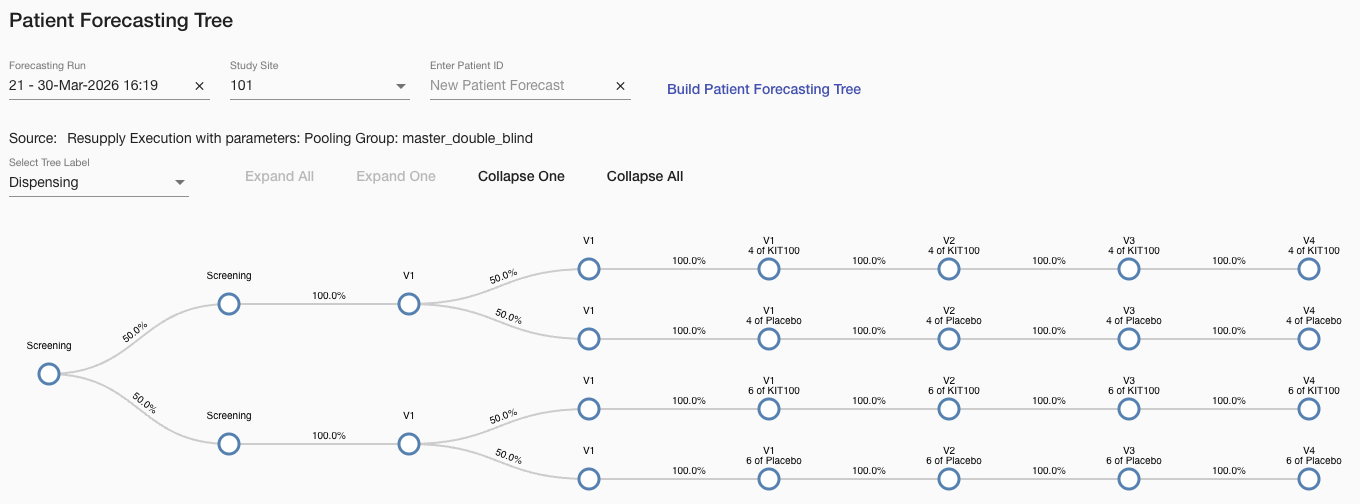
The interesting move is to bring the forecast closer to the events that disprove it. Prancer’s Patient Forecasting Tree shows a patient’s current position and projects future progression to estimate demand. A supply plan can then respond to study activity rather than continuing to worship its original spreadsheet.
4C Supply, launched in December 2019, extends the question into scenario modeling. Supply managers can compare different assumptions before committing to a plan. Its launch announcement described using plain-English study parameters to produce forecasts, with Eisai participating in early development and Infinity Pharmaceuticals identified as an early adopter.
The current positioning separates two jobs: Prancer manages live execution; 4C Supply addresses broader planning across manufacturing, distribution and programs. Crucially, 4C Supply also connects to third-party IRT systems. A sponsor can investigate forecasting without first replacing the software running every trial.
What is happening?
Assignment, dispensing, inventory and resupply during the study.
What could happen?
Demand scenarios, production timing and longer-range supply decisions.
No forecast can manufacture a batch that does not exist. The operational lesson is to examine assumptions, data freshness and physical supply constraints alongside the model. Connecting information creates a better opportunity to act; someone still has to make the decision and execute it.
The purchase includes the people
4G’s customer is an organization running clinical research. Within it, different people need different things: a trial team needs correct assignment, a site needs a usable workflow, and a supply manager needs visibility into demand and inventory. The business sells cloud software with study delivery and ongoing specialist support. Engagements begin through tailored discussions and demonstrations.
There is public evidence of what buyers wanted. In February 2019, Decibel Therapeutics selected 4G as its preferred IxRS/RTSM provider for development programs involving hearing and balance disorders. The announcement emphasized flexibility as studies evolved. The problem was concrete: an emerging biotech needed technology and expert staff suited to complex trial designs.
4G assigns dedicated roles across RTSM, forecasting, integrations and changes. Its expertise page describes employee-staffed global support available around the clock. That matters because go-live is an opening act. Protocol amendments and operational questions continue after the congratulatory meeting has ended.
The surrounding systems matter, too. In February 2024, 4G and temperature-monitoring company Berlinger announced a partnership addressing scattered temperature data and supply oversight. A kit’s location is useful information; whether its storage history needs assessment is useful information of another kind. The partnership’s announced ambitions included better visibility and less burden for sites.
The capital behind the configuration
Building this business required more than a neat linguistic trick. Schooner Capital led a $2.5 million Series A announced in January 2016 and a further $5 million Series A1 that October. The latter announcement brought the year’s Series A funding to $7.5 million.
Announced investment agreement backed by Goldman Sachs Asset Management.
The 2021 investment was intended to support expansion. At the time, 4G reported serving more than 100 biotech and pharmaceutical clients globally. In 2022 it ranked No. 159 in Deloitte’s Technology Fast 500, reporting 909% revenue growth over 2018-2021. These are dated milestones, useful for understanding the build-out rather than measuring today’s performance.

4G sits in a specialist part of the clinical software market. Medidata Rave RTSM emphasizes integration with Rave EDC, while Suvoda offers RTSM within a wider clinical trial platform. Both describe configurable systems and complex-study support. The useful comparison is therefore the sponsor’s actual protocol, integration needs, forecasting requirements and service expectations.
The cost arrives after go-live
A July 2026 4G article examined an especially recognizable decision: defer useful functionality because launch is approaching. The eventual cost may appear as manual work, reconciliation or a change that becomes harder once the study is running. Its argument gives prospective buyers a better question than whether a feature looks impressive in a demonstration: who does the work if we leave it out?
That is also a useful way to understand the company. Its proposition depends on reducing repeated translation, exposing misunderstandings early and connecting supply decisions to actual study movement. The point is practical enough to travel beyond life sciences. Build an inspectable version. Keep the forecast near reality. Give somebody responsibility for the changes.
Back at the site, Tuesday has arrived. A patient does not experience a successful integration or an elegant configuration framework. They experience an appointment that can proceed. For a company devoted to the machinery between science and treatment, that is a sensible place to keep its attention.