The trouble began with a change of plan. In a global Phase 3 oncology study described by YPrime, protocol amendments had created critical delays. The sponsor needed an electronic outcome-assessment system across 216 sites, 900 patients and 34 countries. A scientific instruction had become a deployment problem. Somewhere, a questionnaire had to catch up.
That is a useful place to meet YPrime. Clinical research attracts attention for its molecules and discoveries. YPrime works among the schedules, screens, questionnaires and supply decisions that let the experiment proceed. Its proposition is practical: make the technology fit the protocol, including the version of the protocol that arrives after everyone thought they were finished.
- Three core tools: eCOA captures outcomes; IRT manages randomization and trial supplies; eConsent handles informed consent.
- Three audiences: sponsors buy it, sites operate it and participants live with it.
- The buying question: how well does the system cope when the study changes?
A questionnaire with a passport
YPrime’s account of the oncology rescue says it used pre-validated eCOA software, pre-configured for complex changes, with guidance from therapeutic-area specialists. The interesting detail is the geography. A rollout across 34 countries requires more than distributing an app. The questions, the schedules and the device arrangements must all remain usable in the places where the research happens.
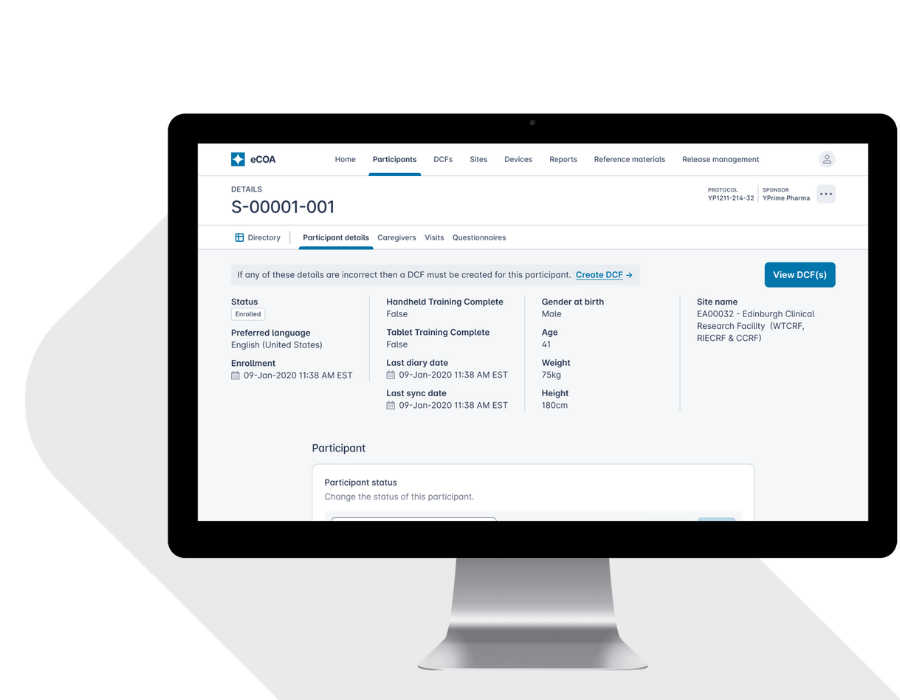
Electronic Clinical Outcome Assessment, or eCOA, turns assessments into digital workflows. Participants can record their experiences through an app. Sites use a portal to manage participants and visits. Sponsors see reports and dashboards. YPrime supports both participants’ own devices and provisioned devices, alongside integrations with wearables, glucometers and sensors.
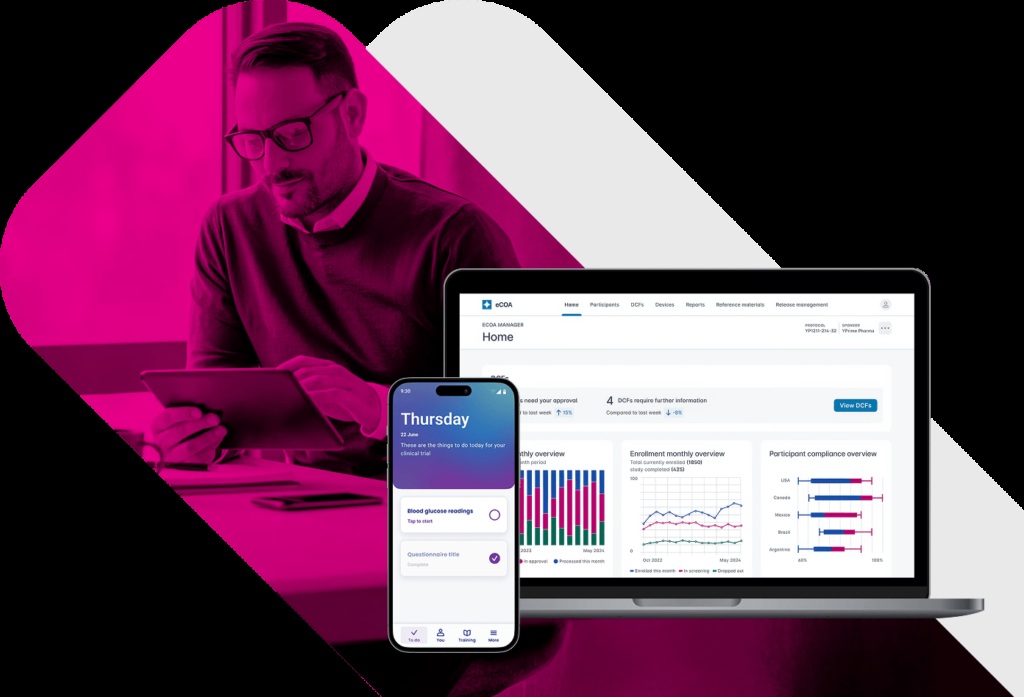
The customers are pharmaceutical companies, emerging biotechs and contract research organizations. The users include investigators, research coordinators, participants and caregivers. These groups want different things from the same software. A sponsor wants usable data. A coordinator wants the visit to run properly. A participant wants to understand what the phone is asking.
The product has to reconcile those interests. A beautifully organized dashboard is little comfort if the daily diary is bewildering. An inviting diary is equally inadequate if its entries cannot be traced and reviewed. YPrime’s business lives in that awkward middle, where convenience must survive inspection.
The consultancy hiding inside the software
YPrime began in 2006 as a two-person consultancy. Co-founder Shawn Blackburn had worked on technology at Cephalon and Parexel; the company’s biography credits his Cephalon work with streamlining clinical trial workflows. The origin explains something about the present business. YPrime sells software accompanied by implementation, integration, consulting and support. There are people behind the configuration.

Ballast Point Ventures began backing the company in 2013. In February 2019, Flexpoint Ford announced a significant investment, with management retaining a substantial ownership stake and Ballast Point remaining a minority investor. This was capital for scaling an existing clinical technology business, with sector experience attached.
For a buyer, the commercial route is a sales conversation or request for proposal. The practical exercise is to price the whole study: configuration, language coverage, devices, integrations, support and amendments. A software proposal needs to describe who will do each job. Otherwise, the most consequential costs can sit politely between the line items.
The protocol changes. The supplies must follow.
Interactive Response Technology, or IRT, handles randomization and clinical supply workflows. YPrime’s system connects enrollment, drug distribution and study progress, with integrations into other clinical systems. In an adaptive oncology trial, cohort decisions and dose adjustments can change the operational plan while the study is running.
YPrime separates routine operational updates from higher-impact changes. Sponsors and sites can manage routine work; YPrime experts implement, validate and document changes affecting protocol logic, supply strategy or system behavior. That distinction is part of the product. Giving everyone an edit button would be a peculiar interpretation of flexibility.
Information + agreement
Randomization + supply
Assessments + review
In its published adaptive oncology example, YPrime reports a four-week IRT startup and successful data exchange with existing platforms. Those are useful delivery details. They invite a prospective buyer to ask for a comparable study, a comparable protocol and a clear explanation of what “startup” includes.
A smaller, more interesting job for AI
Consider what happens to a translated questionnaire on its way into a digital system. Approved text must be imported into the right places. The translation may be sound while the migration introduces errors. The work is repetitive, exacting and easy to underestimate.
In November 2025, YPrime reported a comparison of human-led migration with its AI-supported workflow, using 15 studies across 11 languages. It reported 74% fewer migration errors, 60% fewer screen reports containing errors and a 67% shorter localization review process. These are company-reported results from a defined sample, rather than a promise about every future study.
Normalized illustration of YPrime’s reported 74% reduction. Comparison: 15 studies, 11 languages; published November 2025.
The appeal is the narrowness of the task. Language specialists still review the material. Automation improves the handoff into that review. This is a lesson other businesses can copy: choose a recurring operation, define the errors and compare the new process with the old one before making grand claims about transformation.
In April 2026, YPrime added an AI-powered Calculation Engine inside its eCOA Builder. Teams describe study calculations in natural language; the system produces structured models with formulas, variable mappings and traceability to questionnaire data. Configured calculations then run as participant data arrives. Review and validation remain part of the workflow. The conversational interface makes the instruction easier to give; the structured output makes it possible to examine.
The patient needs a next step
YPrime acquired Tryl in February 2022, bringing in staff, development capabilities and intellectual property focused on participant engagement. Tryl’s approach drew on behavioral principles used in professional sports and consumer finance. The premise was that understanding people’s behavior belongs inside a trial’s technology design.
Research supplied by Clariness also challenged an assumption. It gathered insights from more than 2,000 patients across four countries. YPrime president Mark Maietta said older patients showed greater digital literacy and adherence than expected. That is a valuable correction: design around observed users, rather than the convenient caricature of them.
“An informed participant is an engaged participant.”
Mike Hughes · Participant Hub launch, April 2026
The Participant Hub, launched that April, puts visit information, study education, task priorities and approved support materials inside the eCOA app. Its “For You” page gives guidance a permanent address alongside the work. YPrime’s eConsent product, launched in 2022, similarly treats participant understanding as part of the trial workflow.
Buy the handling of exceptions
YPrime competes in an established market. Clario also offers configurable eCOA, validated assessment libraries and multiple device options. Signant Health offers eCOA within its SmartSignals suite. Global support and configuration are capabilities buyers can find elsewhere. YPrime’s case rests on how its software and delivery teams handle the particulars of a study.
Its October 2025 investigator-oversight release illustrates those particulars. Electronic sign-offs are tied to investigators; changes after sign-off trigger another review and signature. Reports preserve timestamps, signature history and data changes. A correction to an entry has consequences beyond the entry itself, and the system needs to remember them.
For a clinical team, the sensible evaluation is a rehearsal. Bring a difficult amendment, a localized assessment, a device strategy and an investigator-review scenario. Ask the vendor to show each handoff. Software can help carry out a protocol; it cannot make an unsound protocol sensible, establish a drug’s efficacy or substitute for accountable investigators.
YPrime’s most transferable idea is the attention it gives to those handoffs. Put instructions beside tasks. Give consequential changes a review path. Test automation against measurable errors. The clinical trial still depends on the science. Its daily progress also depends on whether the right person can understand, perform and record the next small thing.
Go further into the machinery
YPrime website · Company news · Blog and insights
Localization research · Calculation Engine · Participant Hub