The interview was supposed to be practice. John Reites had been aiming for a job in communications, but that plan collapsed. Someone arranged an interview at a clinical research organization and helpfully explained that he probably would not get the position. Reites got it that day. His new duties involved answering calls from research sites and moving paper files. He later gave himself a more memorable title for this chapter: chief paper pusher.
It is the kind of beginning that resists the polished founder biography. No childhood laboratory. No tidy declaration of destiny. Reites has even volunteered that his only C in college was biology. What he did have was proximity. The files, calls and small operational snags gave him a view of clinical research from the floorboards up. Once inside, he became interested in the purpose of the work and increasingly restless about its methods.
That combination, respect for the mission and impatience with the machinery, became the useful tension in his career. He moved through site support, clinical monitoring, data management and project management. Each role offered another angle on the same elaborate apparatus. His recurring questions were plain: why are we doing it this way, could it be done better, and where might technology help? He jokes that this habit sent him to the principal's office more than once.
An apprenticeship in friction
Reites remained at Quintiles, now IQVIA, from 2002 to 2016. His own biography describes nearly 15 years as a corporate intrapreneur, including leadership of internal ventures from product development through global execution. By 2014 he was publicly presented as a senior director responsible for direct-to-patient research. By 2016 he was leading digital health acceleration and speaking about how to move programs from pilots into platforms.
The progression matters because clinical research software sits inside a particularly unforgiving puzzle. The participant sees instructions, appointments and questionnaires. A site sees workflows, documentation and a thicket of systems. A sponsor sees timelines, evidence and compliance. Regulators eventually need data that can withstand scrutiny. A clever screen can still create trouble if it ignores any one of those rooms.
Reites learned those rooms one by one. The operator's advantage is rarely glamour. It is memory. You remember the duplicate entry, the call that took too long, the form whose logic made sense to its author and no one else. Later, when someone proposes a broad transformation, you can ask what happens at 4:45 on a Friday when a coordinator is holding three passwords and a participant is waiting.
The customer enters the store
About eight years into that career, Reites saw research from the participant's chair. He entered a study with the enthusiasm of an insider, even checking the consent paperwork for missing marks. Three months later, he left. His analogy was commercial rather than clinical: he felt like someone who had managed a store without ever shopping there. Once he became the customer, the gap between the designed process and the lived process was impossible to miss.
A family trip supplied a second piece of the puzzle. At Walt Disney World, he used a MagicBand and the connected app that coordinated a day full of reservations, locations and decisions. Reites was careful about the comparison: a holiday and a clinical study carry very different stakes. The useful similarity was complexity. Disney had taken a stressful chain of moments and made many of them feel connected.
The third piece came from direct conversations with participants, advocacy groups and research sites. They described what made participation difficult and what could make it easier. Put together, the lesson was more disciplined than a call to digitize everything. Begin with the people doing the work. Borrow patterns from consumer products when those patterns reduce uncertainty. Use technology as an enabler, then ask it to leave the stage.
Building THREAD, then staying
In 2016, Reites left Quintiles and co-founded THREAD. The company developed a configurable platform for decentralized and hybrid research, bringing functions such as electronic consent, patient-reported outcomes, virtual visits, engagement and data capture into one environment. Reites began as partner and chief product officer. His early language was about remote patient research. The category's vocabulary later settled around decentralized clinical trials, often shortened to DCTs.
He has consistently described decentralization as a choice architecture, not a plan to erase research sites. Some activities belong in a clinic. Others can be completed remotely, through a virtual visit or from a participant's own device. The useful model is hybrid and specific to the protocol. It gives a study more ways to fit real schedules without pretending every task travels equally well.
In August 2019, JLL Partners and Water Street Healthcare Partners acquired THREAD. Reites stayed. The distinction is important. An exit makes a satisfying closing line, but remaining turns the founder's question from can this work into can this work repeatedly, across organizations, countries and regulatory expectations? THREAD received further investment, expanded its platform and added capabilities through acquisitions, including Modus Outcomes and inVibe. Reites moved into the chief executive role and kept the same essential brief: make an intricate process more coherent.
Patents for the unphotogenic work
Reites's inventor record makes his product role concrete. He is named on three issued US patents in a family covering systems and methods for building intuitive clinical-trial applications. The first was filed in July 2017 and issued in December 2019. Expanded patents followed in October 2023 and June 2024. Patents can make software sound like a glass case in a museum. Here, the underlying concern is practical: how to configure study applications without rebuilding every experience from scratch.
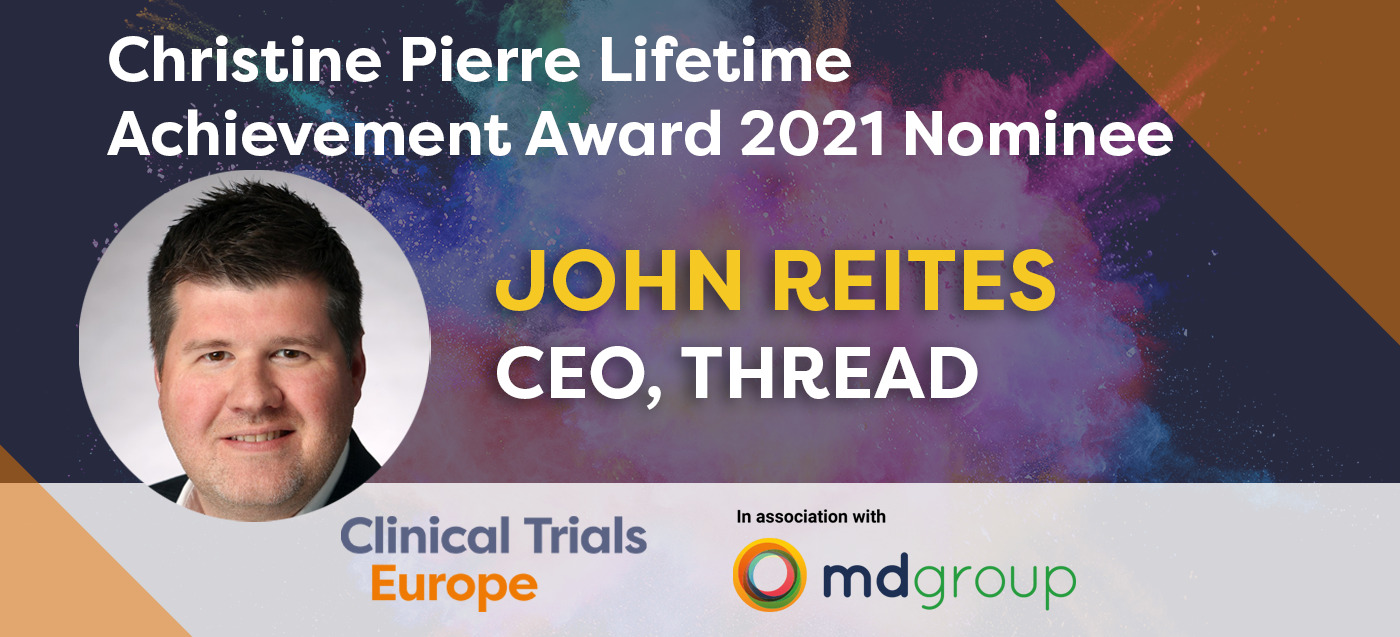
His broader public work follows the same pattern of translation. For more than eight years, he has served as an executive in residence connected with Duke University's Master of Management in Clinical Informatics program. His personal biography lists more than 100 appearances at global events, including SXSW, CES, Apple and AWS re:Invent. In 2016, Onalytica placed him on its list of 100 digital health influencers. In 2021, he was shortlisted for the Christine Pierre Clinical Trials Lifetime Achievement Award.
The résumé is substantial, yet his memorable anecdotes keep returning to beginner status: the biology grade, the practice interview, the paper files, the participant who discovers his own store. It is an effective way to talk about innovation because it removes the costume. New systems often begin with an experienced person becoming willing to feel inexperienced again.
The Reites product index
Editorial index based on the themes Reites emphasizes in public interviews, not a company performance measure.
A cautious relationship with the new
Reites now applies that posture to artificial intelligence. He has described his position as cautious and measured, a useful phrase in a market where caution is often mistaken for lack of imagination. His public writing focuses on narrow jobs with visible outcomes: summarizing stakeholder voice responses, exploring data through conversational interfaces, drafting study materials and guiding qualitative interviews. The test is not whether a feature can be called AI. The test is whether a study team will use it and whether it improves the work without damaging quality.
That emphasis has become visible in THREAD's product news. The company began developing AI-supported tools around patient voice data in 2020, launched new patient-insight tools in 2023, expanded generative AI capabilities through Amazon Bedrock in 2025 and introduced an AI Moderator for qualitative interviews in March 2026. In July 2026 it announced an adaptive-trials solution for complex cohorts and multi-arm designs.
The thread running through these releases is configuration. A platform has to accommodate variation without turning every variation into a new software project. That is a founder's version of the old operator's desire: fewer disconnected handoffs, fewer reasons for a site to invent a workaround, and more room for the study design itself.
Inclusion, with a microphone
In 2025, Reites launched Inclusion Criteria, an independent podcast about clinical research. The name is an industry term with a second life. In a protocol, inclusion criteria define who may enter a study. In a media project, the phrase becomes an invitation to widen the conversation. Reites describes the show as non-corporate and focuses it on the people, career paths and ideas behind treatment development.
Hosting suits his stated preference as an audible learner. It also gives the executive a format built around questions rather than announcements. Episodes and clips have covered research-site networks, scientific publishing, practical AI and the human element in research. He has also co-hosted Clinical Research Evolved, another long-form conversation series about changes in the field.
There is a small consistency in all this. The young employee answering calls learned by listening to sites. The product leader gathered feedback from participants and advocacy groups. The CEO now records conversations with researchers and operators. The technology changes. The method does not: listen closely enough to find the unnecessary difficulty.
The work after the question
Reites's career offers an unfashionable lesson about disruption. Deep change can come from staying with a system long enough to know which constraints are real. He did not arrive with contempt for clinical research. He was drawn to its purpose, learned its operations and then became increasingly unwilling to accept avoidable burden as the price of seriousness.
The aspiration on his personal site is direct: help make global clinical research digital, inclusive and less costly. THREAD phrases its purpose as enabling studies for everyone, everywhere. Those are large aims, but Reites's stories keep giving them a smaller unit of measurement. One participant who can complete a task without another trip. One coordinator who can work from one platform instead of several. One technology that does its job quietly.
The practice interview opened the door. The paper files supplied the education. The participant experience rearranged the view. Everything since has been an attempt to connect those observations without sanding off their complexity. Reites still asks why the machinery works as it does. The difference is that he now has a company, a patent record, a classroom and a microphone with which to pursue the answer.