Doug Pierce used to sell paper forms to medical practices. Before that, he taught English. Neither occupation sounds like the obvious preparation for a clinical technology company, but the forms business gave him a useful education: people will abandon an old tool while continuing to miss the things it did well.
As customers moved to electronic medical records, they asked whether Pierce could reproduce the convenience of his paper forms on a screen. He developed a tablet prototype. A family connection brought it to the attention of Dr. Tommy Littlejohn, who saw an application in clinical research. Clinical ink’s origin was less a love affair with gadgets than an encounter between a familiar interface and an expensive administrative habit.
- Capture trial observations electronically where they happen.
- Check missing or inconsistent entries while correction is still practical.
- Combine assessments, consent, and device data around a study’s needs.
- Make room for the workflows sites actually use.
The number that had to travel twice
A clinical trial needs reliable observations. In a paper-source workflow, a clinician records information during a visit; someone subsequently transcribes the required values into an electronic database. A monitor then checks whether the two records agree. The database may be electronic, but the route into it contains a small clerical relay race.
Clinical ink’s Direct Data Capture moves entry to the encounter itself. Protocol-specific forms run on an electronic device, and edit checks can flag omissions or inconsistencies while the participant is still there. A missing answer discovered immediately has a very different cost from one discovered after the visit. The product’s argument depends on that difference in timing.
That distinction matters. Removing transcription can remove the need to compare a copied value with its original. It does not prove that the original measurement was taken correctly, or that the protocol was followed. Clinical ink changes the information path; investigators and sponsors remain responsible for the research conducted along it.
Paper was a formidable competitor
Pierce’s early challenge was adoption. A pen offered familiarity without a training session. The company designed SureSource to preserve some of that freedom, including handwritten annotations. In 2014 he put the problem bluntly: “[Paper and pen] works really, really well.” A product asking clinicians to surrender that convenience had to offer more than an attractive screen.
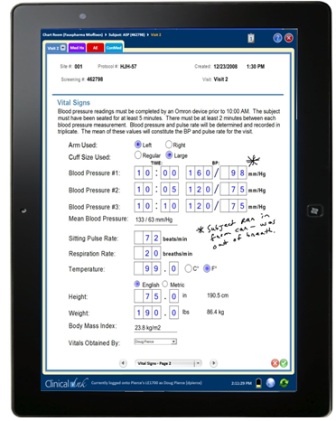
Evidence helped the pitch. SureSource’s work in a tuberculosis trial in Tanzania and South Africa earned a 2014 study-design award. The reported benefit was practical: remote access to source records reduced administrative travel. An elegant idea had found a setting where distance made every unnecessary handoff more expensive.
For builders outside clinical research, the lesson travels well. Watch where users copy information, then ask why. Preserve the useful parts of the old interaction. An unfamiliar device becomes easier to justify when it removes a recognizable task. Novelty is an expensive substitute for that explanation.
The paperless company lets paper back in
In August 2024, Clinical ink introduced EDCXtra, a web application combining Electronic Data Capture, Direct Data Capture, electronic clinical outcome assessments, and electronic consent. Its revealing feature is hybrid operation: a site can enter case-report data directly, or transcribe paper records later.
The launch statement explains the decision in terms of site flexibility. Megan Petrylak, then executive vice president of clinical operations, said the company wanted to improve the site experience with a single flexible EDC/DDC solution. It would be speculative to call this an admission of defeat. A more useful reading is that reducing system fragmentation became part of the proposition, alongside reducing transcription.
“We developed EDCXtra to improve the site experience by providing a single flexible EDC/DDC solution.”
Megan Petrylak · EDCXtra launch, 2024
The platform’s product page reports up to 20% less site workload, 40% fewer queries, and 38% less monitoring time. Those are company-reported figures, rather than promises for a particular study. A buyer’s question should be which workflow and baseline produced them. If a trial continues to transcribe paper, it cannot expect every benefit associated with eliminating that step.
Fewer queries, according to the product page. A procurement conversation should establish the comparison behind the figure.
A home is also a research setting
The expansion beyond investigator forms was deliberate. In 2015 Clinical Ink merged with CentrosHealth, which supplied mobile patient-engagement and reporting tools. Contemporary reporting described at least $9.8 million in equity and stock exchanged alongside financing. That figure includes merger consideration; treating it as a simple cash fundraising round would flatten a more complicated transaction.
The users now include patients and caregivers as well as clinicians. In a four-study neurology program described by Clinical ink, pandemic anxiety slowed enrollment and threatened participation. The sponsor moved questionnaires from research sites to participants’ homes using remote ePRO. The customer is unnamed, so the instructive detail is the change in workflow: move a task that need not require a clinic visit.
Remote research still needs an honest account of physical work. In another company case study, a late-stage infectious-disease trial involved more than 1,000 older participants across 82 sites in long-term-care facilities. Televisits were unsuitable. Traveling coordinators and nurses collected data using the company’s tools, and the reported deployment took ten weeks. The software traveled to patients with people attached.
When the assessment needs a specialist
A questionnaire about symptoms and a test of cognition pose different design problems. Clinical ink has developed a particular presence in neurology: in April 2021 it reported 16 concurrent Phase II/III Alzheimer’s studies supporting more than 9,000 patients across 25 countries. That is a dated measure of experience, not a current customer count.
Later that year, its acquisition of Digital Artefacts expanded cognitive, behavioral, and physiological measurement, including more than 50 modular, self-administered neurocognitive assessments. The attraction was richer observation: active tasks could sit alongside information from wearables and sensors. Capturing a response is one challenge; deciding what a movement or behavioral signal means is another.
The partnership roster exposes the surrounding work. Cogstate contributes cognitive science and rater training. Perceptive Imaging supplies imaging expertise. Mural Health addresses participation logistics, including payments and travel. eClinical Solutions maintains a Snowflake-based integration. These relationships show how much a clinical data product depends on disciplines beyond form design.
The sensor gets to ask a question
GlucoseReady makes the disease-specific approach tangible. It brings continuous and blood glucose monitoring together with electronic assessments and connected-device data. Following a detected hypoglycemic event, it can prompt a protocol-defined patient questionnaire. The reading and the patient’s account can then be collected close together, rather than relying entirely on later recollection.
In December 2025, Clinical ink announced a collaboration with Tandem Diabetes Care to bring automated insulin-delivery data into GlucoseReady. Participants who opt into a study can have basal and bolus insulin data transmitted from supported Tandem pumps. The opportunity is to examine treatment delivery, glucose measurements, and patient reports within the same research environment.
SPUR tackles a different gap: why someone may stop following treatment. Its questionnaire evaluates social, psychological, usage, and rational factors, then supplies adherence-risk information and communication guidance. In January 2026, Clinical ink announced an exclusive perpetual license from Observia for US cardiometabolic disease management. Software that records behavior was acquiring a role in supporting it.
From the study protocol to ordinary care
April 2026 brought Kaitality, an announced app combining personalized adherence support with weight, body-composition, and activity measurements for people receiving obesity therapies. Clinical ink said observational studies would precede wider patient-support and payer use. That sequence matters: experience in research provides a starting point, while usefulness in everyday care still needs demonstration.
The commercial core remains software and supporting services for sponsors and contract research organizations. Study builds, integration, and operational support make this a purchasing decision involving a protocol and delivery requirements. Buyers should compare the cost of implementation with the transcription, query resolution, monitoring, and participant work they expect to change.
GI Partners acquired Clinical Ink in 2020 and continues to list it in its portfolio. Its market is crowded. Medidata Rave also offers source and health-record integrations, alongside a broader clinical platform. The sensible comparison is therefore study-specific: which vendor handles the required assessments, devices, site practices, and review process with the least avoidable work?
Clinical ink’s story offers a useful procurement test. Follow one observation from patient to analysis. Count the people who re-enter it, the systems it crosses, and the delays before someone can challenge it. Then ask what the proposed software actually removes. A copied number is a small thing. A trial contains rather a lot of them.
Follow the work
Explore Clinical ink, EDCXtra, GlucoseReady, and the Kaitality announcement.
Find company updates on LinkedIn, X, Facebook, and the insights library. Watch Doug Pierce’s Startup Grind conversation or browse the company’s YouTube videos.