Fourteen sources of data sound like a useful possession. In Amnet Digital’s account of a US retailer, they were also a problem. Point-of-sale records, online orders, campaigns, loyalty information and customer conversations lived apart. The business had information in abundance. Getting that information to describe the same business was the harder job.
Amnet says it joined those fourteen sources into a governed data architecture in six weeks. Buying intent could then be surfaced daily; the company reports a double-digit improvement in campaign return on investment during the first quarter. The interesting number is fourteen. It gives the problem a shape. Before anyone could make a better recommendation, someone had to arrange for the systems to agree.
- The job: connect enterprise data, build AI systems and put decisions into working software.
- The buyers: large organizations with complicated systems and expensive operational delays.
- The proposition: proprietary platforms backed by the engineers who implement them.
- The useful lesson: decide what should change in the business before choosing the AI demo.
Fourteen systems enter the room
Amnet Digital occupies an easily overlooked part of the AI market. It provides the engineering that makes an attractive demonstration useful inside a business. Its services extend from data pipelines and machine learning to cloud infrastructure, interfaces and testing. The customer can ask for help with a forecast, a migration or a software product; the work can reach well beyond the model that supplies the answer.
This is why the retailer’s predicament makes such a good introduction. A sale recorded online and a sale recorded in a shop must enter a common account of the customer. A marketing team and a finance team need a definition of revenue they can both use. Otherwise, a confident answer merely adds another voice to the meeting. Confidence is easy to admire when nobody checks the arithmetic.
Six-week retail integration, according to Amnet’s published case study. A reported project result, rather than a delivery promise for every customer.
The machinery beneath the answer
Amnet Data Foundry addresses that preliminary work. Its agents discover schemas, map records, build pipelines and monitor quality. The platform also handles lineage: the trail that lets a buyer follow a number back to its origin. Entity resolution brings records about the same customer, product or account together. These are modest-sounding chores with considerable power to spoil a project when neglected.
The organizing idea is a Medallion architecture. Bronze preserves the raw material. Silver cleans and conforms it. Gold expresses the business models and measures that people actually use. A semantic layer supplies business-friendly definitions. The metals are a pleasing flourish for a process whose virtue is rather less decorative: an executive should be able to ask where an answer came from.
The product’s pitch is faster implementation with less manual engineering. That claim deserves a buyer’s own test. A useful demonstration would take a sample of the buyer’s data, expose the exceptions and show how a disputed metric gets resolved. A pipeline that behaves beautifully on clean sample records has enjoyed a remarkably considerate audience.
The dashboard acquired a pair of hands
Amnet’s earlier Swift Insights offering concentrated on analytics. Its January 2024 public launch announcement described predictive and prescriptive reports, centralized report management and language-model-based questions about business data. The promise was to make the business easier to understand. Its newer Amnet Agent Foundry moves further into what happens once that understanding arrives.
Agent Foundry monitors signals, reasons about context, recommends actions and executes approved workflows in systems such as CRM and ERP. Its published design includes policies, evidence, audit trails and configurable human approval. That last detail matters. Changing a field in a customer record and changing a commercial strategy do not deserve identical permissions.
An answer becomes an operating decision when somebody gives it permission to act.THE QUESTION BEHIND THE PLATFORM
Consider an illustrative retail decision: whether to change a promotion. The inputs might be sales, stock and customer response. The recommendation then needs to fit the company’s rules, reach the person allowed to approve it and enter the system that runs the offer. Amnet’s architecture connects those steps. This example explains the design; it is not a reconstruction of a named customer’s workflow.
The evolution is visible in the catalog: analytics, then data foundations, then governed agents. Reading it as a move toward operational responsibility is an interpretation of the product sequence. It is also the company’s current commercial argument. The deliverable increasingly includes the action after the report, and the controls around that action.
Five thousand hours, one missing clip
The same problem takes a different form in media. Amnet describes building an AI-powered digital asset management system for an information-management business with more than 5,000 hours of video. It reports 90 percent faster asset discovery. Transcription, optical character recognition, face and object detection, and generated summaries helped make the material searchable.
Its DAM offering also includes proxy playback, clip creation and access controls. These features describe the actual task more clearly than the phrase “AI-powered” does. Somebody needs to find a passage, inspect it, extract it and share it with the right people. A vast archive can be an impressive possession and an irritating workplace at the same time.
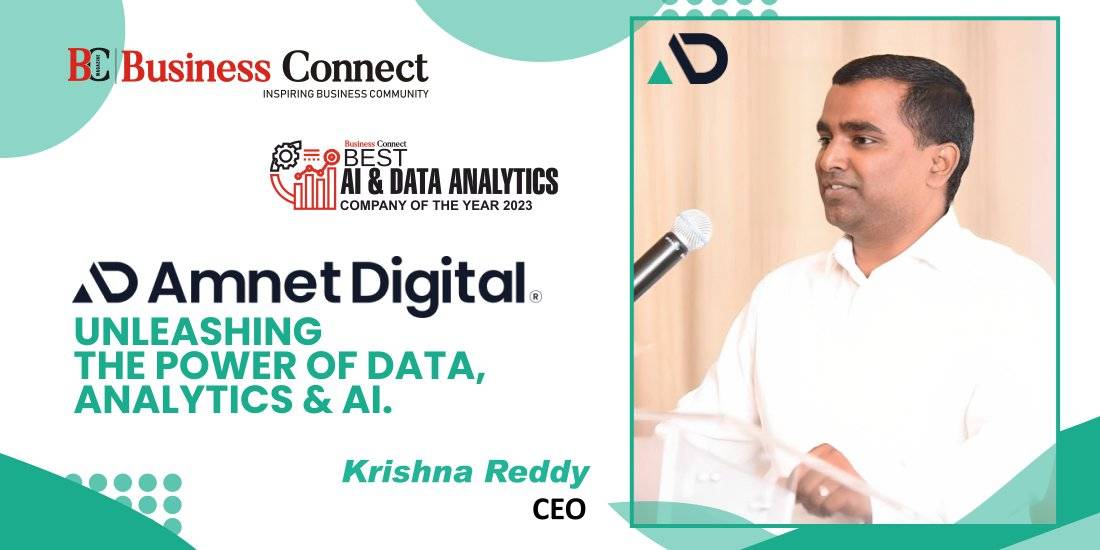
Reddy, Amnet’s founder and CEO, has expressed the ambition plainly: “Our purpose is to make a positive business impact that matters.” The test of that ambition is wonderfully concrete in an archive. Can a person retrieve the needed clip sooner? The minutes saved are easier to understand than another promise about transformation.
Buying the joins, not just the boxes
Amnet’s business combines enterprise services with its own products and accelerators. A buyer is purchasing engineering and implementation capacity as well as software capabilities. Its service portfolio covers AI, analytics, product development, cloud, DevOps, quality assurance and consulting. The proposed advantage is continuity: the team building the data foundation can also help build the application that consumes it.
AIDLC, its AI Development Lifecycle methodology, supplies the delivery discipline. It runs through strategy, architecture, building, validation, deployment and ongoing evolution. The validation work includes groundedness, hallucination detection, business-rule compliance and reliability. A system that produces a sensible answer once still has to operate when inputs, users and models change.
The alternatives depend on the job. Swift Insights sits beside analytics products such as Tableau, IBM Cognos and Zoho Analytics in LinkedIn’s product directory. A broader Amnet engagement competes with an internal team or a consultancy assembling a solution from other platforms. Comparing only dashboard features would miss much of what its engineers are being hired to do.
Costs should be examined at those joins. Implementation effort, cloud consumption, ongoing evaluation and human review all belong in a buyer’s calculation. Faster engineering can improve the economics; elaborate approvals can consume the time saved. The sensible comparison is a scoped operating result, with its running costs attached. A short build time tells only part of that story.
Choose the decision before the demo
The practical lesson can be copied without buying anything. Pick one recurring decision. Identify the records it needs. Agree what the relevant measures mean. Name the person who owns the result and the person who may authorize an action. Then measure a change people can recognize: time to retrieve an asset, time to approve a workflow or the performance of a campaign.
This approach depends on access to the underlying systems and a business willing to settle its definitions. If departments cannot agree what counts as a customer, automation will inherit their quarrel. If every recommendation waits in an unattended approval queue, execution will remain slow. Amnet’s emphasis on governed data and controlled action makes those organizational questions part of the product conversation.
That is what makes the fourteen-source retailer worth remembering. The revealing step was the creation of a shared account of the business. Only then could the business ask better questions of it. Enterprise AI acquires much of its usefulness in these ordinary negotiations over records, rules and responsibility. The machinery may be new. The need to agree what happened is very old.
Amnet Digital · Data Foundry · Agent Foundry · AI-Powered DAM · AIDLC