Consider a $100 gift card for a shop you never visit. The number is precise. Its usefulness is another matter. You cannot pay the electricity bill with it. Someone else, however, shops there every month. Give that person a discount, give yourself cash, and suddenly the unwanted present has somewhere to go. Raise began with this small mismatch between the value printed on a card and the value of actually being able to spend it.
- Sell the mismatch. GCX matches unwanted gift cards with buyers seeking a discount.
- Buy for yourself. Raise rewards everyday spending through digital gift cards.
- Go behind the counter. Its business API puts gift cards inside other companies’ rewards programs.
The grocery-store education
George Bousis came to the problem through his family’s grocery business. In a 2017 interview, he described working on technology and loyalty there, researching a gift-card program, and noticing the money sitting unused on other people’s cards. He launched Raise in 2013. His earlier experience included professional esports. The combination is pleasingly practical: someone accustomed to both checkout lines and computer systems found a problem involving both.
The original transaction was straightforward. A seller supplied the merchant, card number, PIN when required, balance and asking price. A buyer got spending power for less than its face value. Raise supplied the meeting place. The difficult work sat underneath: verifying balances, supporting redemption and deciding who paid when a card did not work.

A discount has two sides
The seller’s arithmetic deserves as much attention as the buyer’s bargain. GCX’s seller table, updated October 21, 2026, lists a 15% commission and a $0.30 listing fee for new sellers. Higher-volume sellers have different terms. That means the discount on the card and the cost of selling it are separate deductions.
Imagine listing a $100 card for $90. A 15% commission on that selling price is $13.50. Subtract the $0.30 listing fee, and the simplified net is $76.20. This is an illustration using the published new-seller rates, before any other applicable adjustments. It explains why a card can be attractive to a buyer while still requiring a meaningful concession from its owner.
There are operational limits, too. GCX says some brands cannot be listed because their balances cannot be verified. Its seller-accountability policy allows buyer refunds and seller debits when cards fail its guarantee standards. Liquidity has a price, and somebody still has to check the money.
Two apps, two shopping habits
Raise Marketplace became Gift Card Exchange, or GCX, in 2024. Today, the Raise brand also describes a different habit: buying a digital gift card for a purchase you already intend to make, then earning Raise Cash toward another purchase. The barcode or card number becomes the way to pay. A gift card can spend its entire useful life in the hands of the person who bought it.
An October 7, 2026 help notice makes the division explicit. Cashback purchases are due to move from GCX Pay into Raise. Discounted marketplace cards, stored cards and remaining GCX Cash stay with GCX. The balances cannot be transferred between the products. Raise Cash expires 180 days after earning it.
For a shopper, the sensible experiment is small: choose a familiar retailer, check the redemption rules, and buy against an existing shopping list. An extra purchase made to earn a reward changes the arithmetic. So does forgetting the balance. A rewards balance is useful only when it turns into something you wanted.
The customer you never see
The less visible business sits inside someone else’s product. In February 2025, Raise announced that Bilt Rewards members could exchange points for gift cards through its API, following a January start. The integration included balance inquiries, transaction histories, cancellations and wallet features. Bilt brought the relationship with its members; Raise supplied the gift-card machinery.
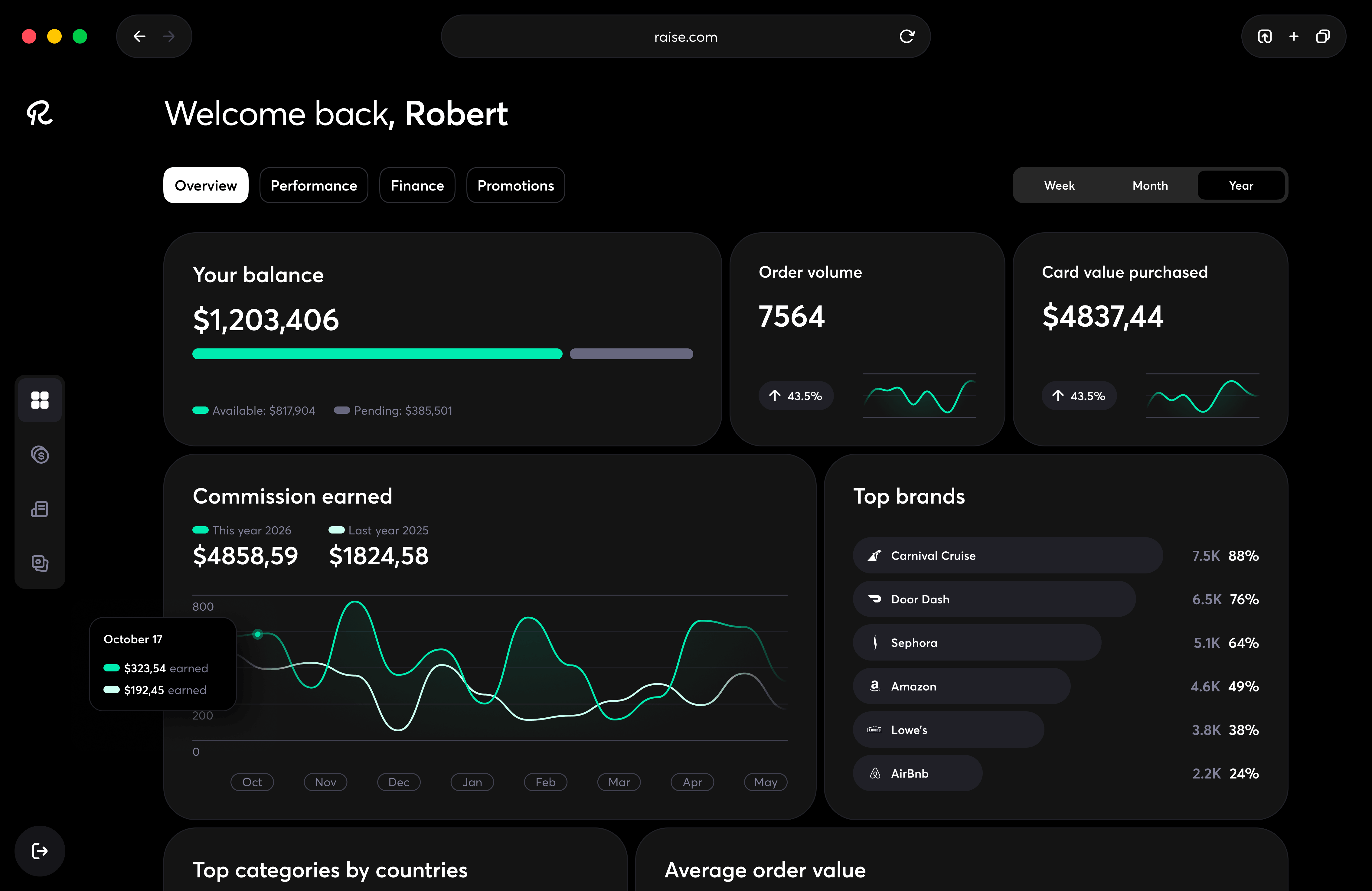
That arrangement explains Raise’s place in the market. CardCash offers another route to sell unwanted cards; Gift Card Granny competes for shoppers looking for gift-card value. On the business side, Blackhawk Network and InComm Payments occupy the broader distribution and payments market. Raise spans the consumer bargain and the software integration. Its business page offers a global catalog of more than 2,000 brands, distinct from the consumer storefront’s catalog.
Raise reports more than seven million members on its website. That is a membership figure, rather than a measure of how many people shop each month. Likewise, the more than $5 billion in cumulative transactions it announced in February 2025 describes activity across its businesses. It is not company revenue.
The expensive part was underneath
Building that position required outside capital. In September 2017, Accel led a $60 million Series C with PayPal, NEA and Bessemer participating. The stated use was expanding a closed-loop mobile payments network. In February 2025, Haun Ventures led a separate $63 million round tied to blockchain gift cards and loyalty infrastructure. These are financing amounts, not the price of building a comparable company.
“We wanted to tokenize gift cards but faced issues with transaction speeds and gas fees.”
George Bousis / Cryptonews interview, 2024
That account identifies an early technical obstacle: moving a familiar retail balance onto infrastructure whose speed and fees could undermine an ordinary purchase. In the 2025 funding announcement, Bousis pointed to improved technological maturity and the regulatory environment as reasons to proceed. SmartCards represent the ambition to make those balances programmable. The investment demonstrates commitment; it does not establish that fraud or checkout friction has disappeared.

The merchant proposition follows the same logic: a gift card commits spending to a particular brand. The reward gives the shopper a reason to make that commitment. The test is whether that incentive produces a purchase both sides consider worthwhile.
Follow the stranded dollar
Another founder can copy the sequence without copying gift cards. Find value customers cannot readily use. Make the exchange understandable. Charge enough to handle verification and support. Then ask whether an established business needs the same mechanism inside its own product.
The conditions matter. Buyers need merchants they will use; sellers need proceeds worth accepting; partners need dependable issuance and redemption. Without those, a larger catalog simply creates more stranded balances. Raise’s most interesting move is following the same dollar from an unwanted present to an ordinary checkout - and offering to run the machinery along the way.