At first, the computers kept dinging. Nick Baum and his co-founders had installed software that made a sound whenever someone visited GiftRocket, their new gifting website. A TechCrunch launch brought a morning chorus. Then the intervals grew longer. Within a month or two, Baum later recalled, they were selling one or two gifts a day. The speakers had become a rather expensive way to hear silence.
- Tremendous turns business rewards into a single sending workflow.
- Recipients choose from locally available cards, cash options, and donations.
- No platform subscription; monetary payouts and credit-card funding can carry fees.
The company that emerged from that quiet period now helps organizations distribute research incentives, referral rewards, employee gifts, and nonprofit grants. Tremendous sits between the organization promising a payment and the person choosing how to receive it. Its appeal is easy to underestimate: a thank-you that does not become somebody’s afternoon.
The customer who came back
GiftRocket’s original proposition was personal. You could suggest a business somebody might enjoy while giving them money they could ultimately redeem as cash. Baum and Kapil Kale had started with gifting. What eventually caught their attention was the less sentimental customer.
Businesses were using the consumer site to pay individuals in bulk. A research firm compensating survey participants had a recurring operational problem. A birthday shopper had an occasional errand. The same underlying payment could belong to two quite different businesses, depending on who needed to send the next one.
The consumer business grew slowly but became profitable. Baum says its profits financed Tremendous’s business launch in 2018. The founders had raised $500,000 for GiftRocket; the company says they bought out the original investors in 2013. The useful lesson is specific: inspect the customers who keep returning, especially when they are doing something your homepage barely mentions.
A hundred dollars, 109 countries
Consider Atlassian. Its researchers interview people around the world and typically offer a thank-you worth about $100. Its research operations team sometimes receives little more than a name and an email address. Someone still has to determine which reward works, in which country, in which currency.
Atlassian’s published customer story describes payouts across 109 countries. Tremendous handles the local menu and currency conversion; the recipient chooses among the options the sender permits. The administrator can track rewards and pull reports without asking a vendor to prepare everything.
“It had to be simple”Sarit Geertjes · Atlassian research operations
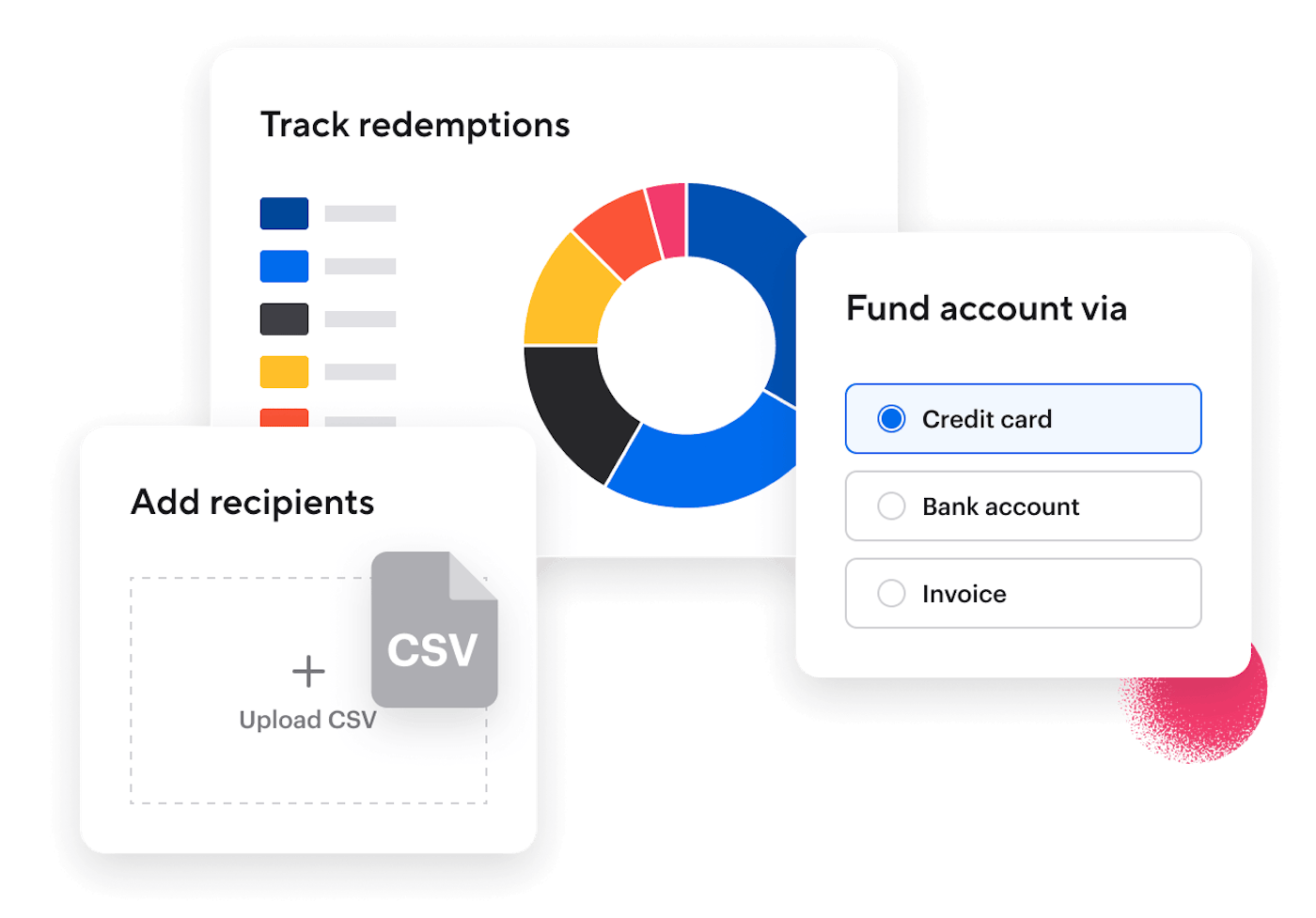
That is the product in miniature. Teams can upload a recipient list, work through the dashboard, connect an existing application, or use an API. Behind the send button sit branded delivery, redemption records, approvals, and support. The expertise lives in connecting payment methods to a repeatable business process.
Free has a footnote
Tremendous charges no platform subscription. Its pricing page says it makes money through relationships with reward brands, including Amazon.com and Visa. Gift cards, prepaid cards, and donations can be sent at face value. Monetary options generally carry fees of 4-6%, depending on the option and who absorbs the charge.
Here is an illustrative budget: 100 rewards of $50 equal $5,000. For eligible fee-free rewards, that is the sending cost. At a sender-paid PayPal fee of 4%, add $200. Funding by credit card generally adds a separate 3% processing charge; eligible bank funding avoids that charge.
Sender-paid PayPal example. Funding charges excluded.
The competitive pitch follows from that structure. Against rewards providers such as Blackhawk Network and Virtual Incentives, Tremendous emphasizes one platform, recipient choice, and no subscription. A buyer still needs to compare the actual payout mix. A program built around bank transfers faces different economics from one built around gift cards.
The thank-you needs a brake
Convenient payouts introduce another problem: people who should not receive them. At CUNY’s Institute for Implementation Science in Population Health, researchers had used physical cards and digital Amazon codes. Tracking and auditing them involved manual work. After adopting Tremendous, the institute integrated its API in 2024 so completed study activities could trigger incentives.
Fraud alerts added another checkpoint. CUNY’s published account estimates $40,000 saved through the fraud features and describes stopping an attempted $7,500 claim. These are customer estimates, rather than a promise that every study will save the same amount. The researchers continued using their own checks alongside the payout tools.
Notion illustrates the other side of automation. Its community team needed to send small grants for local gatherings. Manual international payments became messy. Former community head Ben Lang estimated that Tremendous helped the program scale fivefold. An Airtable field, connected through Zapier, could trigger the grant.
There is a practical sequence to copy here: decide who qualifies, establish approvals, then automate delivery. Faster money cannot repair a poorly screened survey. Nor does a global catalog mean every payment method is available everywhere. Local availability, verification requirements, and the recipient’s preferences still matter.
A company that bought itself time
Tremendous’s ownership helps explain its pace. Since the investor buyout, it says the company has belonged to founders and employees. Its working culture favors written briefs, autonomy, and few meetings. The team is fully remote, with semiannual offsites bringing people together.

In July 2026, the company published guidance on maintaining research-panel quality as AI makes fabricated responses harder to spot. It is a revealing subject for a rewards provider: delivering the incentive and deserving the incentive are separate questions.
The business began by noticing that a gift could be something else in the hands of a repeat customer. Today, the same observation travels well beyond research. A community organizer, a marketer, and a nonprofit administrator may all need to move a modest amount of money without creating a large amount of work. Tremendous built around that mismatch.