The gift card has an image problem. It arrives in an envelope, apologizing for the giver’s lack of imagination. Fluz gives it a less sentimental occupation: getting a shopper through checkout while returning a little money. Buy a digital card for a merchant you were already going to use, pay with it, and collect cashback. The object is familiar. Its job description has changed.
- For shoppers: gift-card cashback, virtual cards, and rewards linked to friends’ purchases.
- For businesses: controlled team spending, procurement rewards, and bill payments.
- The useful habit: compare the reward with the funding fee before pressing buy.
The gift card leaves the envelope
Fluz sits between a merchant’s desire for customers and a customer’s desire to keep more cash. Retailers pay for the sales Fluz brings them; members receive a share. In its September 2026 account of the model, the company identifies merchant marketing budgets as the source of those rewards. That makes cashback a customer-acquisition expense with a particularly agreeable recipient.
The simplest transaction is a digital gift card. Pick a participating brand, inspect its current offer, choose a funding method, and redeem the card at that merchant. Fluz advertises gift-card rewards up to 25%, but that ceiling is an offer-dependent maximum. Buying groceries and buying a promotional gift card are not automatically the same bargain.
The sixth checkout, and the first conviction
Maurice Harary says development began in 2016; Fluz’s corporate announcements date the company to 2018. Its consumer launch followed in September 2019. In a 2022 interview, he identified Nike joining as the moment the idea gained credibility. He also acknowledged an early omission: building the business had displaced the work of establishing company values.
The product demanded its own education. Harary’s 2020 stakeholder letter describes rebuilding the payment journey for the sixth time after listening to customers. He presents those revisions as improvements, rather than six catastrophes. Still, the detail is revealing: a generous offer must survive the small indignities of checkout. Every unfamiliar step asks the shopper to reconsider.

“this year, we rebuilt the payment journey within the app for the sixth time.”Maurice Harary · 2020 stakeholder letter
The party has a purchase target
Fluz’s social mechanism makes the cashback business more peculiar. Referrals can produce royalties when connected members shop, with earnings extending through as many as five degrees of connection. This is spending-dependent income. An address book, however magnificent, does not by itself generate cash.
The company’s historical example puts the scale in perspective: its roughly 50-cent monthly figure per active network member used an average $163 in spending and a 0.3% gift-card royalty rate. Other transactions can carry lower rates, and actual results vary. Read the example as arithmetic with assumptions, rather than a salary offer.
Fluz Parties add a collective target. A timed event starts with boosted cashback; enough group spending unlocks an additional bonus. Bath & Body Works’ Candle Day supplied a ready-made occasion. Fluz reports that event gift-card sales grew 147% across the 2023-2025 events, and that the 2025 week supplied 23% of the brand’s annual volume on Fluz. These are company-reported platform results, not the retailer’s overall sales.
The transferable idea is modest: attach the reward to an occasion customers already recognize, then give participation a shared consequence. Instacart’s seasonal campaigns offer another example. Fluz reports 126% growth in that brand’s gift-card volume from 2024 to 2025. Such results support another experiment; they do not isolate cashback from every other influence on demand.
A reward is only as good as its arithmetic
Joining Fluz is free. Funding a transaction can cost money. The published payment table lists no fee for ACH gift-card purchases, but a 3% fee for credit-card purchases. Debit-card charges depend on card eligibility and account type. “Free to join” answers one question; it leaves the checkout calculation to you.
Assumes the same 5% gross offer and a fee equal to 3% of face value. Excludes credit-card rewards and interest. Actual checkout terms govern.
For a hypothetical $100 card offering a $5 gross reward, a $3 funding fee leaves $2 before any separate card rewards. Stacking can help: merchant coupons, loyalty benefits, and eligible shopping-portal rewards may coexist with gift-card payment. Eligibility matters. A portal that excludes gift-card-funded purchases removes one layer; credit-card interest can overwhelm the entire pile.
Buy against a real shopping list. Most Fluz merchant gift cards are valid only in the United States and are non-refundable. International registration does not make every card useful abroad. A reward on money trapped at the wrong merchant is an unusually elaborate way to save nothing.
Your bank stays. The controls arrive.
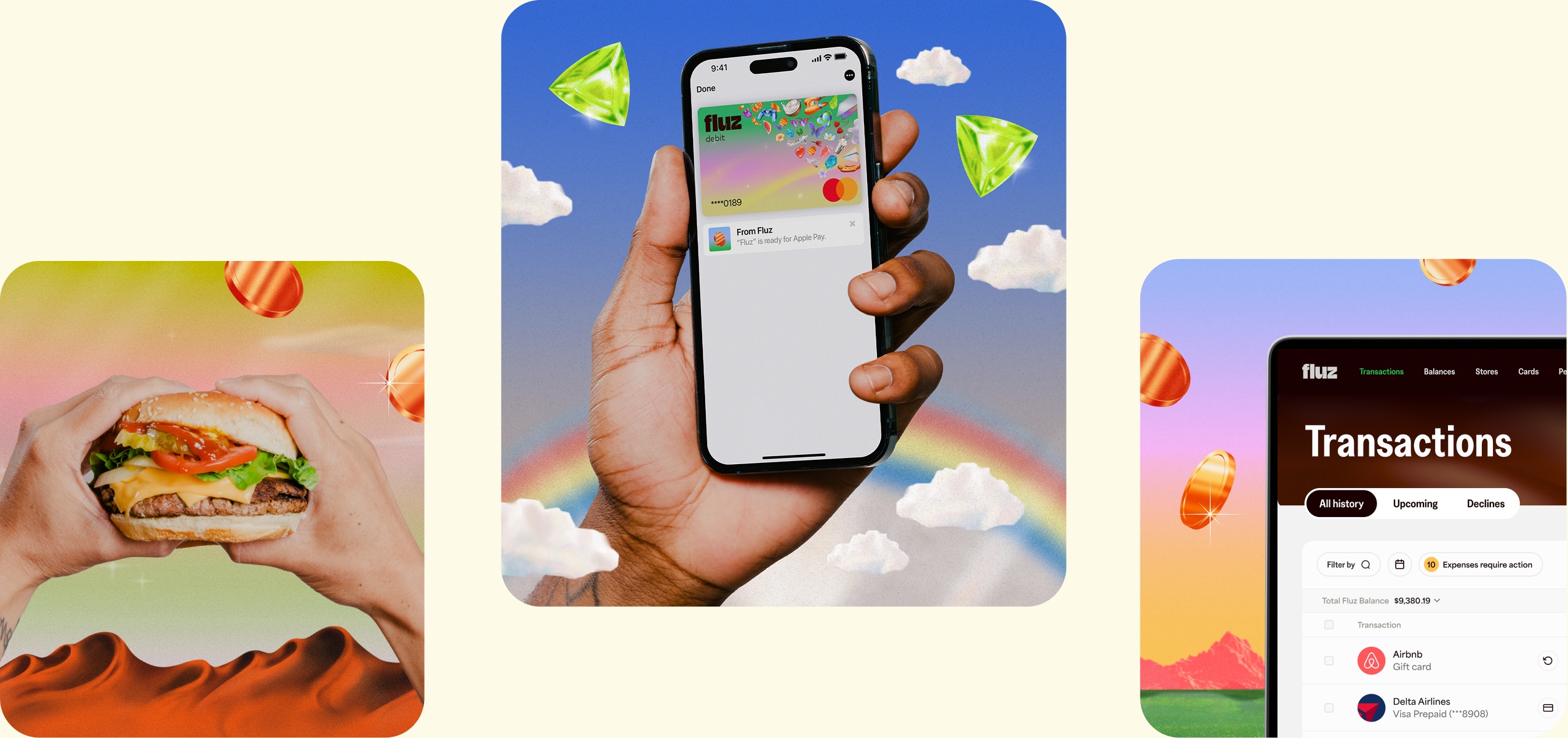
Gift cards explain the origin. Virtual cards explain the broader ambition. Fluz advertises 1.5% instant cashback, subject to merchant terms, on Mastercard virtual cards funded from a linked bank account or Fluz balance. A customer can keep an existing bank while adding a different payment instrument. Online acceptance follows Mastercard; in-store use depends on Apple Pay or Google Pay acceptance.
Merchant locks, single-use settings, spending limits, and scheduled freezes make those cards useful beyond rewards. A trial subscription can have a card that freezes before renewal. A supplier can have a dedicated spending limit. Blocking a charge does not cancel the underlying contract, but it gives the payer a concrete control.
Business accounts extend the arrangement to shared budgets, permissions, procurement, and a unified ledger. Fluz names customers including Vida Shoes International and WE-BRU Cold Brew Coffee. Travel cards address another specific nuisance: matching cardholder details to a client’s booking, with advertised 2.5% cashback at eligible merchants.
The checkout becomes someone else’s infrastructure
In February 2026, Fluz announced an embedded platform for software companies: pay-ins, wallets, controlled spending, rewards, and disbursements inside their own products. Its market now touches consumer alternatives such as Rakuten and Ibotta, business spending tools, and payment infrastructure vendors. Those are overlapping contests, each with different customer expectations.
Fluz reports more than $5 billion in processed payments. Payment volume is not revenue. Its practical proposition remains smaller and easier to test: route an expense you already have through a suitable offer, retain control, and count the cash left afterward. The gift card has found employment. The shopper should still check its wages.