A bouquet has an uncomplicated destination. Someone buys it, someone carries it across a city, someone opens the door. Hatem Kameli began Resal in that recognizable world, helping people in Jeddah send flowers and gifts. The business that followed would ask a more awkward question: what happens when the gift is a balance, a code or a collection of points, and the recipient would rather spend it somewhere else?
It is a long way from petals to payment infrastructure. In Kameli’s career, though, the route has a certain continuity. Before Resal, he worked with enterprise technology, digital marketing and customer analytics. He had experience with the systems businesses operate and the customers those systems are supposed to serve. A gift brought those two interests together in a pleasantly ordinary transaction.
He co-founded Resal with Fouad AlFarhan in 2016. A soft launch in September preceded formal operations in February 2017. Years later, the company would describe its progression with the economical phrase “From Flowers to Fintech.” A bouquet, it turns out, can be the first item in a rather complicated technical specification.
The distance between two doors
The earliest proposition was local and tangible: order a gift online and have it delivered. Resal offered flowers, other presents and even flower subscriptions. Its early web and mobile experience was Arabic. The founders were applying digital convenience to a familiar social habit, with Jeddah as the starting point.
By January 2018, Resal had announced a seed investment described as a six-figure dollar deal. Kameli said the service had reached 17 Saudi cities. The business was expanding the geography of a simple promise: a sender should be able to arrange a thoughtful gesture without personally managing every stage of its journey.
That promise contains several jobs. A customer sees a gift; the business has to coordinate availability, ordering and fulfillment. Read this way, Resal’s early years were already an exercise in connecting separate participants. Flowers made the result visible. The machinery behind a successful delivery was less photogenic, but it was what allowed the gesture to travel.
- 2016Flowers & gifts
- 2019Digital cards
- 2021Loyalty via Boonus
- 2025Wider payment network
Before the flowers, the systems
Kameli’s professional background helps make sense of this attention to connections. His early career included IT work at Saudi British Bank and technology roles at Saudia, where his responsibilities included enterprise architecture and IT strategy. He later worked in digital marketing and analytics at Gulf International Bank.
His education joined the same two disciplines: information technology at King Abdulaziz University and an MBA in marketing at Al-Faisal University. He also founded iCLICK, a digital marketing business. The combination put technical operations and commercial behavior in the same frame. A system could function perfectly and still leave a customer cold; a persuasive campaign still needed a working business behind it.
His public teaching was practical. In a December 2017 podcast conversation about digital marketing, the subject was how to market a project without wasting money on advertising whose results you could not understand. His listed publications include guides to content marketing, digital strategy, social media analytics and return on investment. Measurement kept appearing beside persuasion.
Learning to listen in Arabic
Lucidya, which Kameli co-founded, brought another version of the customer problem into view. Businesses were surrounded by online conversation. Making sense of it, particularly in Arabic, required more than accumulating mentions. There were meanings, sentiments and local differences to understand.
The company’s early positioning emphasized AI-powered, Arabic-focused social listening. Kameli worked alongside founder and CEO Abdullah Asiri, bringing a digital marketing background to the venture. A 2017 industry profile identified his responsibilities as marketing and business development, while describing technology designed to turn social conversation into usable customer insights.
Arabic itself was part of the commercial challenge. Kameli pointed to the shortage of sentiment-analysis software able to handle the language and its dialects. Lucidya offered a subscription service, with a platform and reports for businesses. He saw that software model as a way to reach additional markets. The important unit of expansion was a service that another customer could access online.
The detail about dialects matters. People rarely phrase their preferences in the tidy vocabulary of a dashboard. They talk as themselves. For a business trying to interpret that conversation, local language capability becomes part of the product. It gives Kameli’s customer focus a specific regional dimension, rooted in the way people actually communicate.
There is a useful connection between listening and loyalty. A business first tries to understand what people value. It then has to decide what to offer them and whether the offer works. Kameli’s ventures occupy different parts of that sequence. Their overlap helps explain why a founder associated with marketing and analytics would become preoccupied with the mechanics of rewards.
A present with fewer logistics
By 2019, Resal was offering digital gift cards. A digital card changed the practical arrangement. The recipient could choose within the card’s terms, while the sender could deliver value without organizing a physical object. The company’s product was becoming less tied to a particular bouquet, shop or doorstep.
That shift also opened up business customers. An employer rewarding staff or a company thanking customers has different requirements from a person ordering flowers. It needs repeatable distribution, a manageable selection of rewards and a way to administer the process. Resal’s glee product addressed corporate rewards and incentives; in 2021 it received an Incentive Awards technology-provider award.
The digital card also introduced a larger question. Once value is represented electronically, somebody must decide how it is issued, where it is accepted and how it is redeemed. The convenient little code is the front end of a set of relationships. For Kameli, those relationships were becoming a business in their own right.

The next customer visit
Resal acquired Boonus in 2021, adding a company specializing in digital loyalty and rewards. The acquisition connected gifting with the recurring relationship between a merchant and a customer. A gift can mark a single occasion. A loyalty program has to give people reasons to return, then make the promised benefit accessible when they do.
In February 2022, Resal announced a Foodics partnership around Boonus. Restaurants and cafés would be able to manage rewards programs and track customer visits through the combined offering. It was a concrete setting for an otherwise abstract ambition: loyalty had to fit the operations of a real business serving real people.
Partnerships with Mastercard added another connection. A 2021 agreement offered Mastercard customers access to Resal’s digital card store and promotions. Another agreement followed in 2024, centered on shopping convenience and benefits for Saudi consumers. These relationships show how the business expanded through links to other networks, with Kameli increasingly working across the boundaries between rewards, retail and payments.
The numbers, with the year attached
In August 2024, Resal closed a $9 million investment round. Investors included Derayah, VentureSouq, Al Wafrah AlThanya, ADDiriyah Asset Management, NOMD and Bugshan. The announced purpose was to expand in Saudi Arabia, enter additional sectors and develop products for alternative payments, loyalty and rewards.
Kameli’s own review of 2024 put the company’s sales growth at 80%. He described 2.5 million people connected with 2,000 organizations, merchants and brands, with services extending across 40 cities and five countries. Those are his reported figures for that year, a snapshot of the network Resal had assembled rather than a permanent description of its size.
August 2024
Reported by Kameli
Reported by Kameli
His language about the organization is revealing too. In a post celebrating workplace recognition, he wrote: “We believe that people should love what they do.” He connected results with employees feeling inspired, empowered and trusted. The annual review ended with the familiar startup insistence that the work was still at Day 1. Even a growing network needs people prepared to keep rebuilding it.
“We believe that people should love what they do.”
Hatem Kameli, on Resal’s workplace culture
Where the points go next
By 2025, Kameli was describing Resal’s ambition as infrastructure for programmable non-cash value. His examples included loyalty points, rewards, vouchers, prepaid products and stipends. The functions he outlined were specific: issuing, routing, converting and redeeming value across organizations, merchants and users.
He also welcomed Sidney Scott as a strategic advisor, emphasizing product, AI and infrastructure experience. The appointment fitted the wider technical ambition. A network handling different types of value needs rules and connections that work across many participants, while preserving the usefulness of the reward at the end.
At Money20/20 Middle East in September 2025, Resal’s announcements included a Runa partnership, Resal Pay and an API-powered micro-loan solution. Kameli described plans to expand a network spanning 10 countries to 60 markets over three years. That was an ambition, with a timetable attached, and a much wider horizon than the original Jeddah delivery business.
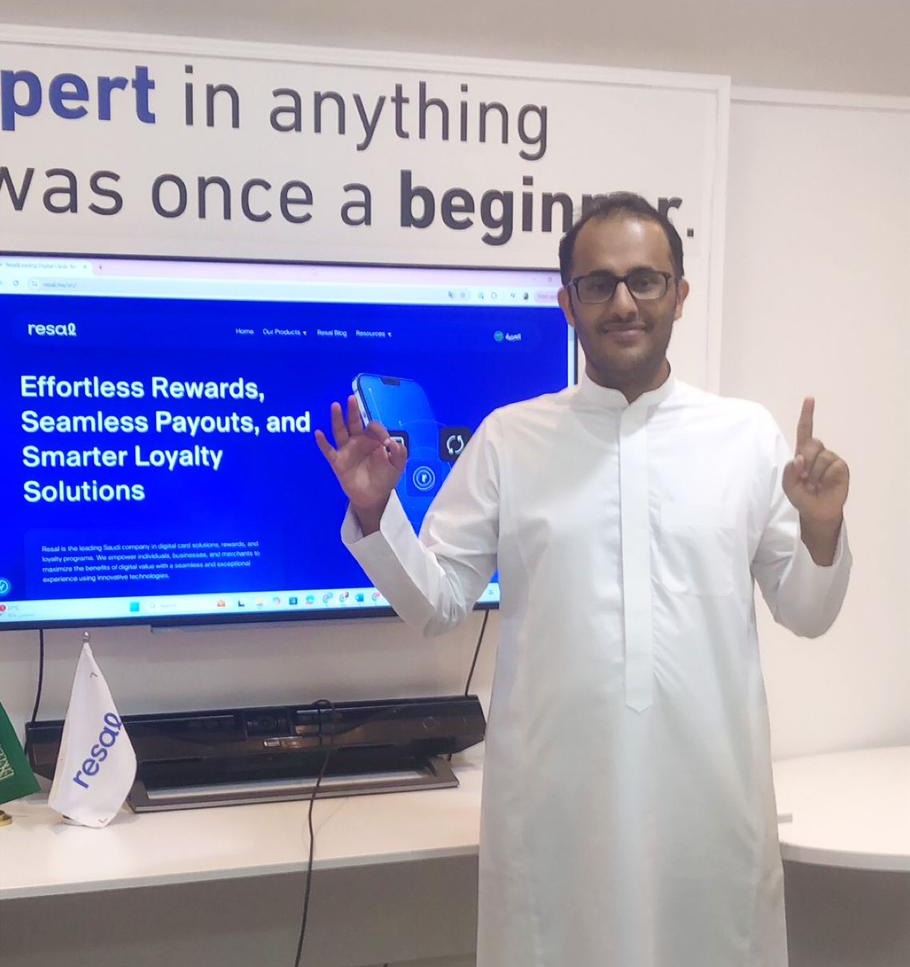
A September 2025 agreement with Bookme supplied a more everyday example of the direction. It was intended to let rewards become travel, entertainment and leisure experiences through ticketing technology. The point balance could move toward something a person actually wanted to do.
Asked about the company’s trajectory, Kameli offered a compact answer: “Our plan simply is to solve bigger problems.” His career provides a series of increasingly large versions of the same practical concern. Understand the customer. Make the gesture easier. Connect the systems needed to deliver it. Give the recipient somewhere useful to go.
The flower business began with a destination. The next chapter asks how many destinations a gift can have.