The gift card has a peculiar design flaw: the money can be perfectly good while the choice of shop is completely wrong. Then there is the other problem. The card is at home, you are at the checkout, and the birthday generosity of a favourite aunt is doing precisely nothing. Prezzee built its original proposition around making those small frustrations less likely.
Today, the Sydney-founded company sells digital gifts to consumers and reward-delivery tools to businesses. Its signature Smart eGift Card lets the recipient choose from participating retailers after receiving the gift. The giver supplies the budget and sentiment; the recipient supplies the shopping list. That division of labour is the useful idea beneath the animated wrapping.
It has travelled well beyond birthdays. An employer can reward a scattered team, a marketer can send an incentive, and another company can put a gift-card marketplace inside its own service. Prezzee now also wants to help retailers run the machinery behind their cards. A product designed to tidy the wallet has become a business concerned with what happens at the checkout.
First, get the card out of the handbag
Prezzee dates its founding to 2014. Its corporate history credits Claire Morris, Matt Hoggett, Shaun Bonétt, Edward Piazza and Roger Hatem, alongside development by Pollen Digital. Early accounts focus on Morris and Hoggett spotting the opportunity to replace physical cards with something customers could buy, send and keep on their phones.
Morris brought a design background, including work as an art director at Marie Claire. In a 2017 interview, she described a deliberately small beginning: five retailers, with Myer and JB Hi-Fi among the early recruits. By then, the company had attracted backing from Bonétt’s Precision Group, which took a 40% stake in late 2015.
“When we launched, we literally had five retailers on board.”
Claire Morris · 2017

The initial problem was ordinary enough to explain without a slide deck. A card that stays in an email or digital wallet is easier to retrieve than one that has wandered off. Prezzee’s help service still reflects that original job: search the inbox, ask the sender to resend through the gift tracker, or contact support to recover the delivery.
The clever bit is choosing later
A Smart Card is a staging point for a purchase. The recipient opens the gift link, chooses the swap option, selects an eligible brand and amount, and receives the retailer card needed to shop. Depending on that retailer’s redemption options, the next step can mean copying details online or presenting a barcode in a store.
The entire balance need not go to one brand. A recipient can exchange part and keep the remainder for later. In the illustrative A$100 gift below, A$40 goes to one retailer and A$30 to another, leaving A$30 undecided. Actual choices and denominations depend on the card’s catalogue. The pleasure is having permission to postpone the decision.
Illustrative split, not a promise of available denominations.
Meanwhile, the sender can add a photograph, video or greeting. These touches address a different defect of the gift card: it can look like a transaction with a bow drawn on it. Personalisation gives the sender somewhere to put the affection while leaving the practical decision with the person who will spend the money.
The distinction matters when shopping. A standard retailer card commits you to that retailer. A Smart Card preserves a choice among eligible brands. The separate Australian Prezzee prepaid Mastercard uses a payment-network model. Similar-looking digital rectangles can therefore have quite different rules, fees and places where they work.
The birthday present gets a business account
Prezzee Business launched in 2016; its marketplace offering followed in 2018. Those dates mark an expansion of the buyer’s job. A person sending one birthday gift needs an easy checkout. A business sending hundreds of rewards also needs consistent branding, recipient lists, scheduled delivery and a way to see what happened after pressing send.
The current portal offers that administrative layer. Campaigns addresses larger promotions, while the API lets partners connect gift distribution to their own software. This is where Prezzee sits between consumer commerce and enterprise services: the gift remains recognisable, but the person buying it may be managing a budget, a campaign or a customer relationship.
The customer list extends beyond office thank-yous. Official materials name QBE, HSBC and Coca-Cola. Its Australian business site also features Anglicare WA and The Smith Family, alongside commercial users. The same delivery format can carry a reward or practical support, although the recipient’s needs determine whether the available shops make the gift useful.
Businesses using Prezzee globally, according to its US business site. A customer count, not a revenue figure.
For a manager, the sensible starting point is a small batch. Check the country, available retailers and message, send a test gift, then follow the redemption process yourself. A spreadsheet can tell you an address is populated. It cannot tell you whether the recipient will understand the next screen. That is an operational lesson worth borrowing.
Free to open. Read the rest of the bill.
Prezzee’s Australian price list makes the core business portal and email gift delivery free. The gift value is still purchased, and optional services have charges: A$0.50 for SMS delivery, A$2 per gift through Campaigns and bespoke pricing for API projects. Payment-method charges can also apply, so the final checkout matters more than the word “free”.
Gift value is additional. Product, payment and regional terms apply. Checked September 2026.
The prepaid Mastercard is priced separately. Its Australian product page lists values up to A$3,000 and an A$4.95 issuance fee, including GST. Purchases in other currencies incur a 2.99% foreign-exchange conversion fee. The card, powered by Vault Payment Solutions, can be saved to Apple or Google Wallet. Wider payment acceptance comes with a different cost structure.
At the business-model level, Morris described taking commission on gift-card sales. Today’s optional services and custom integrations add further ways to charge. The economic appeal is understandable: consumers want convenient gifts, companies want manageable distribution, and retailers want spending directed towards their stores. Prezzee sits between those interests rather than manufacturing the things ultimately purchased.
A growth story with a staffing cut in the middle
International launches took Prezzee into the US, UK and New Zealand during 2020-2021. Its current recruiting material reports more than 140 million gift cards sold cumulatively, over six million customers and partnerships with more than 1,500 brands. Those are company-reported measures of reach; they do not establish profit or the value of the company.
The expansion also had a less celebratory chapter. In November 2023, the Australian Financial Review reported cuts to about 10% of the workforce, concentrated largely in technology. The newspaper recalled that Prezzee had considered an ASX listing and sought a valuation as high as A$1 billion during the 2021 technology boom. That listing did not happen.
The useful distinction is between an ambition and a completed transaction. A hoped-for valuation cannot stand in for a funding round. Nor does a staff reduction, by itself, explain every subsequent product decision. What the public sequence shows is a company that continued expanding its offering after the exuberance of the listing period had passed.
Its employer pitch mixes international work with values including “give a damn”. Recruiting materials also report workplace recognition for 2026. Those claims describe how Prezzee wants to recruit and organise people. The earlier cuts belong beside them: a culture statement and a staffing decision are different pieces of the same company’s record.
Now it wants to run the gift programme, too
On November 27, 2025, Prezzee announced PrezzeePay, a wholly owned subsidiary it said held an Australian Financial Services licence. Developed with UnionPay International, the proposition targets retailers and brands that want a gift programme without rebuilding their existing checkout infrastructure. The company says programmes can launch in weeks by using the payments network.
That is a shift in the problem being sold. The original app helped a shopper carry a card. This product promises to help a merchant issue and operate one. Shopping centres, venues and franchise groups with differing point-of-sale systems are part of the proposed audience. For them, adoption depends on whether integration and operating work really shrink.
Competition remains close to the transaction. Buying directly from a retailer is an obvious alternative; prepaid cards offer another acceptance model. Blackhawk Network competes in gift-card distribution and, like Prezzee, supplies Afterpay. Access to a big distribution partner is valuable, but the relationship does not automatically make the underlying business exclusive.
Recent moves cover both visibility and usability. In July 2026, Prezzee’s Sydney FC agreement added football sponsorship and planned fan initiatives for the 2026-27 season. A help-page update dated August 28 says Google and Apple login now work across regions on web and mobile. One move puts the name in public; the other reduces the effort of opening an account.
The football connection predates the kit deal. In 2022, Sydney FC Foundation credited Prezzee’s support for a two-day powerchair football clinic attended by eight young people. Players visited, participants received kits, and the company’s then-chief executive joined the presentation. It is a specific example of community involvement, with people, a place and an activity attached.
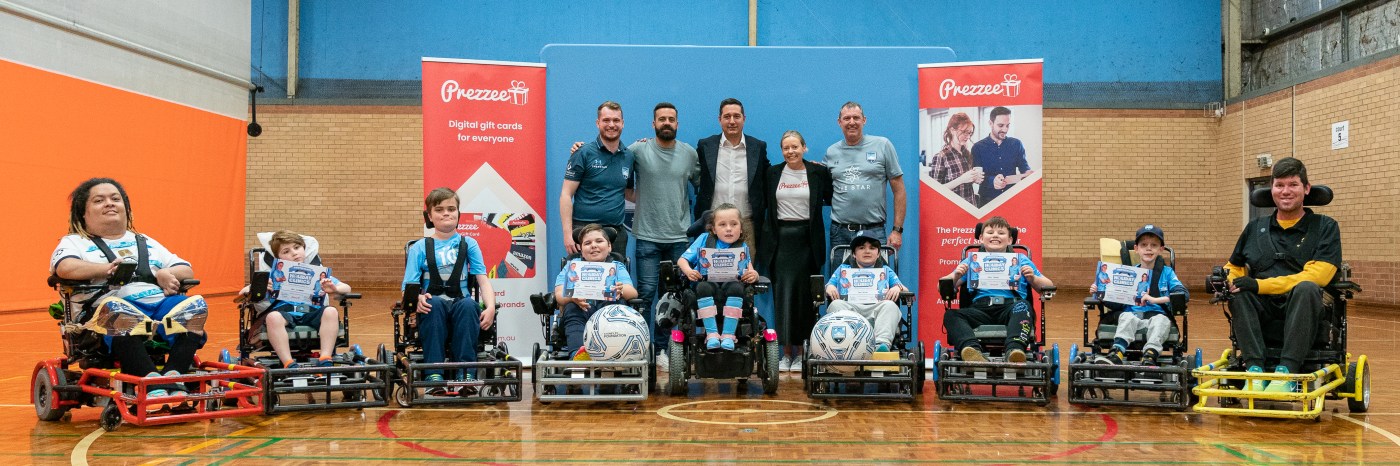
That local history gives the later sponsorship some context. The 2026 agreement has a one-year term with an option for two more seasons, according to the published announcement. Its planned fan activities will put the consumer product in front of a football audience, alongside the less visible corporate and retailer businesses.
For buyers, the final test is still modest: can this person use this gift? A Smart Card does not turn into cash, its eligible retailers matter, and exchanged cards carry their own terms. For companies copying the approach, the lesson is to hand the recipient a useful decision and make the surrounding administration easy. The wrapping earns attention. The successful purchase earns the thank-you.