In 2015, Ashley Walsh offered the derivatives industry a wish so modest that it almost sounds extravagant: greater consistency in its rules. He was an ICAP executive working across North Asia and the wider Asia-Pacific region. His subject was the rulebook governing markets. By 2025, he was leading BGC Group in Australia and New Zealand and sitting on the board of a charity rooted in rugby league.
The distance between those appointments is part of the interest. One involves institutions moving money across borders. The other serves a sporting community held together by clubs, volunteers and friendships. Walsh has a place in both. His professional life has developed through legal work, compliance and operations; his connection to league reaches into his own family. There is rather more here than a title long enough to require a second business card.
The rulebook comes first
Walsh began his markets career at CMC Markets. His early work was in legal and compliance functions, followed by responsibility for compliance in Australia at BGC Partners. He then moved to ICAP, where his responsibilities expanded from legal and compliance work in Australia and New Zealand to regional business management and operations across Asia.
It is a useful sequence to keep in view. The chief executive role arrived after years spent inside the machinery of financial businesses. Before the regional leadership appointments came work concerned with how a business could operate within its obligations. There are less conspicuous routes through finance than the trading desk, and this is one of them.
His education included a Bachelor of Laws at the University of New South Wales and a Bachelor of Economics at the University of Sydney. In 2025, when Family of League welcomed him to its board, it also described him as a lawyer with a practising certificate and membership of the Law Society of NSW. The legal qualification remained part of his professional identity well into his executive career.
The combination gives his biography a particular shape: economics, law, compliance, then a widening operational brief. It would be too tidy to make every appointment the inevitable consequence of the previous one. What the sequence does establish is that his responsibilities grew across both functions and geographies. The person eventually running a regional brokerage business had already worked in several of its less visible corners.
- CMC MarketsEarly markets career
- BGC PartnersAustralian compliance
- ICAP / TP ICAPRegional management and operations
- GFI GroupAsia-Pacific operations
- BGC GroupAustralia and New Zealand CEO from April 2021
A regional job meets a global rulebook
By 2015, Walsh was chief operating officer for North Asia and regional business manager for Asia Pacific at ICAP. That June, he appeared on the opening panel of the ASIFMA-GFMA Market Liquidity Conference in Singapore. Its subject was the impact of market regulation on Asian liquidity. Alongside him were executives from DBS, Deutsche Bank, J.P. Morgan and Nasdaq, with Reuters journalist Rachel Armstrong moderating.
The setting helps explain the significance of his request for standardisation. Financial businesses can operate across borders while answering to rules written within them. The practical question becomes how those different requirements fit together. A market may be described as international in a presentation; the paperwork still has to satisfy particular jurisdictions.
Walsh's comments at the time concerned the effects of regulation introduced after the financial crisis. He had initially welcomed the prospect of the US Commodity Futures Trading Commission examining how those changes affected liquidity and addressing unintended consequences. He subsequently expressed concern that the direction of travel was toward tighter regulation.
These were operational questions with commercial consequences. Liquidity concerns whether transactions can be completed, and on what terms. Reporting requirements concern what firms must record and communicate. When the same business has obligations in several places, the relationship between the two becomes a daily practical matter. Walsh's contribution belonged to that discussion: how the system's rules affected the ability of its participants to do business.
“Standardisation is what the industry wants.”
Ashley Walsh, speaking as an ICAP executive, 2015
Back at BGC, with a different brief
His subsequent career included Asia-Pacific chief operating officer positions at TP ICAP and GFI Group. In April 2021, he became CEO of BGC Group's Australia and New Zealand business. The portfolio encompasses BGC Partners, GFI and Fixed Income Solutions. BGC's Sydney office identifies him as CEO for the two countries.
The return to BGC makes an appealing turn in the chronology. Earlier in his career, his job there had concerned Australian compliance. By the time of his CEO appointment, his experience included regional roles at other brokerage businesses and Asia-Pacific operations at GFI. The familiar company name brackets a substantial expansion in the work attached to his own name.
BGC's Australian brokerage business dates to January 2005. Its Sydney offering includes energy products, foreign-exchange options, futures, Australian and New Zealand interest-rate swaps, government bonds and other over-the-counter transactions. That list is technical, but it gives substance to the title. The business sits among the arrangements institutions use to trade, finance themselves and manage exposure to changing markets.
Running such a portfolio involves keeping several kinds of activity under one regional leadership structure. BGC Partners, GFI and Fixed Income Solutions each appear in Walsh's remit. The two-country designation supplies a geographic boundary; the range of products supplies a reminder of the variety inside it. A regional chief executive's short title can conceal a surprisingly long inventory.
Keeping the market's company
Alongside his executive work, Walsh has participated in the Australian Financial Markets Association's Market Governance Committee. He appears in its governance listings for June 2023, June 2024 and June 2025, representing BGC Partners Australia. The committee's membership brings together people from banks, trading businesses, investment firms and public-sector financing institutions.
That is a different gathering from an internal management meeting. The names in the 2025 listing include representatives of ANZ, Bank of America, Barrenjoey, Citi, Commonwealth Bank, First Sentier Investors, Goldman Sachs and state treasury corporations. Walsh's place there puts him within the industry's continuing work on market governance.
There is continuity with the Singapore panel a decade earlier. In both settings, the conversation reaches beyond the fortunes of one desk or firm. The shared subject is how markets function across participating institutions. For someone whose career began in legal and compliance work, it is a recognisable professional thread, now running alongside responsibility for a commercial business.
The other team sheet
In 2025, Walsh joined the Family of League board as a non-executive director. His introduction arrived in the same chair's message that welcomed Mal Meninga as patron. The organisation was established in 2002 as Men of League by Ron Coote, Jim Hall and Max Brown. Its work extends across the rugby league community, including the people whose contribution is made away from the professional spotlight.
Walsh's family supplies a direct connection to that community. His son played junior rugby league at Belrose Eagles, and his daughter played NRL Tag. The board introduction described league as a game he loved. It also singled out his financial and compliance experience as useful additions to the organisation.
Those details make the appointment more personal than a corporate affiliation attached to a biography. Junior clubs and tag competitions are part of the game's everyday structure. In Walsh's case, the board role sits beside family participation in that structure. The connection runs through children playing, as well as an adult taking responsibility around a board table.
Family of League offers financial and social support across a community that includes former players, referees, administrators and club volunteers. Its constituency is wider than the familiar names on a match programme. There is a practical fit in asking a finance executive with legal experience to help govern an organisation sustained by donations, memberships, sponsorships and fundraising.
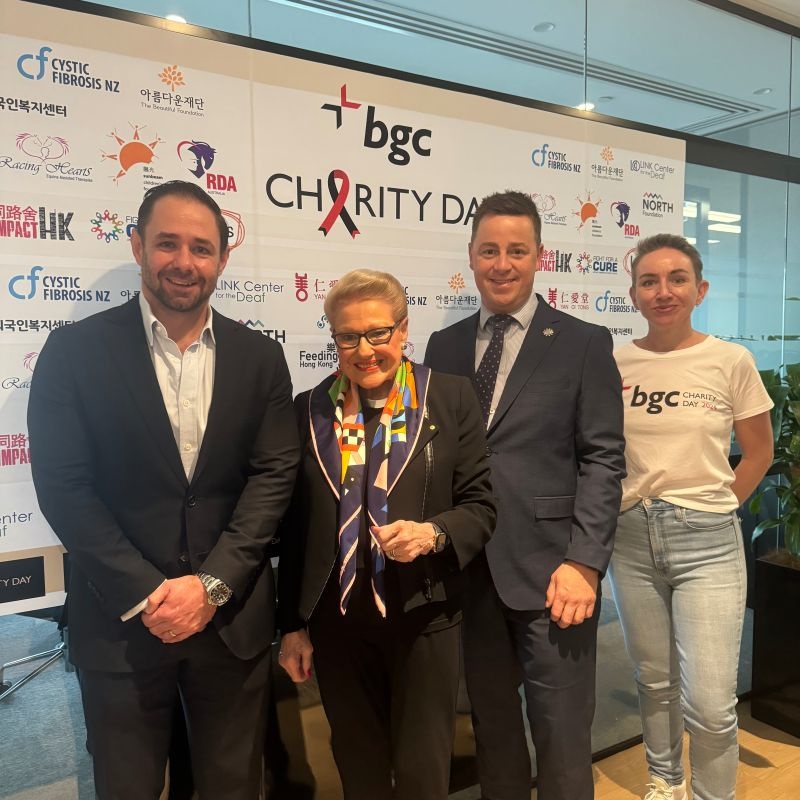
When the trading floor opens its doors
There is another meeting point between Walsh's professional world and community organisations: BGC Charity Day. In September 2024, Tim Parker publicly thanked Walsh for welcoming a visiting charity team. The accompanying account described guests joining dealers to take part in trades, with revenue from the day contributing to charitable fundraising.
The photograph captures the occasion's mixture of business and visitors: suits, an event T-shirt and a backdrop crowded with charity names. It is a useful counterpoint to the formal portrait and the committee listing. Here the brokerage workplace becomes a place where people from outside finance can take part in its annual fundraising ritual.
Across these roles, Walsh's career has accumulated a particular set of responsibilities: operating financial businesses, participating in market governance and helping oversee a sporting charity. The connections are concrete. There are legal qualifications behind the executive title, regional appointments behind the two-country remit, and junior rugby league behind the charitable board seat.
The standardisation request from 2015 remains a good place to begin because it concerns something so practical: making complicated arrangements work together. Walsh's later appointments move through different institutions and communities, each with its own obligations. The work has changed in scale and setting. The rulebook, it seems, has kept a seat at the table.