A tonne is a perfectly serviceable unit of wheat. It becomes less convenient when the market on your screen speaks in bushels, the price arrives in US dollars, and your business is in Australia. Before a farmer can decide what to do about a price, there is translation to do. Finance has a habit of charging admission in vocabulary.
In July 2023, Nicholas Orssich was explaining a StoneX launch that addressed precisely this problem. Through City Index, farmers and agribusinesses could trade grain contracts for differences denominated in Australian dollars per metric tonne. His description focused on what a customer would see and do: familiar prices, a smartphone, the ability to place a trade.
That small change in presentation offers a useful entrance to Orssich’s career. Now StoneX’s Chief Executive Officer, Australia, based in Sydney, he has worked across derivatives brokerage, agricultural markets and the expansion of the firm’s Australian offering. The recurring subject is access: who can reach a market, through which arrangements, and how much practical friction stands in the way.
Before the bell, a broker’s education
Orssich studied at the University of Bristol from 2008 to 2011, with economics and mathematics forming his degree. His earlier education at Marlborough College included mathematics, further mathematics, business studies and politics. Numbers and institutions were both on the timetable. In derivatives, both would remain relevant.
He began as a derivatives broker at Berkeley Futures in July 2011 and stayed until August 2015. In October 2015 he joined INTL FCStone as a client adviser. His subsequent StoneX roles included agricultural leadership in Asia Pacific and senior responsibility for derivatives. These were brokerage and client-facing jobs before the Australian chief executive title.
The sequence matters because it puts the customer problem before the management position. A broker works where an intention has to become an actual transaction. A client may understand the business exposure perfectly well and still need help finding the appropriate contract, exchange and route to execution. That is the territory in which Orssich built his career.
His professional description on LinkedIn begins with helping clients navigate Australian and international derivatives markets. It is a compact description of a job whose details can grow very large. A title tells you where someone sits in an organisation. The question they keep answering tells you rather more about the work.
- 2008-11Bristol
Economics & mathematics - 2011-15Berkeley Futures
Derivatives brokerage - 2015INTL FCStone
Client advice - 2024StoneX
ASX membership
The bushel problem
The 2023 City Index offering brought together contracts linked to Chicago, Kansas and Minneapolis wheat, ASX wheat and ICE canola. The common language was Australian dollars per tonne. For an Australian agricultural business, that made offshore pricing easier to read alongside local prices. The unit on the screen finally matched the unit in the conversation.
Orssich described products “priced in Australian dollars, by the tonne”. The appeal lay in that unshowy choice of words. There was no requirement for a farmer to become fond of the bushel before using a global grain price. A unit conversion is a small mathematical exercise; repeated across decisions, it becomes a design issue.
The contracts were CFDs, a particular type of derivative, and the launch sat alongside the firm’s established institutional grain desk. Grain parcels could be as small as one tonne. The distinction between those channels matters: a new retail interface expanded the ways customers could participate while the desk continued handling bulk commercial and institutional business.
In explaining the launch, Orssich also emphasised live prices available on a phone. The point was practical convenience. A market can be open in the technical sense while remaining awkward to use in daily life. Currency, minimum size, terminology and the device in someone’s hand all influence how accessible it actually feels.
Tom Brown, then head of Australia retail, and Asia Pacific chief executive Greg Kallinikos also spoke about the launch. The product crossed teams as well as markets. Orssich’s agricultural perspective belonged inside a wider undertaking involving an existing trading platform, retail distribution and the firm’s international capabilities.
A wheat field has an international address
Orssich’s market commentary in March 2023 showed the other side of this work. Australian growers were approaching planting after three large crops, with changing weather expectations and a softer global price outlook. He was discussing how to think about risk when the recent run of favourable conditions might no longer be a useful guide.
His attention moved from Australia to Europe, the Black Sea and Asian customers. He described greater use of European wheat futures as a reference for Black Sea competition. The choice of a benchmark depended on where Australian grain competed and how well the available market reflected that competition.
He also discussed limits to the regional appeal of the deliverable ASX wheat contract. Offshore buyers could be interested in Australian pricing while worrying about what happened when Australian production tightened. These were specific market mechanics, with consequences for whether a contract attracted participation.
This is the geographical oddity at the centre of his profession. The crop has a location. Its competitive price has several. An Australian broker has to keep those places in view without pretending they move together perfectly. Orssich’s comments concentrated on those differences rather than offering a single overseas price as a universal answer.
CME Group’s directory separately lists Nick Orssich among the inter-dealer brokers serving Australian wheat futures. It is a modest entry, the kind of thing readers tend to pass over. Yet it locates him at the working connection between a named client-facing professional and an international exchange product.
The membership behind the photograph
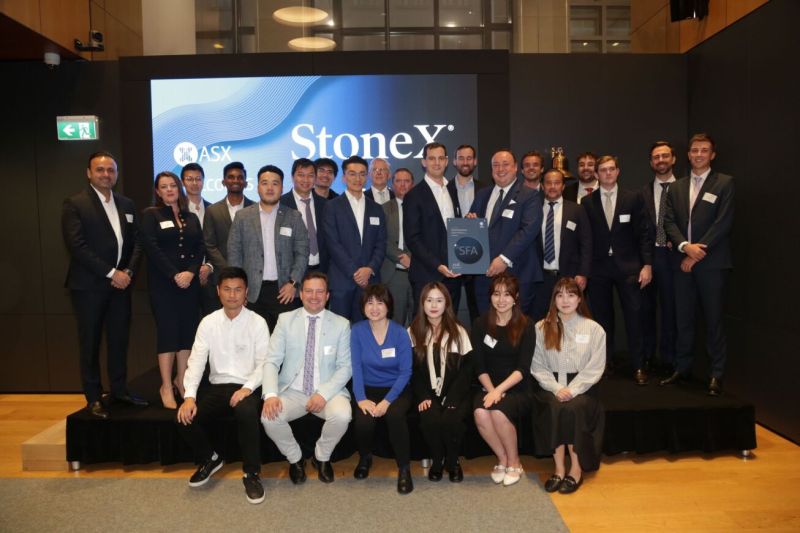
In April 2024, StoneX Financial Pty Ltd became a direct ASX derivatives clearing and trading member. Orssich, then identified as senior vice president for derivatives, described the need for more routes into the domestic market. The company was expanding its Australian sales and execution capacity across commodities, equity futures and rates.
At a celebration of the admission, Orssich joined Kallinikos and the Australian team for the familiar exchange ritual of ringing the bell. The group photograph is an appealingly crowded explanation of the occasion. There are rather more people involved in opening a market connection than a trading screen tends to admit.
ASX’s own April activity report recorded StoneX’s admission as an ASX 24 and ASX Clear (Futures) participant. Those two descriptions carry different responsibilities. Trading participation provides a route to execution on the exchange. Clearing participation concerns the arrangements that follow a trade. Both sit behind what a customer experiences as market access.
The membership gave domestic and international customers another provider through which to reach Australian derivatives. For Orssich, the development extended the access question beyond the design of a product. It concerned the institutional machinery that makes a service possible, including the capacity to support clients across markets and time zones.
His own LinkedIn response thanked the people involved in making the membership possible. That brief public reaction fits the photograph: a collective occasion, with a substantial amount of work behind it. The ceremonial bell supplied the sound effect. The participation arrangements supplied the substance.
The meeting after the milestone
By June 2025, Orssich appeared on the membership list for ASX’s ClearStar Program Committee as StoneX’s senior vice president, derivatives, APAC. Alongside him was Raghuraman Uthaman, whose responsibilities covered business development and operations in the region. Commercial access and operational delivery had seats at the same table.
The committee agenda included the replacement of TradeAccept and consultation on futures-clearing replacement. This is a less photogenic part of financial markets than a bell ceremony. It is also the part that determines how systems change, how participants prepare and how industry feedback reaches the exchange.
The minutes describe a forum for stakeholder input, with quarterly meetings and comments that are not attributed to individual representatives. Orssich’s listed participation places him in that process; it does not turn every discussion into his personal position. The useful fact is the continuity between winning access and engaging with the infrastructure behind it.
For a career that began at a brokerage desk, the committee listing marks a widening field of responsibility. The work now includes the shared systems on which firms and customers depend. A market relationship carries on after the congratulatory photograph has been filed away.
“now we’ve got three offices and about 70 people”
Nick Orssich · In the Round · October 2025
A bigger office, the same practical question
In an October 2025 episode of In the Round, Orssich discussed the Australian business with Philip Smith, Stefan Meyer and Ripley Atkinson. The operation had broadened from its grain focus into multiple markets. Orssich put its scale at three offices and approximately 70 people at that time, and identified ASX membership as an important step in its development.
He was describing the evolution of an existing business. StoneX’s Australian beginnings predated his arrival at INTL FCStone in 2015. Keeping those dates separate makes the story more useful: his career developed inside an operation that was itself changing, with agricultural expertise becoming part of a broader offering.
The ambitions discussed by the team included additional business lines, more services for existing clients and stronger collaboration across offices. Those are organisational goals, but they return to a recognisable client question. If a relationship already works for one exposure, what else does the customer need help managing?
Meyer’s cash-grain relationships and Atkinson’s livestock work gave the discussion concrete neighbouring businesses. StoneX’s cattle work includes an Australian feeder cattle swap, linking the expansion story to another industry dealing with price uncertainty. Orssich’s role sits among those specialists, connecting the Australian operation with the wider group.
From Bristol to brokerage, from agricultural contracts to exchange membership, the progression has involved increasingly large arrangements around a very small moment: a customer deciding whether and how to trade. The Australian dollar, the tonne, the phone and the clearing connection each belong to that moment. Orssich’s career is a reminder of how much work goes into making it look straightforward.