Alissa Holz once tried to apply actuarial thinking to an unusually stubborn problem: the temperature of the offices she visited in Asia. The weather outside offered little guidance. Her choice of clothing seemed, rather unhelpfully, to predict the opposite of what the air conditioning would deliver. This was a joke in a 2014 travel essay, but an apt introduction to someone whose working life has required both mathematical discipline and a willingness to be surprised.
By April 2025, Holz was chief executive of RGA Australia and New Zealand. Behind that appointment lay years spent pricing risk, developing business and considering how people learn. Read across those activities and a question emerges: how does an institution become capable of changing its mind?
There is a practical version of that question, too. Her first manager at RGA had a response to obstacles that she still remembers. It was short enough to survive the journey from one job to the next.
“How can we make that work?”
The question Holz recalls from her first RGA manager
The education of a traveller
Holz studied mathematics at Queensland University of Technology, earning a Bachelor of Applied Science. She became a Fellow of the Institute of Actuaries of Australia and joined RGA in 2006. From 2012 to 2018, she was Chief Pricing Actuary for Asian Markets. She later led business development for Australia and New Zealand, before becoming deputy CEO and then CEO.
The sequence matters. Pricing calls for understanding the terms on which a business accepts risk. Business development brings those terms into conversation with a client’s plans. Regional leadership adds responsibility for the operation as a whole. Her career crossed those boundaries inside the same company, allowing the questions to widen while the institution remained familiar.
In Asia, even familiarity required caution. Working from Sydney, she encountered differences in business customs, regulation, language and currencies. In her travel writing, she treated the etiquette of seating arrangements in Japanese meetings as a subject that could occupy an entire career. Expertise, apparently, did not entitle anyone to choose a chair without thinking.
Her observations were often small and exact: the risk of ambiguous translations, the different ways numbers are written, the tension between useful data and privacy obligations. These details resist the convenient habit of treating a region as a single market. A spreadsheet may cross a border without complaint. Its assumptions deserve closer inspection.
A widening brief / selected RGA roles
- 2006Joins RGA
- 2012–18Asian markets
Pricing - 2018–24Australia & NZ
Business development - 2025Australia & NZ
Chief executive
A place at the table
A photograph from November 2016 places Holz at a long conference table in Gurgaon, India, alongside actuarial and regulatory figures. Water bottles, name cards and extravagant flowers occupy much of the foreground. The occasion was the 20th Asian Actuarial Conference, where she appeared as RGA’s senior vice president and chief pricing actuary.
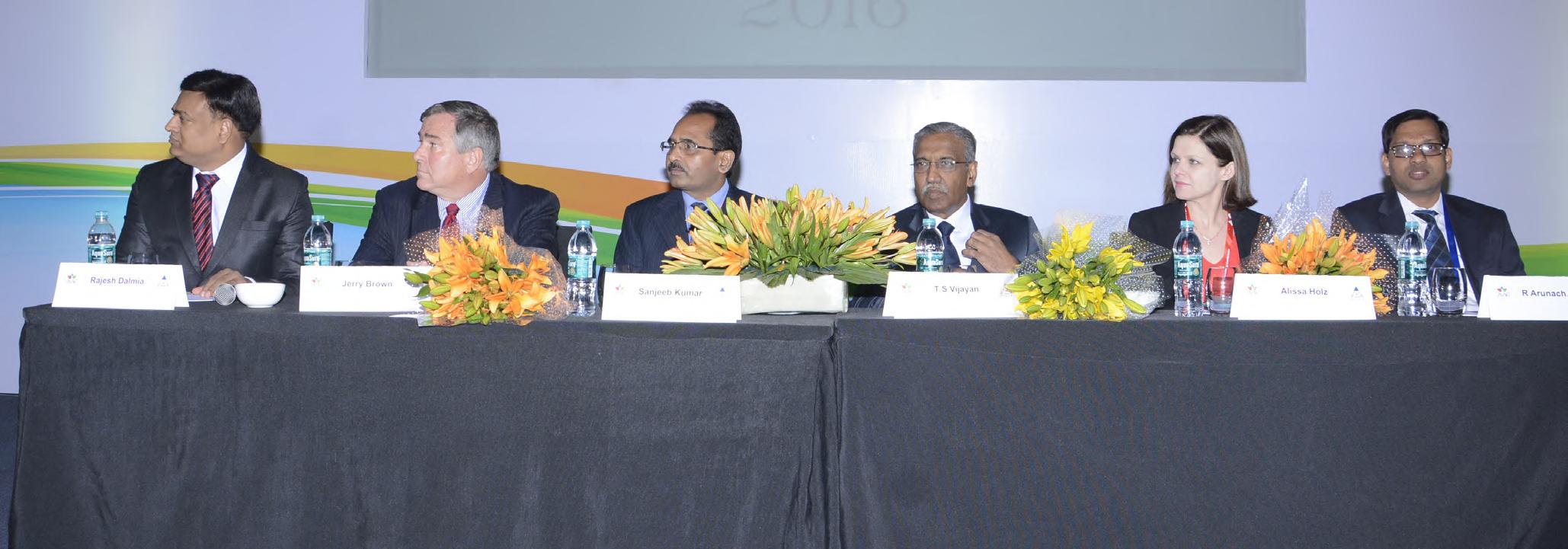
The conference brought together more than 700 delegates from 26 countries. For a profession often associated with solitary calculation, this is a useful corrective image. Insurance also gets discussed across tables, between institutions and among people operating under different rules. The numbers need advocates who can explain what they mean.
That setting helps make sense of the direction her writing took next. Having worked across markets, she began examining the organization itself as something that must keep learning.
Can an insurance company learn to bend?
In July 2017, Holz wrote a paper on plasticity in the life insurance industry. The vocabulary came from thinking about biology and adaptation; the problem was organizational. Companies could invest in innovation, yet still struggle to develop an internal capacity for changing how they worked.
Her argument placed responsibility with leadership and culture. An organization needed the ability to respond to change and to initiate it. It needed people who could learn, communicate and question familiar approaches. Buying access to an external idea could be useful, but the capacity to adapt had to exist inside the business.
This is an awkward proposition for anyone hoping that innovation might arrive in a box. It makes ordinary management decisions consequential. Who gets time to learn? How do ideas travel between departments? What happens when an employee identifies a problem that a comfortable process has concealed?
Holz considered such practical matters as communication across locations and the value of face-to-face contact in building trust. The subject may sound abstract until it reaches the calendar. Giving colleagues time together costs something. So does failing to discover what they know.
The organizational question
How do people inside a business become better at responding to change?
For an actuary, the attraction of this question is understandable. A model depends on assumptions. An organization depends on them too, although it seldom keeps them all in one convenient file.
The work that ends in someone else’s qualification
Holz’s interest in learning also had an institutional address. She chaired the Actuaries Institute’s Education Strategy Committee from 2020 to 2023. In 2024, the Institute gave her its President’s Award, recognizing her contribution to professional education.
The committee’s work covered governance during changes to the education program. The award citation credited her support for the Education Strategy Review and its contribution to student recruitment and retention. Her involvement extended to the Life Insurance & Retirement Education Faculty, examining, scrutinizing and marking assignments. She was also a plenary curator and presenter at the International Congress of Actuaries in 2023.
There is a particular kind of professional generosity in marking somebody else’s work. It comes without much of the theatre attached to leadership. The beneficiary may never see the hours spent checking a question, reviewing an answer or ensuring that an assessment does what it is supposed to do.
Placed beside her writing on organizational learning, those activities suggest a consistent interest. The profession needs people ready to exercise judgment. Developing that readiness requires systems, standards and volunteers willing to attend to the details. The award makes visible a part of her career that an executive title alone would leave out.
When a customer brings different priorities
Another strand of that work concerns what insurers choose to offer. In October 2023, Holz coauthored an article with Jaqui Wassenaar and Tjaart Esterhuyse about meeting the needs of environmentally conscious consumers.
They examined ways insurance products could engage with sustainability, including charitable contributions, information that helps customers understand their environmental footprint and incentives for different behaviour. The focus was the connection between a customer’s stated priorities and the design of a financial product.
The implications extend beyond the colour of a marketing brochure. A company has to decide what it will actually provide, how the customer will understand it and whether the proposition has substance. A promise that sounds attractive in a presentation must eventually become a set of choices somebody can use.
This fits the wider pattern in Holz’s public work: attention to the space between a technical capability and the people expected to act on it. Product design sits in that space. So do education and communication. Each requires an expert to take another person’s perspective seriously.
Four stakeholders, three points in time
In a May 2025 conversation with actuaries Jennifer Ng and Peter Whittigan, Holz discussed strategic thinking. Her explanation offered two perspectives: the people affected by a decision and its relationship to time.
On the first, she identified clients, employees, shareholders and the community. On the second, she considered the past, the present and the intended future. Strategic thought becomes necessary when these perspectives create tension. What serves one group immediately may look different when another group or a longer period enters the picture.
Two ways to examine a decision
Clients · Employees
Shareholders · Community
Yesterday · Today · Tomorrow
It is a useful account because it leaves the difficulty intact. Listing stakeholders does not make their interests identical. Looking further ahead does not make today’s targets disappear. The framework asks a leader to hold competing considerations in view long enough to make a deliberate choice.
The interview also put her transition from actuarial work to the CEO role under examination. In the new position, her responsibilities included strategy, client engagement and financial results. The appointment took effect on April 1, 2025, and included joining the RGA Australia board. The questions had become broader; accountability had become broader with them.
A business still populated by people
Her April 2025 comments on artificial intelligence carried a similar concern for the person at the other end of a process. She saw uses across insurance operations while retaining a place for human interaction. Faster administration and a better experience were related ambitions, with judgment still required about how they met.
Outside work, the details became pleasantly specific. She enjoyed going to shows with her daughter and singled out Come from Away. Her son’s interest in cricket had made her an enthusiastic spectator. She also expressed unmistakable pride in her Queensland origins. There are audiences, it seems, for whom a neutral position is quite unnecessary.
By April 2026, Holz was among the executives attending a joint APRA and ASIC insurance CEO roundtable. Her public responsibilities also included signing the Australian RGA entities’ modern slavery statement in May 2025. Leadership involves these formal obligations as well as the more appealing business of imagining what comes next.
The thread through her career is a repeated willingness to examine the setting around a decision: the market, the institution, the learner, the customer. Her remembered manager’s question allows for an obstacle and the possibility of progress in the same breath. For someone now responsible for a regional business, that is a useful sentence to have kept.