Sunil Sharma did not grow up intending to become an actuary. He studied physics, specialising in electronics. Insurance entered the picture because it offered a job. There is something pleasingly unvarnished about that beginning: before the international career, the professional fellowships and the chief executive’s office, there was a graduate looking for work.
Born and brought up in Delhi, Sharma joined Life Insurance Corporation of India. His family’s acquaintance with insurance had largely consisted of the cover his father bought for a two-wheeler. The subject that would occupy his working life arrived without a grand introduction. He would have to learn it from the inside.
Today he runs RGA India, the Indian operation of Reinsurance Group of America. His career has crossed India, the United States, the United Kingdom and Singapore, moving between companies that sell insurance and companies that help those insurers carry risk. It is a useful vantage point for someone whose current argument is that insurance ought to become easier for other people to understand.
A physicist gets a different set of problems
The professional biography can make such a journey seem inevitable. Put the employers in a neat line, add a few senior titles, and every move appears to point towards the last one. Sharma’s own account is more interesting. He described entering insurance as a consequence of circumstances during a period of difficult employment prospects. The career came before the calling.
That distinction gives the early years their weight. LIC offered an education in how an insurance business actually operates. A policy travels through many hands; the premium calculation is only one stop. Serving customers, managing money and administering contracts all affect whether the promise on the page works in practice. For an aspiring actuary, contact with that machinery is a useful correction to the idea that a sound calculation settles everything.
Actuarial qualification added another kind of discipline. Sharma became a Fellow of the Institute of Actuaries of India and of the United Kingdom’s Institute and Faculty of Actuaries. These credentials would travel with him. So would the experience of beginning in an established Indian insurer before venturing into a changing private market.
Physics and electronics. A job at LIC. Then a profession built around the financial consequences of uncertainty.
Learning the business from both sides
GE Financial Assurance took Sharma into product development in the United States. He also helped establish GE’s actuarial centre of excellence in India. The combination matters: developing a product and developing the team that supports actuarial work are different assignments. One concerns the offer a company makes; the other concerns its ability to keep doing the work.
At Swiss Re, he worked across India, Singapore and the United Kingdom during a tenure of more than seven years. His responsibilities included pricing, reinsurance treaties and risk management. A treaty is the agreement through which an insurer transfers specified risks to a reinsurer. Its terms help determine how the two businesses share the consequences when experience departs from expectations.
He later headed actuarial work at ICICI Prudential before joining Kotak Life in March 2012. At Kotak, where he spent more than a decade, he rose to President, Chief Actuary and Chief Risk Officer. His remit extended into product development, valuations, analytics, business planning, capital management and the relationship between assets and liabilities.
Consider the range of questions contained in that list. Can a product meet a customer’s needs? Is its price appropriate? What resources will the insurer need in future? How does the portfolio behave as conditions change? Each question has its own specialists. Senior actuarial leadership requires those answers to make sense together, including when one department’s attractive proposal creates another department’s awkward problem.
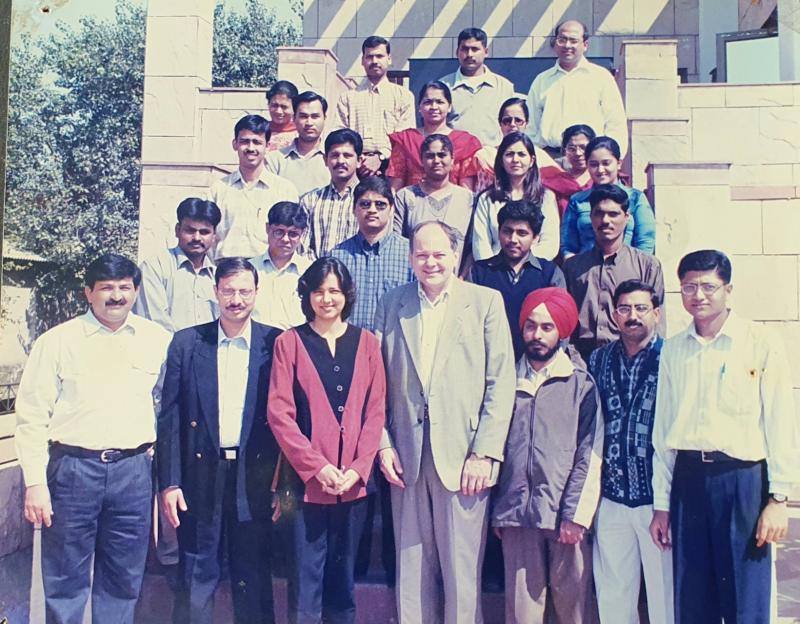
The old team photograph he shared on LinkedIn offers a different way to read a career. The people stand together on steps, long before many of their later appointments. Sharma invited readers to identify them and recalled the group’s role in an early Indian actuarial knowledge-services operation. A corporate history can be a sequence of company names. Here it is also a set of people who learned and advanced together.
The work behind the qualification
Alongside his company roles, Sharma built a record of service to the actuarial profession. He served as President of the Institute of Actuaries of India from 2018 to 2020. He has also served on the councils of the International Actuarial Association and the Institute and Faculty of Actuaries, and on the latter’s Life Board.
These positions involve a different constituency from a company’s customers and shareholders. A profession must decide how people enter it, what they learn and what standards they carry into practice. Examinations, guidance and professional development require work that rarely produces a glamorous photograph. Someone still has to do it.
Sharma’s contribution has included examining and editorial work. There is a practical connection between those activities and executive responsibility. An examiner asks whether an answer is good enough. An editor asks whether another person can follow it. An insurance leader needs both habits, particularly when a technically correct explanation leaves everyone outside the room none the wiser.
In a 2020 interview, he pushed back against an easy explanation for the profession’s employment challenges. Before declaring a shortage of actuaries, he argued, companies should examine whether they were actually employing them to address their problems. It was a pointed intervention: demand for a skill must show up in decisions to hire and use it.
His public career has continued to include discussion of actuarial leadership. At the IFoA India Conference in 2024, he joined a panel on the skills and experience involved in moving beyond technical roles. The subject suited the trajectory of someone who had already held responsibility for products, risk and planning before becoming a country chief executive.
A little less drama on the road
Colleagues’ recollections add some texture to the appointments. R. Jayaraman remembered a drive to an annual offsite in Lonavala when a two-wheeler rider tried to start an argument. Sharma smiled and let the encounter pass. Jayaraman also described a habit of learning the names of drivers and hotel staff, and thanking them for their work.
Another colleague, G. L. N. Sarma, recalled the Mumbai floods of July 2005. After a prolonged attempt to get home, Sharma offered colleagues shelter with his family. The recollection includes Punjabi parathas. It is a welcome detail in a professional life otherwise measured in appointments: sometimes the useful thing a colleague provides is a place to wait and something to eat.
There is music, too. Friends have described his singing and enthusiasm for older Hindi songs. His interests provide a small escape from the assumption that anyone fluent in actuarial work must spend the evening checking another spreadsheet. A karaoke system is allowed to have a place in the biography.
A bigger brief, a simpler explanation
RGA announced Sharma’s appointment as India CEO in January 2024, initially subject to regulatory approval. The role placed him in charge of a business whose customers are insurers. Reinsurance can be unfamiliar to the people who eventually benefit from it: an insurer transfers agreed risks, and the reinsurer brings capacity and expertise to that arrangement.
For Sharma, the country role brings his earlier experience together. He has worked within direct insurers and within a reinsurer, with responsibilities spanning product decisions and the resources behind them. That breadth is relevant when a client conversation moves from launching a product to managing its risks and financing its growth.
A simplified view of the relationships. Customers’ policies remain with their insurer; reinsurance terms govern the separate arrangement behind them.
His recent public discussions have focused on how that arrangement can help extend insurance access in India. In an August 2026 television conversation, he discussed reinsurance’s role in the country’s insurance system, affordability, technology and the ambition of Insurance for All by 2047. The agenda reaches well beyond the calculation of an individual premium.
His case for wider access also involves everyday communication. In January 2026, he advocated products that people could understand, alongside local-language explanations, visual communication and digital access. He connected the use of technology with the practical task of reaching people who have been underserved.
“Insurance products need to be simple, relevant, and easy to understand.”
Sunil Sharma · January 2026
That sentence sets a demanding test. An insurer may be able to describe every feature of a contract while leaving a prospective customer unsure what to do with it. Simplicity requires decisions about the product itself, the language used to sell it and the experience of buying it. A shorter explanation helps only if it preserves what the buyer needs to know.
There is a satisfying connection between that concern and Sharma’s beginning. The graduate who entered an unfamiliar industry now leads a business that helps other insurance companies operate. He has accumulated the technical vocabulary, the cross-border experience and the institutional responsibilities. The current challenge includes helping the industry speak more plainly to people with none of those advantages.
His route into insurance was circumstantial. The work that followed has been deliberate: learning the business, taking responsibility for its promises, and contributing to the profession that judges the calculations. For someone buying a policy, the ultimate value of all that expertise is fairly direct. They should be able to understand the promise, and the institutions behind it should be equipped to keep it.