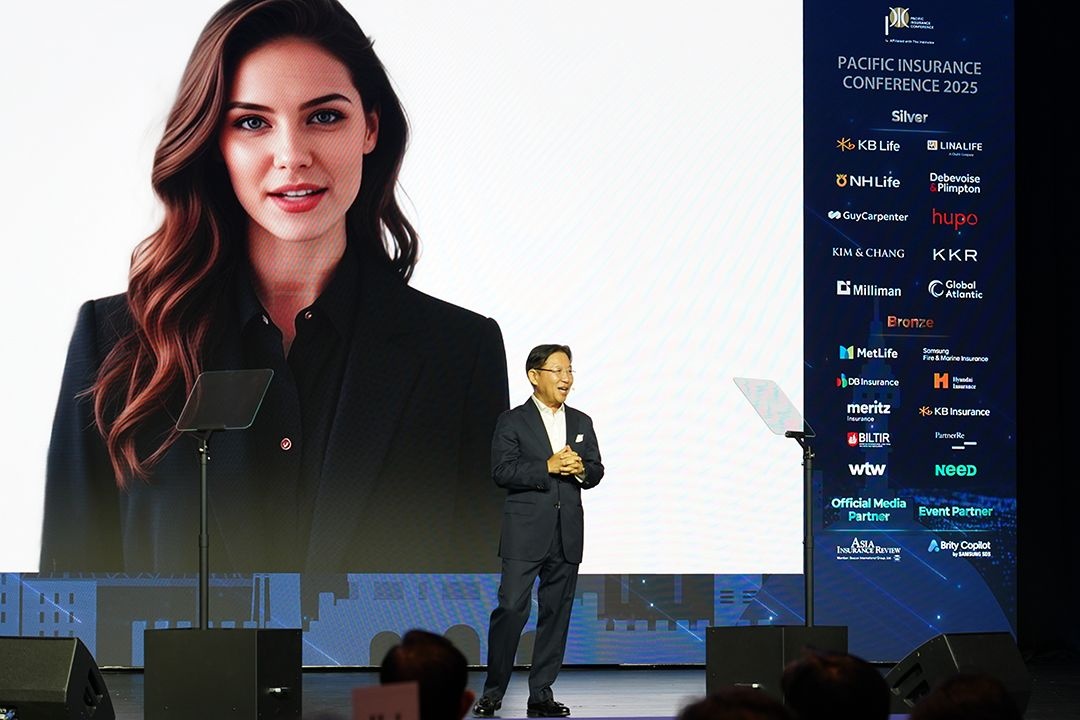
Jenny had the larger face. At the Pacific Insurance Conference in Seoul in September 2025, an AI adviser appeared on a screen behind Michael Shin, who stood below in a dark suit, hands together, looking pleasantly at ease with the arrangement. Insurance executives had gathered to talk about a changing business. Their host had given one of the changes a speaking part.
Jenny and Shin conversed about navigating the conference. The photograph has the agreeable oddness of a business meeting in which the software has finally been invited to introduce itself. Shin, chief executive of RGA Korea and a regional marketing leader at Reinsurance Group of America, supplied the human half of the opening.
The gathering returned the Pacific Insurance Conference to Korea after a forty-year absence. Shin was president of the Asia Insurance Leadership Forum, its organizer, and led the conference organizing committee. Here was a veteran of distribution and product design helping arrange a room in which competitors could discuss what came next.
Before Jenny, there were sales teams
Shin’s route to that stage passed through the parts of insurance where a product must be explained, sold, and supported. He studied economics and international business at the University of Wisconsin–Madison. His early career included more than fifteen years with Prudential Financial, where he became managing director for the Asia market.
Samsung Life Insurance followed. He held senior responsibilities involving advisers and financial planning. At New York Life Korea, he became executive vice president and chief marketing and distribution officer. His remit included agency distribution, marketing, product design, and corporate communication. These are neighboring jobs, though anyone who has attended a product meeting knows neighbors can have quite different views of the fence.
Each responsibility presents a different question. What should the company offer? How will an adviser explain it? How will it reach a customer? What will the company say about itself? Shin had worked across that collection before joining RGA in 2011.
A Korean announcement of his appointment as RGA Korea chief executive appeared in February 2012. The distinction between joining a company and the announcement of a particular role is small but useful here. By then, his experience already crossed several institutions and connected the practical work of distribution with the design of insurance products.
The appointment that a larger client could not buy
In 2015, looking back at RGA’s development in Korea, Shin recalled an episode from the business’s earlier years. A large insurer wanted to collaborate on a product. RGA had already promised development time to a smaller company. It declined the larger request to keep the existing commitment and schedule.
Shin offered the episode as an example of the company’s character. It is also an unusually concrete business anecdote. Partnership, a word that can pass through an entire presentation without touching the ground, becomes a question of who gets the next appointment.
The story concerns RGA’s early practice; Shin recounted it rather than claiming to have personally made the decision. That makes it useful in a different way. It shows which part of the organization’s history he chose to hold up when explaining its approach to clients.
He also described a regional challenge. Established Asian insurance markets and faster-growing emerging markets offered different opportunities. A large existing market could still matter despite slower growth. New technology and changes in regulation could alter its prospects. The work called for attention to the particular market, rather than enthusiasm for a regional average.
“Insurance is a service based on trust and a promise to customers.”
Michael Shin, RGA Korea CEO’s message
A product launch leaves plenty unfinished
In a signed message introducing RGA Korea’s service approach, Shin described the work that follows a product idea. There are design workshops and marketing plans, then performance tracking through individual distribution channels. Teams examine what succeeded and what failed. They can refine the product or use the findings to plan another version.
The company calls the approach “360° Commitment Service.” The label is expansive; the useful detail is the sequence. Someone remains responsible for looking at what happened after the product reached the market.
That sequence fits the career behind it. A former distribution executive has reasons to pay attention to a channel. A former product leader has reasons to ask whether the design works in practice. In reinsurance, those questions sit beside pricing, risk, and capital. The customer’s experience and the insurer’s accounts eventually meet, however separate their meetings may have been.
- 01Design
the product - 02Plan
distribution - 03Track
performance - 04Refine
and repeat
A simplified view of the service process described in Shin’s RGA Korea message.
RGA Korea’s present-day offering includes distribution advice, strategy development, capital management, and digital underwriting alongside product development. Shin’s role puts him at the intersection of those activities. A reinsurer has to make itself useful to an insurer that already knows a great deal about its own business.
Korea keeps the clock running
In a 2019 discussion of the Korean market, Shin used the expression “pali-pali” to explain the pressure for speed. His point was practical: products could lose momentum within months, requiring another round of development. He described local investment in product teams, underwriting solutions, and consumer research.
He also observed that insurer clients were becoming more knowledgeable and retaining more risk themselves. Technical expertise, once acquired, needed continued investment. The relationship could become less useful if a reinsurer merely repeated what its clients already knew.
That historical snapshot gives some texture to the later AI discussions. The demand for quicker decisions and more useful information preceded the arrival of a digital conference adviser. Jenny appeared in a business that already had a demanding clock.
By November 2024, Shin was discussing a further complication: insurers adjusting their strategies under IFRS 17 and Korea’s K-ICS capital framework. He described increasing sophistication in capital management and interest in a wider set of solutions, including reinsurance. Product competition also put pressure on margins. Growth had to be considered alongside the financial consequences of winning new business.
His discussion of AI was similarly specific. Predictive analysis could support risk assessment, pricing, and claims planning; fraud detection was another application. These are jobs with decisions attached. The interesting question is what an improved tool allows a team to do with its time, information, and resources.
Getting the industry into the same room
At the East Asian Insurance Congress in Hong Kong in 2024, Shin joined other executives to discuss the industry’s public image. He emphasized clearer education, simpler offerings, transparency, affordability, and solutions adapted to customers. Reputation was being treated as something shaped by the way insurance operates.
That conversation connected naturally with his marketing background. Explaining a complicated promise takes more than an attractive sentence. The terms, the price, and the process all contribute to what a customer thinks the company has promised.
At Digital Insurance APAC in 2025, he joined a CEO panel whose subjects included personalization through AI and analytics, regulatory compliance, cooperation with technology partners, and ethical data use. The discussion also considered involving customers in developing digital services. Distribution had acquired new tools, while keeping its old obligation to reach people intelligibly.
PIC 2025 in Seoul, as reported by RGA after the conference.
The September conference gave that regional work a physical scale. RGA reported more than four hundred executive attendees from nineteen countries, with representation from ten industry associations and ten country regulators. Shin helped assemble a gathering with many different interests under one program.
Before the event, his own public update carried a host’s practical excitement: more than three hundred executives had registered and the hotel was fully booked. After the opening, he posted a brief, cheerful verdict: the first day had begun well. The details bring an organizer down from the conference theme to the business of getting everyone there.
The work waiting beyond the stage
Shin’s official responsibilities now combine oversight of RGA’s Korean business with marketing across Asia Pacific. His 2025 speaker biography also lists responsibility for the Asia Ideation Hub and membership of the LIMRA Korea Executive Board since 2007. The roles give his work several settings: the local business, the regional network, and the forum where executives compare experiences.
The public agenda continued into 2026. Organizers listed him for a CEO panel on insurance leadership in the age of AI at the September IAAI Asia conference in Singapore. RGA subsequently reported his participation in executive discussions there, including AI, distribution, and sustainable growth.
These appearances form a recognizable continuation of the earlier career. Products need routes to customers. Clients need reasons to keep working together. New tools need a purpose within those relationships. The subjects change their vocabulary faster than they change those underlying questions.
Back in the Seoul photograph, Jenny occupies much of the screen, while Shin stands in front of it with room to spare. It is a pleasingly literal picture of a current management task: finding a place for a large new technology in a business built from commitments between people. Once the screen goes dark, there are still appointments to keep.