When Jesús Spínola welcomed clients to INSPARK in Mexico City on December 1, 2022, the evening came with an unusual invitation for an insurance gathering: try the virtual reality experiences. Guests could enjoy the sensation of flying. The newly appointed CEO of RGA Latin America had also brought a more terrestrial message. The company had new offices on the 45th floor of Torre Reforma, and clients were welcome to visit.
“Ahí está su casa,” he said. Make yourselves at home. It is a hospitable phrase to attach to a corporate office, especially one so far above the pavement. Spínola thanked his guests for their business and the relationships they were building together. Around him, the event offered Mexican food, music and comedy. For an evening, a business devoted to uncertainty had arranged some fairly dependable pleasures.
The scene offers a useful introduction to his work. There is the interest in technology, the attention to clients and the insistence that relationships should last. His career has moved through planning, sales, marketing and regional management. The thread connecting those jobs becomes clearer when he explains how insurance products should be made: begin with the person who will actually use them.
A marketing chief takes the chair
Spínola joined Reinsurance Group of America in 2014 as chief marketing officer for Latin America. He also led business development for Mexico. Before RGA, his experience included senior positions at Seguros Monterrey New York Life, Vitamédica and Seguros BBVA Bancomer. Those roles put him on several sides of the insurance business before he took responsibility for a regional reinsurance operation.
His education crosses a similar set of boundaries. He studied engineering at Universidad Anáhuac, earned an MBA at the University of Warwick in the United Kingdom and added marketing studies at Tecnológico de Monterrey. Engineering, business administration and marketing make an interesting combination for an executive whose public arguments concern both how a product works and how a customer experiences it.
By the December 2022 client gathering, his new appointment as Latin America CEO was being celebrated. Dean Abbott, then RGA’s senior vice president heading group reinsurance and Latin America, addressed the event remotely and congratulated him. Spínola had also served as interim regional CEO. His progression joined commercial responsibilities to the broader task of leading the business.
The MBA adds an international stop to an otherwise Mexico-centered educational account. Warwick is in the United Kingdom; Anáhuac and Tecnológico de Monterrey are in Mexico. Taken together, these studies span technical training, management and the commercial side of business. That range is worth keeping in view when reading a career that eventually combined regional strategy with responsibility for client relationships.
That progression matters because marketing in this setting reaches well beyond advertising. It involves deciding which insurers to work with, which customer needs deserve attention and how an offering reaches its eventual buyer. A regional chief executive who has worked on those questions brings experience of the route between a product proposal and a sale.
The customer has already left the meeting
In his presentation on lessons from launching new products in Latin America, Spínola described a familiar temptation: concentrating on distribution before establishing precisely what the customer needs. His proposed sequence began with understanding an underserved market segment, then checking the assumptions through analysis. The work should also consider service, transparency and the systems surrounding the product.
There is a practical distinction here. A distribution plan can explain how something will be sold. It cannot, by itself, explain why someone should keep buying it. The person a product is intended for has a life outside the planning meeting. An offering eventually has to survive there, away from the presentation slides and the colleagues who already understand its vocabulary.
“Los seguros están hechos para la gente.”
Jesús Spínola, on product development
His plainest formulation was that insurance is made for people. In the same talk, he challenged a permanent emphasis on low prices and argued for clearer distinctions between customer segments. The appeal of the argument lies in its demand for specificity. Which people? Which need? What service? It asks a business to make choices before congratulating itself on having a new product.
Price remains a number that can be put in a comparison table. Service is harder to compress into a cell. Consider the difference between a tidy purchase journey and one requiring repeated explanations. Both may end with the same document. The experience can be quite different. That is the sort of operational detail his attention to the end user brings into view.
- UnderstandIdentify the underserved customer and the need.
- TestCheck the assumptions with analysis.
- BuildConsider the service and the systems around the policy.
A condensed reading of Spínola’s product-development approach.
His commercial experience covers several routes to the buyer: agents, bank distribution, telemarketing, mass channels and digital platforms. Each route gives a product a different setting. A bank conversation and a website visit create different opportunities to explain an offering. Those channels also form part of his public account of the work he has done with clients since joining RGA.
A room in Mexico City, a regional conversation
On February 22, 2024, RGA held its first product-development seminar, Avanzando Juntos, at the Marriott Reforma in Mexico City. Participants elsewhere in Latin America could attend virtually. Spínola welcomed the gathering and later spoke about lessons from implementing new products. The format gave a local room a regional audience, a fitting arrangement for the responsibilities he had taken on.
The agenda brought different parts of the product business into the same conversation. Israel Ramírez addressed pricing and adapting offerings to local markets. Hamza Shaiban discussed RGA’s product library and global development trends. Othmane Akesbi covered bancassurance and alternative distribution channels. A closing panel brought together representatives of insurers and the insurtech community.
Spínola described the seminar as an opportunity to connect with markets and collect information. He also emphasized the growing relevance of data analysis. Those comments give the event a purpose beyond a succession of lectures. A company can explain what it knows while learning which problems its counterparties are trying to solve. The quality of that exchange depends on both sides having something to say.
His participation places him between regional commercial work and a wider pool of expertise. A product library can make ideas available across borders. Local adaptation decides whether an idea is suitable in a particular market. The seminar’s subjects put those two activities beside each other, leaving room for a question that deserves to interrupt any international rollout: how will this work here?
The numbers belong to a team
The year of his appointment gives some scale to the operation. RGA’s Latin America business reported $375 million in revenue in 2022, up 41 percent from 2021. These are regional company results for the full year. They describe the business around the leadership transition and the work of its teams, rather than a personal scorecard for an incoming chief executive.
Regional revenue · 41% above 2021
Company performance during the leadership transition.In that annual review, Spínola pointed to the client base as a foundation for the years ahead. The emphasis fits the welcome he gave in December: established relationships would carry weight in what came next. Revenue is an outcome. Relationships describe part of the continuing work required after the reporting period closes and everyone returns to their desks.
The regional business itself has a history that predates his arrival. RGA entered Mexico in 1994 and opened a representative office in Mexico City four years later. Its Latin America operation serves clients across Mexico, Central and South America, and the Caribbean. Spínola joined an existing enterprise and eventually took responsibility for helping to direct its next chapter.
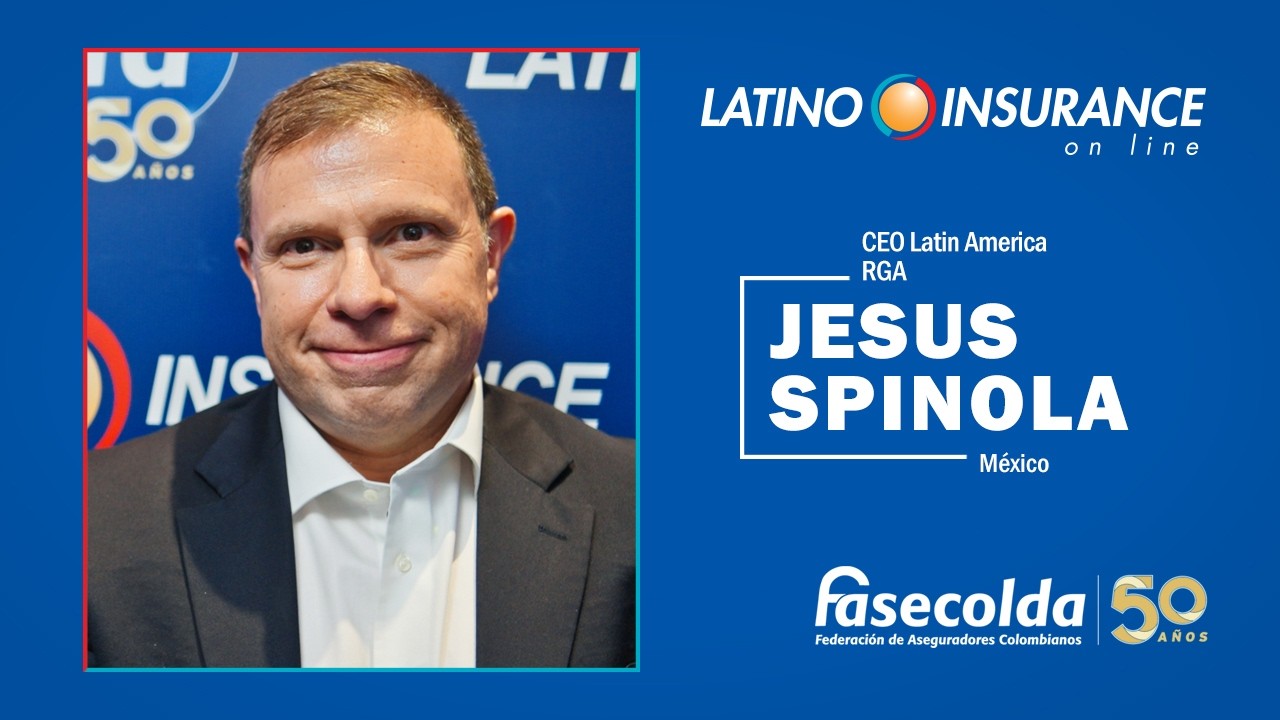
A regional brief also means keeping conversations going beyond Mexico. In October 2026, Spínola appeared in a convention interview during Fasecolda’s 50th anniversary gathering in Colombia. It is another public glimpse of the role: an executive based in Mexico taking part in an industry discussion elsewhere in Latin America, carrying a remit that extends across national borders.
Technology needs a place at the table
In August 2023, he welcomed another industry gathering at Torre Reforma, this time a two-day seminar on underwriting and life insurance. The event also reached regional attendees virtually. Later, he joined a panel on electronic underwriting alongside Smitha Ramgopal, Keiko Imuro and Gerardo Ledesma, with Dominique Hierro moderating. The discussion concerned how feasible its implementation would be in Latin America.
That question is usefully less theatrical than a promise about the future. Feasibility invites people to consider the actual conditions of implementation. It puts an executive in conversation with underwriting, operations and product specialists. A digital process has to pass through those disciplines before a customer experiences it as something pleasantly straightforward.
Spínola’s work also includes supporting professional education through courses, seminars and industry speakers in Mexico. His public biography identifies engagement with events associated with the Asociación Mexicana de Actuarios and the Asociación Mexicana de Instituciones de Seguros. Alongside the commercial role runs this recurring activity of convening people who work on different pieces of the same business.
Read together, these appearances suggest a consistent professional concern: how to bring an idea closer to the conditions in which it must function. The customer needs something. The insurer needs a workable offering. Specialists need to examine the assumptions. Technology supplies tools, and distribution supplies access. The executive’s task is to keep those conversations connected long enough to produce something useful.
Back at INSPARK, clients had been invited to enjoy a little simulated flight. Spínola’s other invitation was to an office, where the work would continue. There is a pleasing balance between the two. New experiences can attract attention. A place where people are welcome to return gives a business relationship somewhere to go.