The customers needed help measuring financial risk. Then they became the risk. During the 2008 crisis, banks and brokers stopped paying SuperDerivatives, according to founder David Gershon’s later account. The company cut costs, dismissed employees and changed its sales emphasis. A business built to put useful prices on complicated instruments had encountered an uncomfortable number of its own: cash that was not coming in.
Six years later, Intercontinental Exchange bought it for approximately $350 million. Between those events lies the useful SuperDerivatives story. There was a clever pricing model, certainly. There was also the less glamorous work of collecting elusive information, packaging it for different buyers and getting it onto desks where decisions were made. The software could do the mathematics. The company had to make the economics work.
The price behind the price
Gershon founded SuperDerivatives in 2000 after a career in options trading that included Barclays. His training in physics gave him mathematical tools; the trading desk supplied the irritation. He wanted prices that reflected the market, rather than theoretical values alone. Euromoney’s 2005 profile described SD-FX, launched in 2001, as a service covering ordinary currency options and more than 90 classes of exotic options. Its readership was professional: banks, corporate finance teams, funds and other institutions.
Consider the practical distinction. A model can value a contract under a set of assumptions. A trader also wants to know how that contract compares with what dealers are quoting. For an instrument negotiated over the counter, gathering those inputs can be a job in itself. SuperDerivatives made that gap its territory: market observations, pricing calculations and tools that helped users investigate the answer.
In a 2012 WatersTechnology interview, Gershon described having to contact brokers for the inputs his model required. The company developed a data operation to gather rates and prices around the world, including difficult corners of commodities and emerging markets. The apparent software problem had created a sourcing problem. Solving the second gave the first commercial value.
“Our number one challenge is to find the data.”David Gershon, speaking to WatersTechnology, 2012
The technical documentation makes the point unusually tangible. For commodity options, the SuperDerivatives model uses at-the-money volatility alongside measures of skew and convexity for each maturity. Those inputs help describe the volatility smile: the way implied volatility varies across option strikes. Behind a price that appears neatly in a box sits a view of how a market behaves. A missing or stale input matters.
Then the customers stopped paying
Gershon’s June 2024 CTech interview supplies the blunt version of the downturn. He returned from London to the Israeli development operation, reduced expenses and shifted toward selling data instead of systems. In his account, the business was back on track in 2010. The change came with layoffs. It was a response to customers’ financial distress, with a human cost inside the supplier.
The distinction helps explain the company’s subsequent product range. Data could be sold as a useful input in its own right, while applications still gave customers ways to examine it. The inference is commercial, not mystical: if the same information supports several tasks, a vendor has more than one way to charge for supplying it. SuperDerivatives continued building software, but the underlying information had acquired a more visible place in the proposition.

SDX arrived with a launch date that practically wrote its own invitation: 10/10/10. The multi-asset front-office system combined pricing and structuring with spreadsheet interaction, historical simulation and workflow tools. Its announcement also promised the ability to upload customers’ own models. That detail matters. Professionals could bring their existing methods into the software instead of surrendering every assumption to the vendor.
A $1,500 invitation to the trading desk
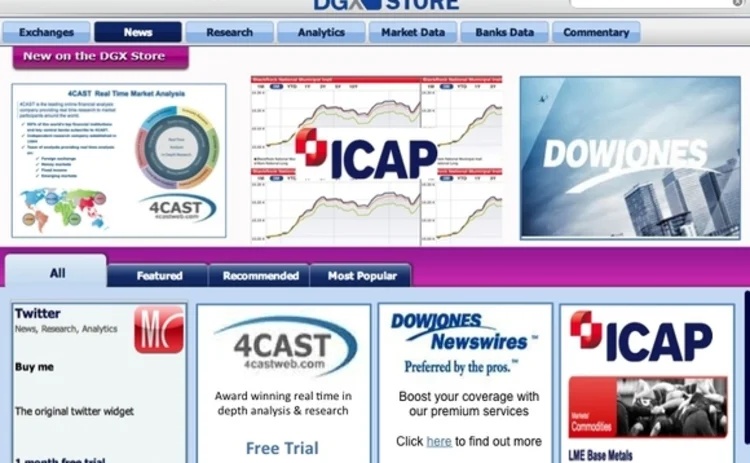
DGX broadened the ambition. Introduced in late 2012, it took SuperDerivatives into the financial-data desktop business, with a browser-based display and an app-store approach to extra services. Charts, news and data lived together. The target was recognizable: the expensive information terminal that had become part of financial working life.
Euromoney reported a $1,500 annual base fee for new customers after a free period through summer 2013. Existing SuperDerivatives customers were offered DGX without an additional charge, while specialized information could be bought through apps. The same report put Bloomberg’s typical base terminal bill at around $20,000 a year. These were contemporary offers with different coverage, not interchangeable shopping baskets - and certainly not today’s prices.
Early-2010s base-price comparison. Different entitlements; paid additions excluded.
The pitch earned attention. In February 2013, SuperDerivatives announced more than 23,000 DGX registrations in its first month. By July 2014, Institutional Investor reported that the platform had passed 100,000 users. Neither number establishes how many paid, renewed or abandoned another terminal. They do show why a lower-cost web product could become a conversation on a trading floor.
Product expansion followed specific demands. In March 2013, the company announced plans to add mutual-fund coverage in response to clients. That was a different use case from pricing an exotic currency option. The shared interface gave SuperDerivatives room to reach people whose daily information needs extended beyond its original specialty.
From a quote to a trade
The alphabet soup needs decoding. SDX was the analytical working surface for pricing and structuring. DGX was the broader information environment. SDeX, launched in 2014, connected to SDX for trade execution across banks and asset classes. Similar names, different moments in the working day. A person might investigate an instrument, decide on a structure and then seek a trade.
Alfa Capital provides a concrete historical example of the analytical need. Reporting in 2013 described the Russian asset manager adopting SDX as its structured-products operation expanded into more complicated instruments and international markets. It needed real-time price indications and tools for analysis before a trade. The customer problem was a growing product menu that demanded better ways to understand what was on it.
Another expansion addressed credit-index options. In November 2013, SuperDerivatives added data and analytics covering instruments linked to indices including iTraxx and CDX. Global Custodian reported more than 20 asset managers and hedge funds already using the service for pricing and revaluation. Here the audience was seeking help assessing and monitoring specific positions, rather than simply reading market headlines.
Partnerships also made the products useful across boundaries. A 2005 collaboration with CME compared currency options in exchange-traded and OTC markets, translating between volatility quotations and exchange tick prices. Bank of Montreal/Harris Nesbitt was a named user. The benefit was prosaic and valuable: compare opportunities without rebuilding the calculation by hand. Later, work with FXCM produced the Deal-X options platform, bringing the company’s technology into electronic negotiation and trading.
The buyer already owned the exchange
ICE announced the completed acquisition on October 8, 2014; the transaction had closed the previous day. Its stated rationale connected SuperDerivatives to market data, risk management and clearing. The fit extended beyond supplying a screen. An exchange and clearing operator also has reasons to care about dependable information on instruments that are difficult to value.
The familiar $350 million figure was the approximate cash price in the announcement. ICE’s 2014 annual filing subsequently recorded $358 million in cash consideration. It was a purchase of the company, not a venture funding round. Calling it funding obscures the actual outcome: ownership passed to an operator that could put the technology into a larger financial-services business.
Today, ICE explicitly identifies SuperDerivatives’ integration into ICE Data Derivatives. The current offering covers market data and analytics across currencies, rates, credit, equities, energy and commodities. It supports work before and after execution, with information delivered into customer systems as well as analytical applications. The present-day company profile therefore needs a date stamp: the independent challenger belongs to the historical story; the technology continues inside ICE.
The part worth copying
The transferable idea is to study the work required to make a product useful. SuperDerivatives’ calculation depended on information that was awkward to obtain. Gathering that information created something it could sell in several forms. For another enterprise supplier, the equivalent might be a difficult dataset, a verification process or a specialized integration. The opportunity lies in finding which supporting work customers would pay for separately.
There are limits to that inference. A clean interface cannot compensate for unsuitable coverage. ICE’s own documentation qualifies historical depth by the underlying instrument, and its SDX help pages explain how users can substitute their own rates. Buyers still need to judge whether the inputs, models and delivery methods suit their books. A low subscription price alone cannot settle those questions.
SuperDerivatives’ story rewards a close look beneath the display. The market-data collection, the customer’s spreadsheet and the route from analysis to execution each mattered. The company began with a trader’s frustration about finding prices. Its eventual buyer wanted those capabilities working across a much larger operation. That is a more useful explanation of the sale than any promise that mathematics could make uncertainty disappear.