Consider the dog. A hotel reservation usually begins with a guest and a room. At a wingshooting lodge, the same booking may also require a guide, a field, and a dog. YellowStone’s Zenith Mobile includes tools for assigning fields and dogs, recording bird counts, and adding purchases to a reservation from the field. That small detail explains quite a lot about RBS. Its starting point was hospitality with an unusually complicated calendar.
- Three working worlds: YellowStone for outdoor hospitality, WinCloud for hotels, Hashmato for foodservice and retail.
- Expansion by acquisition: specialist products brought RBS into adjacent markets.
- The useful lesson: test a complete guest journey before buying a collection of features.
The information arrived too late
In an interview with Jens Heitland, founder Glenn Turner describes a friend’s hospitality business struggling to get timely information and control its operations. Turner spent a year working on finance and IT there. He then bought one of its software suppliers, whose technology he describes as legacy, and concentrated on moving the software onto the web.
The problem he encountered was delayed visibility into the business. His first market was hunting and fishing lodges and dude ranches around late 2019 and early 2020. Later, he says, he recognized substantial overlap with hotels and restaurants. Acquisitions became the route into those markets. Read that sequence closely: observe the work, modernize an existing tool, then look for neighboring businesses with related needs.
There is another detail in the origin story. Development firm Pale Blue Software identifies RBS as its first customer, describing work on YellowStone around December 2019. Its account places the product inside a longer working relationship between Turner and software developer Hasan Ahmad, whose previous projects included accounting and inventory systems. Hospitality software grew from experience with the less glamorous mechanics of running a business.
A reservation with moving parts
YellowStone’s core platform brings bookings, itineraries, payments, and operating details together for ranches, lodges, and outfitters. Its product page describes collecting deposits, applying refund policies, coordinating guides, and tracking meals and gear. These are connected tasks. A reservation change has consequences beyond the room chart; someone must know which people and resources are still needed.
- 01BookGuest + lodging
- 02AssignGuide + crew
- 03CoordinateField + activity
- 04SettleCharges + bill
The product family follows that logic into the workday. Geyser handles employee timekeeping across roles. E-Waiver gathers signatures, licenses, and guest information before arrival. Online Booking passes reservations and availability into the system. These optional tools make the proposition specific: an operator can start with the core platform and add capabilities for the work the property actually does.
“It was never built to replace hospitality; it was built to protect it.”Glenn Turner, on YellowStone, December 2025
Buying a bigger map
RBS’s move into conventional hotels had a concrete turning point. A February 2025 announcement said it had entered an agreement to acquire Chennai-based Winsar Infosoft on January 27. Winsar brought WinCloud and an established international footprint. The announcement described a combined business serving nearly 2,300 customers in 35 countries, extending RBS beyond its North American specialty market.
WinCloud’s remit includes front office, point of sale, financial accounting, banqueting, and materials management. Its accounting tools include property-level financial analysis; its purchasing tools can consolidate requirements across properties. This gives hotel groups a different center of gravity from a lodge coordinating guides. The shared concern is whether operating information reaches the people who need it.
In September 2025, RBS acquired Singapore-based Hashmato, formerly Dineplan. That brought restaurant and retail capabilities including kitchen displays, waiter apps, kiosks, online ordering, inventory, and analytics. The portfolio now covers several distinct working environments. Keeping the product names makes practical sense: a kitchen queue and a hunt schedule call for different tools, even when both depend on orderly handoffs.
The conversation joins the system
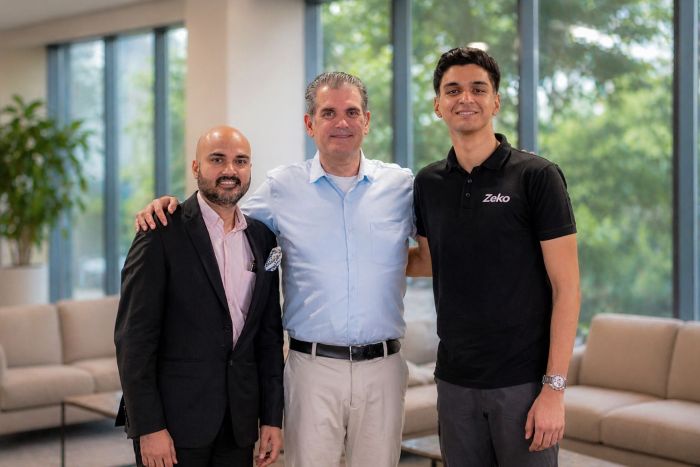
The next addition reaches toward the guest. On April 27, 2026, RBS announced its acquisition of Zeko, whose tools include AI-powered upselling, WhatsApp automation, digital check-in, and concierge features. The announcement describes Zeko as a layer that works alongside existing property management systems. Financial terms were undisclosed.
properties in more than 35 countries, according to RBS’s April 2026 announcement.
That acquisition puts a more concrete shape around RBS’s stated AI ambition. Another example arrived in August 2026, when the company detailed WinCloud’s Feedback Module: surveys for different service touchpoints and a dashboard tracking ratings, negative feedback, and active forms. The practical question is whether that information helps staff notice and resolve a problem during the guest’s experience.
Support is part of the proposition, too. RBS describes its team as including former general managers, guides, outfitters, and frontline managers, and says it handles onboarding in-house. Its partner network includes Basys for payment processing alongside hospitality and outdoor associations. These relationships matter because a property management system sits between several parties: staff, guests, payment providers, and distribution services. The software has to work across those boundaries. A familiar interface is helpful; a dependable handoff is what keeps the day moving.
Bring your awkward booking
RBS sells business software through product demos and modular offerings. WinCloud tells operators to choose the tools they use. Its published onboarding process includes configuration, training, testing, and go-live; its FAQ estimates setup at roughly two to three weeks, depending on property size. The purchase therefore includes an operational transition. Someone must prepare the property’s data and teach the team its new routines.
The competitive field includes Oracle OPERA Cloud, Mews, Hotelogix, and RMS Cloud. RBS’s distinctive position is the combination of outdoor specialization and acquired hotel and foodservice expertise. Industry relationships reflect that range: it appears among the Boutique & Luxury Lodging Association’s Inner Circle partners and has worked with the Texas Trophy Hunters Association.
For a buyer, the lesson is to bring the awkward reservation to the demo: change the dates, reassign the guide, adjust the deposit, then close the bill. WinCloud’s FAQ says channel managers and booking engines are third-party integrations, so those connections need testing too. A property whose required integrations or working routines do not fit should keep comparing. RBS’s most instructive detail remains that dog roster: useful software pays attention to the things its customer has to remember.