The lawyers at aosphere do not keep timesheets. For a business born inside Allen & Overy, that is a revealing detail. Their job is to build and maintain something subscribers can use again tomorrow: a structured answer to a legal question that keeps coming back.
Consider a bank planning to market a financial product abroad. Its question sounds innocent enough: can we offer this here? The answer can depend on the product, the customer, the activity and the jurisdiction. Multiply that across a global institution and a quick query becomes a recurring research assignment. aosphere packages that work into online subscriptions, with detailed legal memoranda underneath summaries, comparisons and alerts.
The company says more than 1,400 institutions and 20,000 individual users now use its services. Its customers span banks, asset managers and private-wealth businesses. Recent acquisitions have widened both its audience and its ambitions: the company increasingly wants to help people apply the answer as well as read it.
Company-reported figures · September 2026
First came the beach balls
The founding product had an admirably short central question: does netting work? netalytics began in 2001 as a joint venture with ISDA, the derivatives industry association. aosphere dates its establishment to 2002. Netting analysis examines whether contractual arrangements can support offsetting obligations, a consequential issue when a counterparty fails.
In a 2021 recollection, derivatives specialist Victoria Wells described helping devise the original template: 13 questions, accompanied by traffic-light colours. The awkward part came next. Answers from different jurisdictions had to be made comparable without losing the qualifications that gave them meaning. She remembered the work proving much harder and slower than expected.
The team’s conference debut was less polished. At the 2002 ISDA AGM in Berlin, the stand had laminated A4 signs and beach balls to give away. “We had no idea how to sell a ‘product’,” Wells recalled. Yet visitors queued, and customers’ gratitude helped establish that the workload they were removing mattered. The useful invention was the disciplined question set behind the coloured flags.
The answer has to survive Monday morning
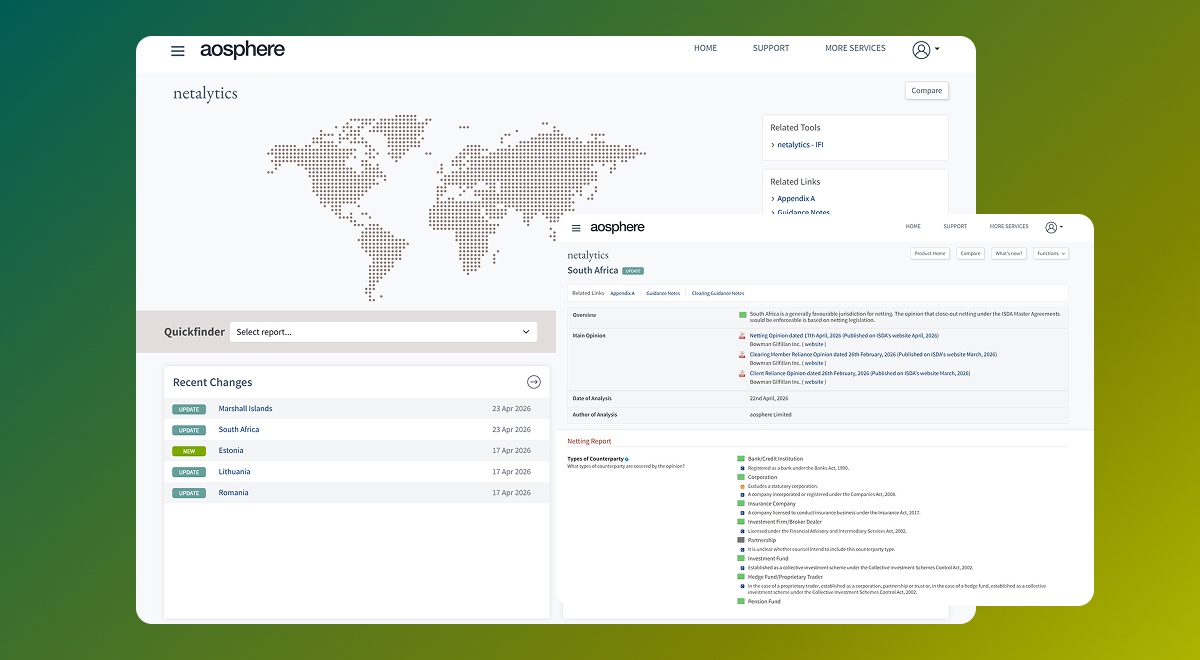
Today’s netalytics addresses 14 key netting questions across more than 80 jurisdictions. It extracts core information from ISDA opinions into a common format, with comparison, version control and email alerts. A specialist can begin with the report, then investigate the supporting detail. The format gives teams a repeatable starting point for their work.
The maintenance problem becomes particularly visible in repoAnalytics. It examines legal opinions on the Global Master Repurchase Agreement, covering close-out netting and title transfer. aosphere points out that these opinions tend to be republished together each year. Legal departments face a sudden pile of reading; its team extracts and republishes the relevant analysis. Commonwealth Bank of Australia supplies a named testimonial describing the product’s usefulness in counterparty negotiations.
Elsewhere, Rulefinder Shareholding Disclosure covers more than 100 jurisdictions, including major shareholdings, short selling, sensitive industries and foreign investment restrictions. The product reports more than 450 institutional subscribers. Its practical apparatus includes threshold tools, a developments tracker, custom reports and access to local counsel memoranda. That matters because a threshold without its calculation rules and exceptions can be a misleadingly tidy number.
Marketing Restrictions tackles another category of recurring questions. Its sell-side service covers more than 65 jurisdictions and distinguishes financial products, services and activities in an activity matrix. Banks can research the conditions around distributing debt, equity, derivatives or other offerings. Separate asset-management coverage addresses fund and advisory-service distribution. The common format makes comparison possible; the underlying legal work supplies the distinctions.
- 01Local legal analysisJurisdiction-specific memoranda
- 02A consistent question setComparable reports and exceptions
- 03Changes made visibleAlerts, trackers and version history
- 04A decision inside the firmApply policies, review and record
A subscription buys maintenance, too
aosphere’s commercial model is refreshingly specific about its rules. Its commercial FAQ describes annual subscriptions, standard terms and pricing tiered by an organisation’s size or type. It says individual clients do not negotiate discounts, although some subscriptions can attract multiple-purchase or introductory discounts. Several products, including Data Privacy and e-Signatures, offer unlimited users across an organisation.
The sensible cost comparison is therefore an annual research budget: what does the relevant subscription replace, how often will people use it, and which specialist questions still go outside? aosphere offers demonstrations and trials. A useful trial would test familiar jurisdictions and difficult recurring questions, so a buyer can assess both the answers and the work required to apply them.
The scope has boundaries. Subscription content is generic; the commercial FAQ directs institution-specific or urgent requests outside that scope to local lawyers or other experts, who may charge separately. The economics are most persuasive when many clients need a maintained version of the same research. An unusual transaction requiring bespoke advice is a different purchase.
A legal career built around a product
The employment model follows the product model. aosphere describes a workforce of more than 150 professionals, with lawyers averaging about 20 years’ experience. Its careers material emphasises flexible arrangements and autonomy, alongside commercial, technology and customer specialists. Business development colleagues carry responsibility for revenue growth; lawyers concentrate on the subscription products.
That is a meaningful organisational choice. A question resolved carefully for one report can serve many subscribers. Improvements to the template, editing and update process can have value across the customer base. The company is still selling expertise, but it packages the result so customers can return to it without commissioning the same exercise afresh.
Independence came with an IT department
In February 2024, investment from Inflexion and Endicott helped carve aosphere out of Allen & Overy. The transaction supported an independent subscription business, with continuing minority participation from the A&O side. Marc-Henri Chamay, its co-founder, later moved from chief executive to chair.
Independence required infrastructure. Inflexion’s January 2026 account describes new finance, technology and HR systems, functional leadership hires and a larger commercial team. It also says BRP had been a long-considered acquisition target that was previously out of reach. “The first six months were tough,” Chamay said. The documented friction was the work of separating a business from its parent.
The acquisitions explain the direction. Switzerland’s BRP Bizzozero & Partners joined in September 2024, bringing private-banking and wealth-management compliance expertise. Investment Navigator followed in September 2025, adding digital cross-border manuals and investment-product eligibility checks. Those purchases make the expanding client totals meaningful, but they also mean readers should not treat the increase as a pure measure of organic growth.
Robert McKay’s appointment as CEO in November 2025 added experience from regulatory information and decision tools, including roles at Neustar and Accuity. By May 2026, the private-wealth Country Manuals were available exclusively on aoslogin, with redesigned navigation and active and passive scenarios displayed side by side. The acquisitions were beginning to meet on the product screen.
“The first six months were tough.”
Marc-Henri Chamay · on the carve-out

From looking up a rule to applying it
aosphere has long supplied other companies’ software. FundApps dates its licensing of aosphere disclosure content to 2012. In a 2024 interview, aosphere’s Faye Sutherland explained that customers had started asking about rules engines after using the research service. The response was to license legal information to regtech vendors that could combine it with positions and market data. FundApps is consequently an awkward name for a simple list of rivals: it is also a route to market.
The newer AssuriFI portfolio brings operational tools under aosphere’s own offering. Cross-Border Activity Check turns banking manuals into guidance for client-facing staff, with internal controls, sign-off and audit trails. Counterparty Control uses AI-supported lookup of a Legal Entity Identifier to propose a counterparty classification, accompanied by rationale and supporting material. Legal staff approve mappings before reuse. Its product page distinguishes the available first module from further modules still described as coming soon.
AI also appears in Intelligent Search. Its public explanation describes answers drawn from aosphere’s own legal analysis, with links back to the relevant memorandum sections. The Data Privacy product includes the search feature alongside research tools and an AI Regulation & Governance module. This is a practical place to judge AI: can a user inspect the reasoning’s legal basis, and does the answer help them reach the right passage faster?
Copy the questions before the software
For another expert business, aosphere’s example suggests a concrete starting exercise. Collect the questions that recur across customers. Decide which parts can share a common structure. Keep the supporting detail accessible, and assign responsibility for updates. Then test whether the result helps people complete a real task. The software has something useful to organise once that work exists.
The scope of the task matters just as much. Rulefinder e-Signatures, for example, examines electronic execution across more than 60 jurisdictions: document types, signatories, registration and enforceability. It helps research signing requirements rather than collecting signatures. That distinction captures what a buyer needs to establish across aosphere’s range: which decision does this product support, and what work remains with us?
Its current operational tools make that remaining work explicit through internal policies, review and approval. A bank still supplies its own context and judgement. aosphere’s opportunity is to make the research behind those decisions easier to reuse, inspect and maintain. Even with AI in the search box, the business still depends on someone getting the legal detail right.