A pub jam session is an unlikely place to look for a regional chief executive. Yet it supplies a useful opening to Brad Howell's story. In 2000, Howell, Jason Howell and Victor Gugger founded Market Rock, bringing musicians from the financial markets together for a band night. The proposition was pleasantly uncomplicated: people who spent their working lives in finance could make some noise for charity.
The event grew to attract more than 800 industry representatives and reported raising over $1 million. Those are historical figures, rather than a running total. They describe an idea that acquired an audience, sponsors and, eventually, a formal nonprofit structure. An evening at the pub had developed an obligation to survive its founders' initial enthusiasm.
Howell's other occupation involves assembling people too. Based in Singapore, he is BGC Group's chief executive for Asia Pacific, with a career reaching back to Australian broking desks in the early 1990s. The band night and the brokerage belong to different worlds of accountability. They do, however, pose a similar practical question: how do you get the right people into the room?
Industry representatives attracted to Market Rock, according to its published history.
A historical attendance claim, not a current event count.A band night acquires a constitution
There is something cheering about a finance-industry event whose central attraction is a band. The usual professional gathering asks participants to exchange cards and remember names. Music gives them another reason to turn up. It also permits a modest rebellion against the idea that a person's job title is the most interesting thing about them.
Market Rock's incorporation made that informal appeal more durable. Its stated intention was to preserve the event's longevity and prevent its commercialisation. That is a revealing choice of ambition. A successful charity night can be valuable precisely because it retains its original purpose when more money, larger audiences and competing interests arrive.
The organisation's committee listing names Howell as president, Jason Howell as vice president and Gugger as public officer, alongside a treasurer and secretary. These are rather less glamorous titles than lead guitar. They are also the sort of jobs that keep an enjoyable idea functioning once somebody must answer the administrative questions.
Read alongside his executive work, Market Rock adds a particular dimension to Howell's public life. He has helped create an institution outside his employer, with other founders and its own governance. The achievement is collective. Its appeal lies partly in that fact: colleagues become participants, and a network has a use beyond the next transaction.
Before the regional title, the rates desk
Howell's professional training was in the substance of financial markets. He earned a Bachelor of Business at the University of Technology Sydney, majoring in finance and accounting, and a master's in applied finance at Macquarie University, specialising in financial markets. Those subjects supplied a technical foundation for a career spent around prices, instruments and institutional clients.
His working history began in broking in 1992. It included Eurobrokers Australia, Prebon and ICAP, with interest-rate derivatives a recurring specialism. Before taking the top job at ICAP Australasia in October 2010, he had headed its swaps desk. The progression ran from a product and its customers to responsibility for a business.
That distinction matters when reading an executive biography. A regional title can make an entire career sound geographical. Howell's earlier work was organised around a particular market. Running an Australian-dollar rates business required knowledge that could be tested in a conversation with somebody whose own work depended on getting the details right.
By 2017 he also held ICAP's Asia-Pacific head of global broking responsibilities. The scope had widened considerably. His later move to GFI would place that experience inside a competing organisation, and eventually within the broader regional leadership of BGC.
- 1992Begins a career in interdealer broking
- 2010Becomes CEO of ICAP Australasia
- 2018Starts work at GFI after notice period
- 2022Represents BGC as Asia-Pacific CEO in its Bitcoin-options announcement
A departure with consequences
The transition was contested. Howell signed an employment agreement with GFI in September 2017, resigned from ICAP and began at GFI six months later. Recruitment of brokers around that move led to litigation in the Supreme Court of New South Wales.
In its June 2021 judgment, the court criticised Howell's credibility on material aspects of his evidence about assisting GFI's recruitment. The outcome must accompany that criticism: the court answered no when asked whether he had breached a contractual, equitable or statutory duty in a way entitling ICAP to relief. It said ICAP's claims against him were to be dismissed.
The episode belongs in his career because a change of employer involved contested obligations to the old one. It also illustrates how consequential relationships can become in a business built around specialised teams.
Tokyo, one desk at a time
By November 2019, Howell was speaking as chief executive of GFI Asia Pacific about the reopening of its Tokyo office. The location was Akasaka Biz Tower. The launch product was G10 forward foreign exchange, covering the yen and other major currencies. Expansion arrived with a specific desk and a list of things it would trade.
He described Japan as a key strategic growth area
. That phrase could have remained safely abstract. The office made it concrete, adding Tokyo to GFI's existing forward-FX businesses in Hong Kong, Sydney and Singapore, with support from London and New York. The regional map gained another place where Japanese and international customers could reach the business.
“A key strategic growth area”
Brad Howell on Japan, November 2019
Forward currency trading has a reassuringly practical place in this account. Currency exposure reaches businesses that never think of themselves as financial businesses. An executive's announcement about opening a desk can therefore connect a specialist brokerage operation to the ordinary need to arrange an exchange of currencies for a future date.
The ambition Howell expressed was a long-term commitment to Japan's financial markets. He paired that commitment with a core product. In this part of his career, growth had an address, a team and a recognisable customer requirement. It was a rather more useful description than a promise to be everywhere.
The microphone changes hands
There was another version of professional assembly during Howell's ICAP years. At its Sydney charity day in December 2014, staff appeared in costumes and visiting ambassadors joined the phones. Deborah Hutton took part and helped close a billion-dollar currency deal. The day's commissions were designated for charity.
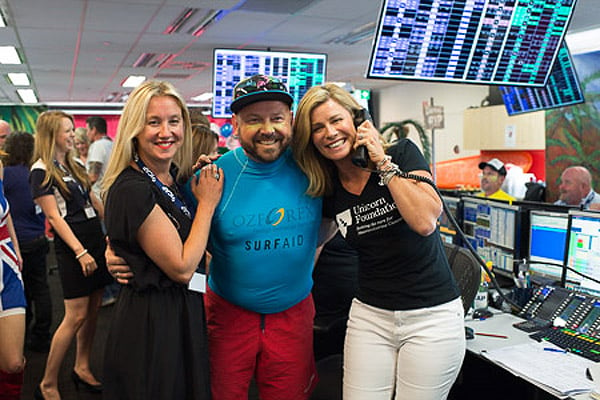
A billion dollars makes a fine anecdote, provided the distinction stays clear: the transaction's value was not the donation. The fundraising mechanism was the commission. That small accounting detail makes the event more interesting. An institution used the work it already knew how to do, and redirected the proceeds for a day.
Howell was among those thanked for the event. His volunteering also included a fundraising-committee role at Royal Far West from 2012 to 2014. These activities sit alongside Market Rock as concrete commitments, with dates, other participants and practical responsibilities. They give the charitable part of his biography more shape than an expression of goodwill.
A familiar intermediary in a newer market
In July 2022, the instruments had changed. GFI's Hong Kong securities business announced that it had arranged an intermediated block trade of CME Group Bitcoin options between Cumberland DRW and Goldman Sachs. BGC described it as the first such trade in Asia. Howell, identified as its Asia-Pacific CEO, spoke for the regional business.
The phrasing of the milestone deserves care. It concerned a particular kind of options transaction, involving a particular exchange's contracts, and a particular form of intermediation. The narrower description is the informative one. It shows an established brokerage connecting institutional counterparties in a newer asset class.
Howell's stated aim was to expand BGC's cryptocurrency offering and work with counterparties as that market developed. The announcement also described plans for electronic platforms and voice or hybrid brokerage desks. Even here, the proposed operating model retained people alongside technology.
Counterparty↔GFI
Intermediary↔Goldman Sachs
Counterparty
CME Group Bitcoin options contracts. This diagram shows the announced participants, not transaction size or trading performance.
Today, BGC's Singapore operation lists Howell alongside managing director Gautam Kapur and regional energy, commodities and shipping director Calvin Tan. Its business includes currencies, rates, credit and commodity products. Tokyo's management listing also places him in the regional CEO role. The territory in his title contains quite different markets and local operations.
That is where the pub story becomes useful again. Market Rock began by giving people with a shared professional world another reason to gather. Howell's brokerage career concerns the more exacting work of getting institutions into transactions. One produces an evening's entertainment; the other demands execution. Across both, his record gives a surprisingly concrete answer to an abstract-sounding executive skill: bringing people together needs an actual occasion, and somebody willing to organise it.