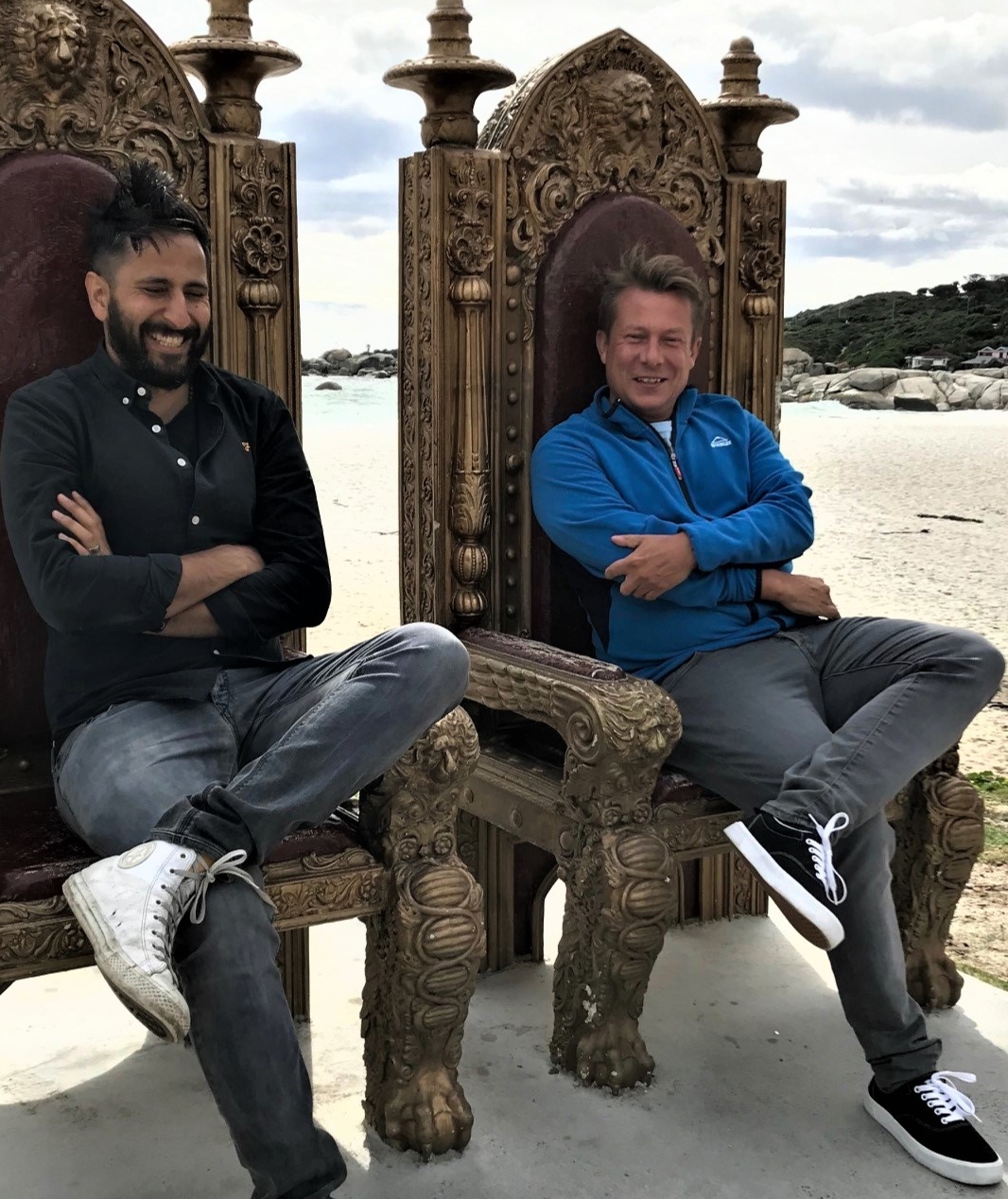
Anurag Bhalla’s introduction to startup life included a hotel booking that left very little room for professional distance. In Ghana, on an early sales trip with Niclas Thelander, the founders discovered that their requested twin beds had become one double. They had chosen to share a room to save money. The hotel had taken the economy rather further.
It is a pleasingly awkward opening for a business concerned with matching people. Today Bhalla is the Singapore-based co-founder and CEO of Outsized, which connects businesses with independent professionals. Its current focus includes banks, insurers, fintechs and consulting firms. Before the platform, the funding and the regional teams came the more basic question of whether two people could build something together.
A burger, a bet, a business
The conversation that drew Bhalla into Outsized happened over a burger near Waterloo station in London. Thelander was setting up a venture focused on growth markets. Bhalla had wanted to start a business and had accumulated savings through a company share scheme. They pooled their money and allowed themselves six months to make it work.
He calls himself “a cheap date if there ever was one!” The joke gives the decision a lightness that its consequences hardly possessed. A salary offers a wonderfully legible arrangement: work, then payment. A new venture substitutes a question mark for the second half. Bhalla brought corporate experience and an appetite to try; neither could guarantee a buyer.
That wager began a partnership with someone whose working style differed from his own. Their disagreements included the full stop at the end of the logo. Punctuation rarely gets a place in a founder biography, though it can offer a surprisingly efficient test of patience.
“We talk a lot”
Anurag Bhalla, on what makes the founding partnership work
The phrase is useful because it makes trust sound like an activity. Partners have to keep explaining themselves, especially when their instincts differ. A shared set of values can give disagreement somewhere to land. The small decisions then become practice for the larger ones: where to spend scarce money, which opportunity to pursue, when to keep going.
Learning both sides of the table
Bhalla’s route to entrepreneurship ran through insurance and consulting. At Legal & General, he became Director of Innovation for Emerging Markets, working on propositions for Asian and African markets. He later worked at Market Gravity and Monitor Deloitte, with a focus on innovation, proposition design and venture building. Those roles placed him close to the difficult passage from an idea to something a customer could use.
There is an earlier, less predictable entry on his CV: a degree in War Studies at King’s College London. It would be tempting to turn that into a theory of his management style. The degree stands perfectly well on its own. Careers sometimes become interesting precisely where the tidy explanation runs out.
The business he joined addressed a frustration Thelander had encountered while working in private equity. Financial-services companies needed people who could carry out growth plans. Finding the right external expertise took work. Bhalla contributed experience in insurance and innovation; Thelander brought the buyer’s problem. Their complementary backgrounds gave the venture a concrete place to begin.
By 2017, Outsized was helping clients scope projects as well as identify suitable consultants. Technology narrowed the possibilities, while outreach and references added human checking. That combination matters to Bhalla’s story. A marketplace can display availability. Understanding whether someone fits a particular assignment requires another kind of attention.
- 01Define the needScope, skills, timing
- 02Curate the fitExperience and availability
- 03Make the choiceClient interviews talent
- 04Start the workContract and onboarding
A simplified view of the company’s current Talent-on-Demand process.
The receipts from the early years
When Outsized closed its Series A in 2023, Bhalla marked the occasion with an unusually candid catalogue of setbacks. The early Africa pitches had generated interest without business. A prospective client repeatedly declined while the founders continued their presentation. Their persistence was rewarded with a cup of tea, which is at least a liquid asset.
Bhalla also recalled moving to India with a newborn daughter, without an entity, team or clients in place. First-year revenue was USD 30,000. These details give the early venture a scale a reader can understand: a family relocation, a business to establish, and sales that had to become more than polite encouragement.
First-year revenue, as Bhalla recalled it in his 2023 account of the company’s beginnings.
The financing round was led by Knife Capital and included FNZ Group founder Adrian Durham. The amount was undisclosed. It backed plans to expand sales and engineering capacity and develop the product. By then, the company was describing a network of 25,000 independent professionals. A financing announcement records one moment; the awkward encounters explain some of the distance travelled.
Bhalla’s recollections also make space for employees. He publicly thanked Amneet Kaur Sahdra for joining when the India operation had no bank account, clients or team. Outsized credited her with helping incorporate the entity, create processes, pitch customers and hire colleagues. These are the tasks through which a company acquires an everyday existence.
The appreciation included her willingness to challenge the founders. That is a useful detail. An early employee’s contribution can extend beyond doing what was asked. Someone has to notice the missing process, question the convenient assumption and insist that the business become better at keeping its promises.
A lighter suitcase
The move to Mumbai also prompted a change in Bhalla’s relationship with possessions. He describes having grown up inclined to accumulate things and reluctant to throw them away. Clearing the family home meant sorting through decades of belongings. He later sold the house and wrote about the relief of owning less.
In his telling, home became more closely associated with family than a physical address. Spending shifted toward people, places and experiences. He began questioning purchases that would add another object to the inventory. One suspects this made shopping a more searching conversation than the cashier had anticipated.
There is a connection between that personal preference and his interest in flexible organisations, though the two need not be identical. Both invite a question about what a person or business must keep permanently. Ownership carries obligations. So does employment. Bhalla’s public writing asks readers to consider those commitments rather than accept them as automatic evidence of progress.
He presents his preference as personal and open to change. That qualification gives it some charm. A founder can develop a conviction without attempting to impose it on every household. The lighter suitcase belongs to him; the reader can keep the bookcase.
The work after the handshake
His advice to independent professionals is practical. Treat the career as a business. Define the offer, understand the customer, plan sales and expenses, develop skills and maintain relationships. An assignment has an end date. A professional needs a view that extends beyond it.
His 2022 consulting-interview discussion with Amneet Kaur and Ines Kossai addressed another part of that preparation: how a candidate communicates and structures thinking. Expertise must be made understandable to the buyer. The person across the table needs grounds to trust the professional in front of a client, as well as confidence in the underlying skills.
On the employer’s side, Bhalla returns to onboarding. Choosing the specialist can be followed by a scramble over contracts, confidentiality, checks and access. The person is ready to contribute while the organisation is still deciding how to let them in. He recommends preparing an internal team before that point.
“I’d say preparation is key here.”
Anurag Bhalla, on integrating independent talent
It is an ordinary sentence with consequences. Speed in sourcing loses value if the arrival creates another queue. For a founder selling access to expertise, the mundane mechanics belong inside the promise. Someone needs to own the handover from a successful match to a functioning working relationship.
Room for a different kind of team
Outsized now describes a platform of more than 60,000 independent professionals globally, including more than 8,000 in Southeast Asia. These are company figures. Its present offer includes individual talent and assembled project teams, with a financial-services focus. Bhalla’s current regional title is Southeast Asia Lead alongside his CEO role; earlier responsibilities covered India, Asia and APAC.
In his September 2025 Human Cloud conversation, he discussed organisations combining a strong permanent core with flexible capabilities. He also explored the professional shift from identifying with an employer to identifying with skills. That shift asks a different question of a career: what remains available when the company name falls away?
The question has a buyer’s side, too. An organisation can have a stable purpose while its next assignment needs unfamiliar expertise. Building a team then involves deciding which capabilities to develop internally and which to bring in for a particular job. Bhalla’s business operates in the space between those decisions, where the length of a commitment has to make sense alongside the work itself.
Bhalla’s answer is rooted in the experience he brings across organisational boundaries. He has worked as the client, moved into consulting and helped build a business serving both. His current commentary favours people who understand delivery as well as advice. A project eventually reaches the point where somebody has to make the recommendation work.
His story returns, finally, to relationships. The partner with a different working style. The early employee willing to take a chance and argue. The professional bringing experience into a new team. Bhalla chose to carry those connections into a business, while gradually carrying fewer possessions between homes. For a founder who once had to negotiate a shared bed, there is something quietly satisfying about making more room.