A car can be a rather elaborate answer to a small question. One person wants to go a few kilometres. The answer arrives with several empty seats, a driver and enough machinery to carry a family. During his Uber years, Alan Jiang noticed the disproportion. In the journeys he observed, 40 percent were shorter than three kilometres, with just over one passenger on average. The destination was nearby. The arrangement was considerable.
The disproportion struck him as inefficient. A short trip with one passenger did not always call for a full-sized car. He had already worked on getting cars to customers across Asian markets. With Beam, which he co-founded in 2018, he turned toward a smaller vehicle for the smaller journey. A purple scooter could offer a different answer to the same everyday question.
There is something appealingly modest about the distance involved. The journey may be to the station, a shop or the next appointment. Nobody needs to cross a continent. Yet making those trips into a business led Jiang through financing rounds, parking systems, municipal limits and, eventually, a merger. The little journey has proved quite capable of producing large complications.
does a short trip need?
His job title was a verb
Before the scooters, Jiang had already founded a company. In 2009 he started Ivy Education Group, advising Chinese students applying to US colleges. He holds a BA in economics from Yale. The early venture concerned access to an institution; his later work concerned access to a city. Both involved helping people negotiate a system whose workings were easier to understand with some assistance.
He joined Uber in 2012 and helped launch its service in China, Malaysia and Vietnam. His role as an International Launcher had an unusually direct name. There was little room to mistake the assignment: enter a market and establish a working business. A 2014 podcast introduced him in that role, discussing the balance of supply and demand and the life of moving between new markets.
Later, as Uber Indonesia’s country manager, he led a market that became the company’s fifth-largest globally. He moved to ofo in 2017 to lead Southeast Asian operations. The sequence put him inside two different approaches to shared transport: booking a car with a driver and accessing a bicycle. Beam would follow with small electric vehicles that customers could ride themselves.
Read together, the roles give his founding story an operational emphasis. The familiar startup image is a person discovering an idea. Jiang’s route included the repeated work of introducing services to places where they had to earn customers and fit local conditions. By the time Beam appeared, he had spent years on the question of whether an apparently simple journey could support a functioning business.
Thirty minutes to find a name
Jiang co-founded Beam with Deb Gangopadhyay, a Yale classmate. Jiang brought his mobility operations background; Gangopadhyay brought experience building technology businesses and working on mobile products. Their partnership joined the work of running a service with the work of constructing it. There was a vehicle in the middle, but the business needed both sides.
The founders gave themselves half an hour to choose a name. They wanted one syllable and a suggestion of movement. Beam satisfied the brief. It is a pleasing detail in a business whose later decisions would involve far less accommodating timetables. A naming exercise can end when the clock does. City operations have a habit of continuing after everyone would prefer to go home.
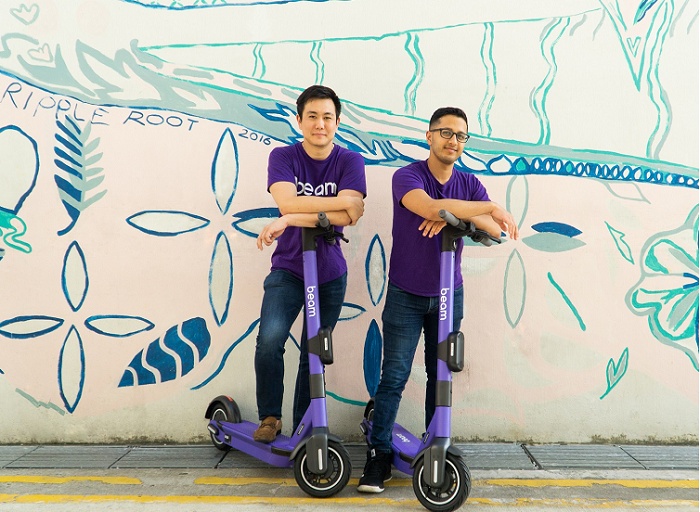
The early team also included Khoa Pham, who became Beam’s third employee after meeting Jiang. Pham had legal experience and already used an e-scooter to get around Singapore. His arrival gives the origin story a useful supporting character: somebody who understood the vehicle as a rider and the venture as a collection of agreements that had to hold.
Beam announced a $6.4 million seed round in October 2018. Its plans put scooters first, with other small electric vehicles in view. The product was compact; the ambitions extended across markets. That difference between the scale of an individual ride and the scale of the operation would remain central to Jiang’s work.
The parking spot gets a vote
A shared scooter has two customers in a broader sense. One rents it. The other must live around it. A ride that ends conveniently for its rider can end inconveniently for a passer-by. Beam’s virtual-dock approach addressed that problem by encouraging people, through the app, to leave vehicles in predetermined locations.
In 2020, Jiang described the approach in terms of keeping streets neater, retaining vehicles and reducing operating costs. Those goals belong together. A scooter placed where it should be is easier for the next rider to find and easier for an operator to manage. It also makes a less irritating acquaintance for the person who has no intention of renting it.
- 01FindLocate a vehicle in the app
- 02UnlockScan its QR code
- 03RideMake the short journey
- 04ParkFinish at an approved location
By 2022, Jiang was describing a service connected through onboard devices, an app and location signals. He also discussed Beam Booster, which linked parking locations with local businesses. A place to finish a ride could become a place to visit a shop. The last few metres of the journey acquired commercial significance of their own.
This is where his smaller-vehicle idea becomes more interesting than its size suggests. The founder has to think about movement and stopping together. A scooter cannot remain an abstraction about urban efficiency when it is standing outside somebody’s door. It occupies a specific patch of ground. The person who controls that patch has a perfectly reasonable interest in the arrangement.
The arithmetic after the applause
Beam raised $26 million in a Series A announced in June 2020, followed by a $93 million Series B in February 2022. The rounds supported a business spreading across the Asia-Pacific region. They also established the financial scale behind a service whose customer might only need a few minutes of use.
Fundraising creates the possibility of more vehicles and better systems. It does not settle what those vehicles cost to operate. By April 2024, Jiang was describing a different emphasis: “laser-focused on operational efficiency and profitability.” Beam reported $53 million in gross revenue for 2023, a 36 percent increase, alongside a 25 percent reduction in group overheads.
The company also reported adjusted EBITDA profitability for the second half of 2023. That is a specified operating measure, not a statement of net profit. The distinction matters to the story. A founder who once introduced services to new cities was now talking about the economics of running them. Opening another market and making the existing business work are related assignments, with different arithmetic.
In his public conversations about entrepreneurship, Jiang has discussed pattern recognition, perseverance and the value of other entrepreneurs as a support network. Those themes fit a career built across several companies and markets. They also leave room for an ordinary truth about operating businesses: experience can help identify a problem, while solving it still requires people who know the particulars.
When the city said stop
In August 2024, Auckland cancelled Beam’s e-scooter licence after investigating its compliance with fleet limits. The council said Beam had exceeded permitted numbers and supplied misleading monitoring data. Its analysis found almost 40 percent excess deployment in two allocation tiers over the period examined. These were the council’s findings, with consequences for the service: vehicles were ordered deactivated and removed.
Jiang acknowledged instances in which Beam had exceeded its vehicle allocation. He apologised for breaches and said the company would revise its processes. Beam announced reviews and the appointment of an independent auditor. His public commitment concerned a thorough revision of the processes behind the breach.
“We have since committed to a full and thorough revision of our processes to ensure this does not happen again.”
Alan Jiang · August 2024
The episode belongs beside the parking strategy and the growth figures. A company can offer a useful trip and still fail a city’s conditions for providing it. For Jiang, the setback exposed the responsibility attached to the operator’s role. Councils needed an accurate account of the fleet. Riders needed access. People sharing the street needed the agreed limits to mean what they said.
The original question about a car’s empty seats had concerned inefficient use of space. Auckland’s objection concerned the terms on which Beam occupied space. That connection makes the episode central to this particular career. Jiang’s proposition depended on making cities work better. Permission to operate was part of the proposition’s practical test.
A rival becomes a colleague
In July 2025, Beam and Neuron announced a preliminary merger agreement. Both companies were headquartered in Singapore. Their announcement set out a combined operation in more than 100 cities, retaining both brands and drawing on their different geographic strengths. Jiang was designated CEO of Asia; Neuron co-founder Zachary Wang was designated Chairman and Global CEO.
The merger moved beyond an announced intention. An investor report for the period ended December 2025 confirmed completion and Jiang’s leadership of Asia operations. Gangopadhyay became a strategic advisor in the announced leadership arrangement. A familiar competitor had become part of the same undertaking.
For Jiang, it is another version of the work he began as a launcher: connecting a service with the places where it can function. The organisation is different, and so is his title. The underlying question remains recognisable. Somebody needs to travel a short distance. Can the vehicle be available, affordable and welcome where it is used? His career has followed that question a long way, usually on behalf of journeys that go almost nowhere.
Continue the journey
- Beam Mobility
- Alan Jiang on LinkedIn
- Jiang’s earlier Uber launch interview
- Launching Micromobility Across Asia - podcast
- Micromobility podcast with Alan Jiang
- Beam video featured in the 2022 interview
- Virtual docks and the 2020 funding round
- Beam’s 2023 operating results
- Auckland Council’s licence decision
- Jiang’s response to Auckland’s decision
- Beam and Neuron merger announcement
- Investor report confirming merger completion