The scooter had a battery that, Skip said, could survive half an hour under a meter of water. This is an unusual selling point for something meant to travel along a bike lane. It makes rather more sense when you remember that a shared scooter belongs to a fleet operator, while briefly being entrusted to just about anyone.
That was the world Skip was designing for in 2019. A rider wanted a smooth journey. The operator wanted the machine back tomorrow. The city wanted its pavement clear. A product that satisfied only the first person was going to have a difficult afternoon.
- Skip rented electric scooters through an app, serving short urban trips.
- It pursued city permits and built hardware around durability and repair.
- San Francisco admitted it to the 2018 pilot, then left it out of the 2019 permit round.
- Helbiz leased its D.C. license; Skip Transport filed for liquidation in 2021.
Today, Skip is an inactive company. This is a history of a service, not an invitation to download an app and go riding. But its brief career leaves a question that matters well beyond scooters: how much of a product must you build before the business around it will work?
01 / THE CUSTOMER YOU CANNOT INVOICEThe scooter had two customers
Skip’s founding team included Sanjay Dastoor, Matt Tran and Mike Wadhera. Dastoor and Tran had already helped create Boosted Boards, the electric-skateboard company. The new venture began in 2017 as Waybots, joined Y Combinator’s Winter 2018 batch, and became Skip. The expertise was unusually relevant: small electric vehicles were familiar territory.
The commercial arrangement was different. A Boosted customer bought a vehicle. A Skip rider rented access to one. Commuters and visitors could use the app to find and unlock a scooter for a short trip, leaving ownership and upkeep to the company. It occupied the awkward space between a walk that feels too long and a car journey that feels unnecessarily elaborate.
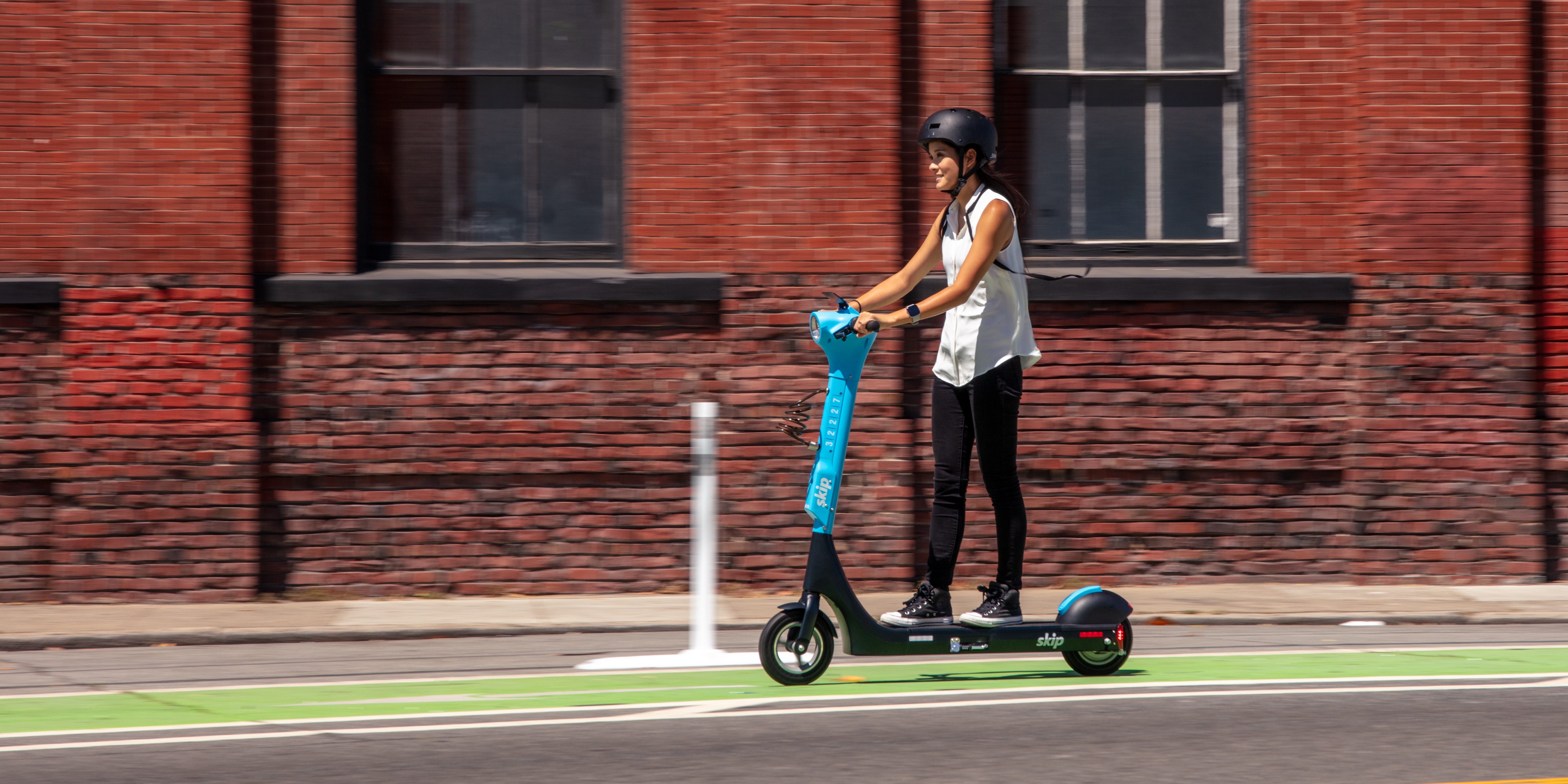
Its reported launch rate in May 2018 was a dollar to unlock plus fifteen cents a minute. Ten minutes therefore meant $2.50 at that rate, before any additional charges. That is a historical price, not a universal tariff for every market or year. The attraction was simple enough: borrow a vehicle for the bit of a journey that needed one.
The rider buys minutes. The operator pays for the whole day.
The other customer never tapped “unlock.” City officials decided whether those machines could occupy public space. Skip’s approach was to work with them before deploying. Dastoor’s argument was practical: consultation could reveal objections early enough to change the service. Rider education and more stable vehicles were part of that proposition.
“By listening, we got to understand what people were worried about and worked out a way to respond.”
Sanjay Dastoor / Willamette Week / August 2018
In San Francisco, the approach helped produce a conspicuous result. Skip and Scoot were the only two operators selected for the city’s 2018-2019 scooter pilot. Each initially had permission for up to 625 vehicles, with potential expansion tied to criteria including equity. Bigger rivals had money and name recognition; Skip had access to the street.
02 / THE HARDWARE ARGUMENTA mechanic’s idea of a good time
A rented scooter is a consumer product with an industrial workload. It must feel approachable to someone using it for the first time and endure repeated use by people who will never oil, inspect or lovingly store it. Skip’s early distinction was a sturdier ride. Its later ambition was a machine designed around the work of running a fleet.
The S3, announced in August 2019, brought larger wheels, a longer and wider deck, brighter lights, rear-wheel drive and a backup foot brake. It also brought less glamorous features: replaceable modules, damage diagnostics, a lock-to system and batteries that could be swapped in the field. These were the advertised design features; their presence did not establish that the company had become profitable.
Earn a fare
Inspect the vehicle
Restore availability
Reach the next rider
Think about the mechanic rather than the marketing photograph. If one component fails, modular construction can let a technician replace that part. If the battery is empty, a replacement can restore the vehicle without a long charging wait. Both ideas attack time out of service. They make the maintenance operation part of product design, where it belongs.
The environmental argument followed the same logic. Skip said field battery swaps could reduce the journeys made by heavy collection vehicles. That is a plausible mechanism, not a complete measurement of climate benefit. Manufacturing, battery life and the travel displaced still matter. A scooter replacing a car trip and a scooter replacing a walk are doing different environmental jobs.
Toyota AI Ventures joined Skip’s extended Series A in September 2019, citing the team’s attention to engineering and operations. Bird and Lime were also developing tougher vehicles. Durability was becoming an industry requirement, making it harder for Skip to own the distinction simply by caring about it first.

03 / A TEMPORARY RIGHT TO EXISTThe permission slip expires
The financial backing was substantial, though the usual total needs unpacking. Disclosed rounds included $6 million in seed funding and a $25 million Series A. Bloomberg also reported $100 million in debt in December 2018. Add those and you get $131 million, but debt and equity are different obligations. That number is neither a spending ledger nor evidence that every ride paid for itself.
Trouble appeared before COVID-19. Battery-related incidents interrupted service in 2019. Skip withdrew its San Francisco fleet after a D.C. scooter fire; D.C. subsequently suspended its permit following further fire concerns. Service later resumed there. These were disruptions to operating continuity and public confidence, not proof of one simple technical cause for the company’s eventual failure.
Then came the permit renewal. San Francisco’s next program selected Lime, JUMP, Scoot and Spin. Skip was absent. The program that began in October 2019 required lock-to devices, clearer parking enforcement, a low-income plan and other obligations. Yesterday’s pilot winner had to qualify again under the next set of rules.
- Skip and Scoot enter San Francisco’s permitted pilot.
- Service interruptions, the S3 announcement and a lost San Francisco renewal.
- Helbiz’s D.C. license lease begins; Skip later files for Chapter 7.
The sequence matters. The pandemic arrived after a major market had already closed to Skip. It would be too tidy to say that the virus killed an otherwise settled business, or that a single fire explained every later event. What the record establishes is that a better vehicle and a cooperative posture had not secured continuous access to both core markets.
04 / READ THE SMALL PRINTWhat Helbiz actually took home
December 2020 news described Helbiz’s deal with Skip as an acquisition. The later filing gives a narrower account. Effective January 1, 2021, Helbiz leased a license to operate up to 2,500 scooters in D.C. for a year, plus nine months of rights to use Skip’s app. It said no other assets were leased or purchased, and that it supplied its own scooters and operations.
Helbiz disclosed $385,000 at signing, $39,000 a month for twelve months, and shares as consideration. The cash portion totals $853,000. Calling that a purchase price for the whole company would misdescribe what the filing says. The agreement illustrates something more interesting: permission to operate retained value even when the original operator was struggling.
In August 2021, Skip Transport filed for Chapter 7 bankruptcy. Liquidation was a separate event from the license arrangement. A successor could serve riders in D.C. without rescuing Skip’s corporate entity. The scooters, the permit and the company were never quite the same thing.
05 / SOMETHING WORTH BORROWINGCopy the repair bench
Skip’s useful idea was to design the ride and the upkeep together. For anyone building shared hardware, the transferable questions are wonderfully concrete. How quickly can a damaged part be replaced? What must leave the street to recharge? Who notices a fault? How does the product behave when its user has no reason to look after it?
The conditions matter just as much. Easier repairs help when technicians, parts and demand are available. Battery swapping needs a dependable supply of charged batteries and an efficient way to deliver them. Neither can compensate for losing the right to operate. A comfortable deck cannot create a protected bike lane, and good conversations with officials cannot guarantee the next permit.
Skip’s story is worth passing to anyone who thinks a physical service can be understood from its app. The screen made borrowing a scooter look simple. Making the next scooter available required machinery, people, public consent and money. Skip understood several of those problems unusually well. Understanding them did not make the others disappear.
Historical website · LinkedIn · Twitter / X · Instagram · Facebook · Company blog
Meet the S3 · San Francisco’s permit history · The Helbiz license agreement · The bankruptcy report
Watch: Dastoor on Climate One’s New Wheels in Town · Watch or listen: building hardware with Sanjay Dastoor