A company that would put bright green vehicles on city streets began with 125 bicycles on a college campus. In June 2017, Toby Sun and his colleagues brought LimeBike to the University of North Carolina at Greensboro. There were no docking stations to build. A rider could find a bicycle through an app, unlock it and take a short trip. The proposition was compact enough to understand before the first pedal stroke.
Greensboro was a revealing choice. Sun was interested in places that wanted the service and would work with the company while it learned. A campus offered people, destinations and repeated journeys in a manageable setting. For a business concerned with the distance between where public transport leaves you and where you actually need to be, those daily movements mattered. The bicycle had somewhere useful to go.
125 bicycles, and somewhere to go
The first fleet was modest enough to count, yet substantial enough to test. GPS, wireless connections and built-in locks allowed the bicycles to operate without fixed docks. The university partnership gave the experiment a defined setting. Sun’s new business could put an idea into circulation and find out whether people would use it.
His explanation of the choice was practical. Greensboro had been considering bike sharing, the campus offered a concentration of potential riders, and local partners were receptive. He wanted smaller, engaged markets where LimeBike could learn before tackling larger ones. Ambition, in this version of the founding story, came with a willingness to begin somewhere that could answer questions.
UNC Greensboro · June 2017
By November, Sun was describing a business that had entered 25 markets, including cities and college campuses. He counted more than three-quarters of a million rides in roughly four months. Those figures belong to that early moment. They show how quickly the little campus experiment became a much larger operating task.
A bicycle on a map is a reassuringly simple dot. The organization required to keep it available is considerably less tidy. Every new location added another set of journeys to understand and another group of people to serve. Sun had entered a business where a successful launch created work almost as efficiently as it created customers.
A city education, followed by a consumer education
Sun was born and raised in Shenzhen. He described a childhood of bicycles and public transport, followed by life in other large cities, including Shanghai, Beijing and San Francisco. Urban congestion was familiar terrain. So was the possibility of getting around without making every journey depend on a car.
Shenzhen also supplied a second education: proximity to the hardware world. A shared vehicle combines a physical object with electronics, software and an operating system on the street. The city in which Sun grew up was a place where connected hardware could be designed and supplied at scale. His account of Lime’s origins joined those two experiences, the journey and the machinery.
His professional route included product innovation and marketing at PepsiCo, consulting at Deloitte and investment work at Fosun Kinzon Capital. He earned an MBA at Berkeley Haas in 2013. The sequence gave him experience with consumer products, organizational problems and the investor’s view of young companies before he became publicly associated with a green bicycle.
Brad Bao entered the story through Berkeley’s alumni network. The two worked together in venture capital before founding Lime. By 2018, their division of responsibilities paired Bao’s attention to internal operations and technology with Sun’s work on external relationships and marketing. Sun described Bao as a mentor. He also remembered Bao’s college rock band and conspicuous hairstyle, a welcome detail in a partnership otherwise easy to reduce to executive biographies.
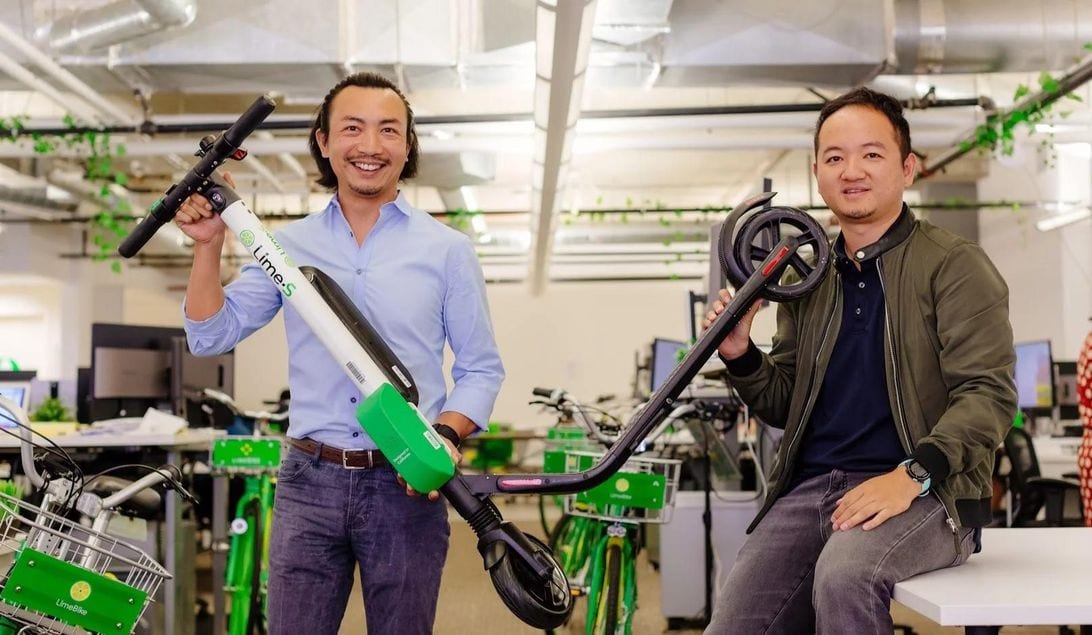
Sun’s own description on LinkedIn is brief: entrepreneur, investor, marketer. Each word catches a different part of the work. An investor examines an opportunity. A marketer explains why someone might want it. An entrepreneur eventually has to deal with the bicycle that needs attention on the far side of town.
The bicycle lost its monopoly
LimeBike began with pedal bikes, but its early product releases suggest that the company’s commitment was to the journey rather than to a particular way of powering it. In January 2018, it introduced Lime-E electric-assist bicycles. An electric motor changed the effort required to travel across a campus or through a city. The shared-use proposition remained familiar.
The following month brought Lime-S scooters. The announcement described testing with city partners and positioned the scooter alongside pedal and electric-assist bikes. That sequence matters. A company carrying the word “Bike” in its name was already giving riders a choice that needed no pedaling at all. Corporate names occasionally discover that customers have been reading them too literally.
Different vehicles could address different trips. The operating question became which option people would choose when they wanted to cover a short distance. Scooters gave Lime another way to meet that demand. Adding them also increased the kinds of hardware, maintenance and street use the company had to manage.
In July 2018, Sun and Bao announced a $335 million funding round led by GV, with Uber participating as both investor and strategic partner. Their announcement put Lime in more than 70 US and European markets. The plans included infrastructure, technology, people and global expansion. Funding gave the business more room to operate; it also gave the operating problems more room to multiply.
The same announcement described cash access and options for people without smartphones. Those provisions broadened the practical meaning of accessibility. A service could have vehicles close at hand and still be difficult to use if its payment or access requirements excluded a potential rider. Convenience has more than one gate.
The sidewalk gets a vote
Shared transport has a peculiarity that many consumer businesses escape: the product spends much of its life in public space. Its customer may be pleased, while the person trying to pass it is less impressed. The rider’s destination becomes everyone else’s surroundings.
A March 2018 letter from the Northwest San Pedro Neighborhood Council captures the bargain in plain terms. The council supported making a Lime pilot permanent, subject to recommendations about parking, removing abandoned or damaged bicycles, responding to complaints and supplying ridership information. It wanted the bikes to work as part of the neighborhood. The enthusiasm arrived with a list of chores.
This is where the first-mile and last-mile idea meets its less photogenic details. A clear driveway matters. So does a clear pedestrian route. The fleet has to remain useful when nobody is riding it. Those obligations are easy to leave out of a story about an app, but they occupy precisely the space in which the app’s promise is tested.
Lime’s early leadership appointments reflected that wider task. In June 2018, it brought in Emily Warren, who had built transportation policy experience at Lyft, to work on policy and public affairs. By February 2019, it was adding its first chief financial officer and chief human resource officer. Sun was helping build an organization that required government relationships, financial planning and people management alongside products.
“We believe that branding and culture are important ingredients for Lime’s success.”
Toby Sun · 2018
The remark is useful because culture, in this setting, has to reach beyond the office. Riders encounter a maintained vehicle or an unavailable one. Neighbors encounter orderly parking or an obstruction. A city encounters a team that responds or one that leaves it waiting. The brand acquires its meaning through those small encounters.
A different job, the same partnership
In May 2019, Bao took over as CEO. Sun’s announced focus shifted toward future research and development and company culture. Joe Kraus became president. The change divided responsibilities differently at a company that had grown rapidly since its first campus deployment.
Sun publicly expressed confidence in Bao and enthusiasm for concentrating on future work while his longtime partner led the day-to-day business. A founder’s title can be an awkward thing to surrender. His explanation framed the change around the partnership and the work that each person would take on.
That July, Sun was in Oslo for Lime’s launch there. The appearance places him on another city’s streets after the CEO handoff, still involved in bringing the service to a new market. He spoke about cooperation with local authorities and developing a code of conduct for riding and parking. The geography had changed. The relationship between a vehicle and the place receiving it remained familiar.
Back to beverages, with an ampersand
Sun’s next venture brings the story back to consumer products. He founded ZERO& in 2020; its first location opened in 2021. The business sold handcrafted fruit teas and desserts. Under Fuji Inc., it sat alongside the bakery brand Hanabi. After the bicycle and the scooter came a cup with a rather assertive punctuation mark.
The preparation took time. Sun described almost a year of testing and evaluating the menu before opening. In a 2022 interview about expansion into Southern California, he emphasized real fruit as a product choice. A drink gives the customer a quick verdict. The recipe and the service have to make that verdict worth repeating.
ZERO& also used an ordering app, with advance orders, store finding and rewards. The digital layer supported a physical transaction, as it had at Lime. Customers still needed the actual product in an actual place. A convenient interface cannot pour the tea.
In March 2025, Sun said ZERO& was closing or relocating some San Francisco stores and negotiating with landlords over rent. He confirmed that its Fillmore Street location would close permanently. The report also described allegations of unpaid rent. Sun attributed accounting difficulties to a change of accountants and said the business was working to catch up. It was a concrete reminder that choosing locations includes knowing when to change them.
There is a continuity in this career that a list of industries can conceal. Sun keeps working with small objects that people encounter during ordinary days: a beverage, a bicycle, a scooter, another beverage. Each needs a reason to be chosen. Each depends on work behind the encounter. The distance to the next corner may be short. Making the trip, or the stop along the way, worth someone’s while remains a substantial job.
More time with Toby Sun
Explore the conversations, career details and companies behind this story.
- Toby Sun on LinkedIn · Twitter / X
- Lime website · Lime’s company profile
- Watch: 50 Markets in 10 Months, Berkeley Haas
- Listen: Toby Sun on the Fifth Wall Podcast
- Listen: How to Scale Rapidly
- The co-founders’ 2018 conversation with NGP Capital
- The early LimeBike interview
- Lime’s 2019 leadership change
- ZERO&’s 2022 expansion plans
- The March 2025 ZERO& report