At a real estate forum in Singapore in May 2023, Stuart Crow offered a domestic measure of the city’s success. His wife, he said, had noticed that even when he was no longer travelling, he was still out all the time. Investors kept coming to Singapore. There were people to see. The airport could give him a break; the diary apparently could not.
It was a small joke from someone whose job involves very large numbers. Crow leads JLL’s capital markets business across Asia Pacific, advising on the money that buys, finances and partners in commercial property. Yet the joke supplies a useful way into his working life. Before a transaction becomes a figure on a spreadsheet, someone has to make time for a conversation.
Before Marina Bay, a tennis court in Kyabram
Crow grew up in Kyabram, in the Australian state of Victoria. His father, Doug, worked in real estate and local government; his mother is Glenys. Stuart attended Dawes Rd school. Among his childhood companions were Nick Stone and Matt Tisdall. Crow and Stone grew up on neighbouring ten-acre blocks on Howards Lane, played tennis together, and formed part of a close trio with Tisdall.
Those details make an appealing opening chapter because they have so little corporate polish. There is a school, a lane, a father’s occupation and a game played with friends. They also resist the temptation to turn a childhood into a business prophecy. Knowing that his father was a realtor tells us something about the household. It does not tell us what Stuart intended to become.
Tennis stayed with him. An older JLL biography describes an enthusiastic player dividing spare time between the court and three children. Property finance has its own elaborate vocabulary, but an appointment with a racket needs very little translation. The continued presence of the game gives the professional biography a welcome change of pace.
Singapore became the base, Asia became the brief
Crow has lived in Singapore since 2001. That places his relationship with the city well before the more recent rush of regional executives and investors to establish themselves there. He has worked across the major Asia Pacific property markets, developing a practice concerned with how overseas money enters local real estate.
His current remit spans investment sales and advisory, equity advisory, debt advisory, and hotels and hospitality. These are different doors into the same building. One client may want to sell an asset. Another may need a partner. Another may want financing that allows it to hold the property for longer. Choosing the appropriate door is part of the work.
A simplified guide to three transaction structures within Crow’s advisory remit.
The distinction matters when reading about him. Crow advises owners and investors; a transaction passing through his team is not his personal investment. The scale belongs to a client mandate and a collective effort. His part is to help connect an asset, a capital source and a workable structure across markets that rarely operate to an identical timetable.
Two towers, several ways of reading a price
Asia Square makes the job tangible. In 2016, Qatar Investment Authority bought Singapore’s Asia Square Tower 1 from BlackRock for S$3.4 billion. JLL was a joint adviser. Crow, then its head of Asia Pacific capital markets, was among the executives explaining the transaction publicly. A sovereign investor, an international asset manager and a Singapore office tower had met in one sale.
The following year, CapitaLand Commercial Trust agreed to buy Asia Square Tower 2 for S$2.09 billion. JLL advised on that transaction too. The two office towers and the Westin Singapore had changed hands through separate transactions in 2014, 2016 and 2017, with a combined reported price of S$5.8 billion. That sequence is more revealing than a single ceremonial deal announcement.
For a passer-by, Asia Square is a place. For its tenants, it is an address. For a buyer, its future income must justify today’s price. For an adviser, it is also a question of timing: which owners want to sell, which institutions can buy, and how competing expectations might meet.
Crow’s commentary around the Tower 2 sale focused partly on the approaching decline in new office supply. That is the less photogenic side of a headline transaction. Behind the tower’s glass sits a forecast about how much competing space will arrive, when it will arrive and what tenants might pay. A skyline looks permanent. Its valuation is full of dates.
The warehouse joins the conversation
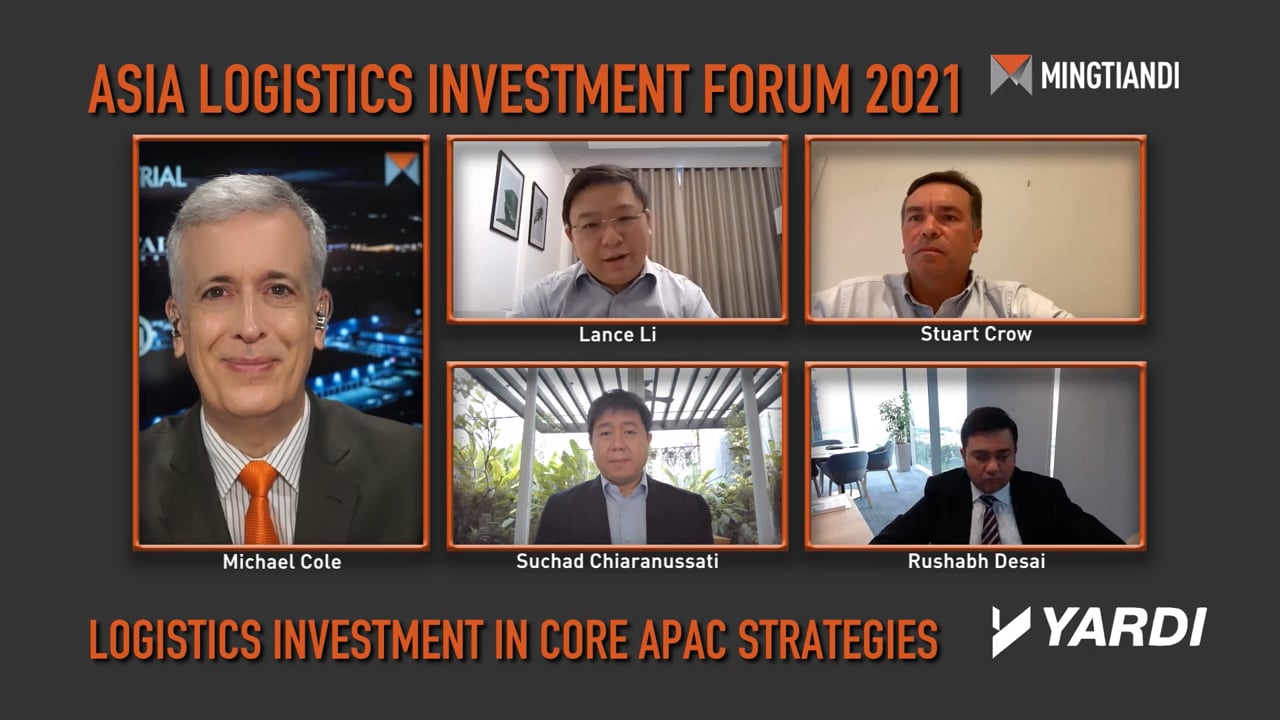
By July 2021, Crow was discussing a rather different property proposition on Mingtiandi’s Asia Logistics Investment Forum. His fellow panellists included BW Industrial chief executive Lance Li, SC Capital Partners founder Suchad Chiaranussati and Allianz Real Estate’s Asia Pacific chief executive Rushabh Desai. Michael Cole moderated. The topic was how warehouses were finding a place beside established office investments in institutional portfolios.
Crow pointed to Vietnam and Indonesia as markets to watch as logistics networks developed closer to consumers. The discussion considered e-commerce, supply chains and the attraction of Southeast Asian markets. It was a useful counterpoint to the towers: a regional property career also requires attention to buildings that attract fewer postcards.
He had also discussed Japan’s multifamily and logistics opportunities in a June 2020 podcast. His argument included the importance of local knowledge when entering a market with established domestic participants. Seen together, the conversations show the breadth of his brief: follow investor interest, then ask what it takes to transact in a particular place.
The buildings can change faster than the basic advisory question. A warehouse and a rental apartment portfolio serve different users, but both require an investor to understand demand, ownership and execution. Knowing that a sector is fashionable is merely the beginning of the conversation.
A partner can be the transaction
In December 2025, Lendlease announced a new Malaysian capital partner for The Exchange TRX in Kuala Lumpur. The proposed transaction involved a 40 per cent interest in its retail mall and Lendlease’s entire 60 per cent interest in the adjacent office component, for approximately RM1.1 billion. JLL advised on the deal.
Here was another form of property transaction: bringing a partner into parts of an established development while retaining other interests. Lendlease described the sale as part of its capital recycling programme. The announcement targeted completion in the second half of its 2026 financial year, subject to conditions.
Crow’s public response stressed investor demand for mixed-use assets with several income streams. On LinkedIn, he credited JLL’s equity advisory team and named colleagues including Martijn van Eldik, Anirudha Ganguli and Hengyu Toh. The emphasis on a team is appropriate. A transaction with different stakes in different assets requires rather more coordination than handing over a set of keys.
Confidence with a qualification attached
The forward-looking side of Crow’s job is visible in his public speaking. At the Milken Institute’s Asia Summit on 1 October 2025, he joined a session called “Global Real Estate: Repricing Risk, Rethinking Strategy”. The panel brought him together with Goodwin Gaw, Kishore Moorjani and Hsueh Ling Ng, with Michelle Martin moderating. Debt, alternative assets and changing demand were central to the session’s agenda.
His organisation’s subsequent appointments show where he wanted to build capacity. In December 2025, JLL announced that Brad Greenway would extend his oversight to Asia Pacific debt and structured finance from January 2026. Crow linked the appointment to the firm’s regional growth ambitions. Financing advice was getting additional attention alongside the business of selling property.
By May 2026, JLL reported US$47 billion of Asia Pacific commercial property investment in the first quarter, up 31 per cent year on year. Crow’s accompanying assessment included a warning about energy prices, construction costs and the consequences for interest rates. The strong opening quarter did not remove those concerns.
In August, the next quarterly release put regional investment at US$45.5 billion for the second quarter. Crow again described substantial capital availability while acknowledging inflation and an unpredictable geopolitical setting. The pairing is characteristic of the public role: explain why investors are acting, then identify what could complicate the next decision.
“capital remains abundant”
Stuart Crow, August 2026
There is a practical tension here. An adviser needs enough conviction to help a client move, and enough caution to recognise why the client might wait. Crow’s comments repeatedly occupy that space between available money and an executable transaction. Enthusiasm alone does not settle a price.
Still finding a reason to get on court
His recent public updates return to people. One describes a JLL client padel afternoon and the conversations around the competition. Another discusses the launch of a Capital Tracker audiocast with Pamela Ambler, including questions about interest-rate direction and whether repricing will translate into transactions. The court and the market briefing sit quite comfortably beside each other.
At the Singapore Grand Prix in 2024, he described hosting more than 100 clients and partners at JLL’s CapitaSpring office. The street race supplied the entertainment; real estate supplied another reason to talk. It is easy to imagine how a calendar acquires its own momentum, although Crow’s wife had already offered the more economical explanation.
From Kyabram’s tennis games to Singapore’s investor gatherings, the recurring detail is company: childhood friends, colleagues, clients, fellow panellists. The sums have become much larger and the geography much wider. Still, a person has to turn up, listen and work out whether the conversation can go somewhere. In Crow’s working life, the diary deserves a place beside the spreadsheet.