In October 2023, Yujun Lin had a question to answer that no amount of elegant trading software could settle. TD Ameritrade had announced its departure from Singapore’s retail brokerage business. People wanted to know whether another foreign broker might eventually do the same. Lin, less than a year into his job as chief executive of Interactive Brokers Singapore, addressed the anxiety directly on a podcast. His assurance was simple: “Interactive Brokers is here to stay.”
It was a revealing place to begin. Brokerage is usually sold through the possibilities it opens: another exchange, another currency, another instrument with an acronym requiring a small act of faith. Here was the more elementary question of whether the door would remain open. Lin declined to speculate about a competitor’s reasons for leaving. He talked instead about why his own firm had come.
His account was that Singapore residents had already been finding their way to Interactive Brokers through offshore accounts before the company established a local operation. Demand preceded the local presence. The firm then obtained its Singapore licence in 2019. By the time Lin arrived, the argument for being there had already been made by customers. His task was to give that relationship a longer future.
An accountant takes the exchange route
Lin graduated from Nanyang Technological University in 2006 with an honours degree in Accountancy. His subsequent career would take him into financial derivatives, product management and international business development. Accountancy provides a pleasingly unromantic opening for someone whose work now involves making distant markets accessible. Before the world can be traded, someone has to understand how its obligations fit together.
He joined Singapore Exchange as a management associate in July 2006. From July 2008 to June 2012, he managed Nikkei 225 Index Derivatives. The geography matters: a Singapore exchange offering exposure to Japan is a compact demonstration of the city’s financial model. A market does not need to be the home of every company it helps investors trade.
His career included a financial consulting role at Prudential in 2012 and 2013. Back at SGX, he worked in London from November 2013 to December 2014, developing its derivatives reach in Europe and the United States. Responsibilities for emerging Asian economies followed, then a wider Asian remit. From July 2019 until October 2022, he headed product management for equities.
This is a career with considerable time spent behind the shop window. Product managers deal with the things that must work before a customer can place an order. Lin’s move to Interactive Brokers in November 2022 put him on another side of the same transaction: leading a business through which investors reach those markets.
- 2006Accountancy graduate
SGX management associate - 2013London assignment
SGX international derivatives - 2022Singapore CEO
Interactive Brokers - 2026IBKR Singapore joins
SGX derivatives market
Singapore, with the windows open
When Lin discusses Singapore, he tends to look outward. In his 2023 podcast appearance, he connected its derivatives business to the broader history of a place that serves as a hub for travel and trade. He recalled the relationship between SIMEX, SGX’s predecessor, and the Chicago Mercantile Exchange, including the mutual offset arrangement that linked trading across time zones.
There is something very Singaporean about making a business out of the hours when somebody else is asleep. Lin used that history to explain how international products could find a home on a small island. His own years managing Japanese equity derivatives had placed him inside that proposition.
He also knows how to make a market conversation less ceremonial. Introducing SGX market strategist Geoff Howie on a November 2023 podcast, Lin described his former exchange colleague as a “borderline celebrity”. The compliment came with an explanation: Howie’s regular media appearances and knowledge of the market. It was a friendly opening to a conversation about the sectors and forces shaping Singapore’s economy.
By May 2024, the pair were talking again, moving between US interest rates, China’s property market, the yen and commodities. Lin’s role was often to ask the follow-up: how long might conditions persist, what had already been priced in, what might change next? The conversation showed the brokerage chief in an interviewing role, giving another specialist room to explain. Global access becomes more useful when someone also helps unpack the map.
The price of doing it yourself
For Lin, the customer’s independence is central to the proposition. At a Singapore digital wealth forum in 2024, he described an audience comfortable making its own investment decisions and interested in efficient, transparent services. Automation mattered because it could reduce the cost of serving that audience. The attraction was control over the process as well as the bill.
His discussion of artificial intelligence was similarly practical. He described his own move from conventional search engines towards ChatGPT for retrieving information. He considered how AI might help with repetitive work, client identification and the false positives that complicate compliance checks. These were possibilities for improving operations, rather than a promise that software could make uncertainty disappear.
That distinction is useful in a business where technology can be presented as a substitute for judgment. Lin’s emphasis was on helping people handle information and making the client journey smoother, while retaining human expertise where it was needed. Even an investment platform has paperwork. Giving it a digital interface does not automatically make it less irritating.
In a public post about his conversation with Tim Phillips, Lin praised Phillips’s financial literacy work and summarised their discussion of risk appetite, complex products and fees. His endorsement of low-cost services came with a qualification: the investor needed to understand what they were doing. A cheaper route into a market still leaves the traveller responsible for the destination.
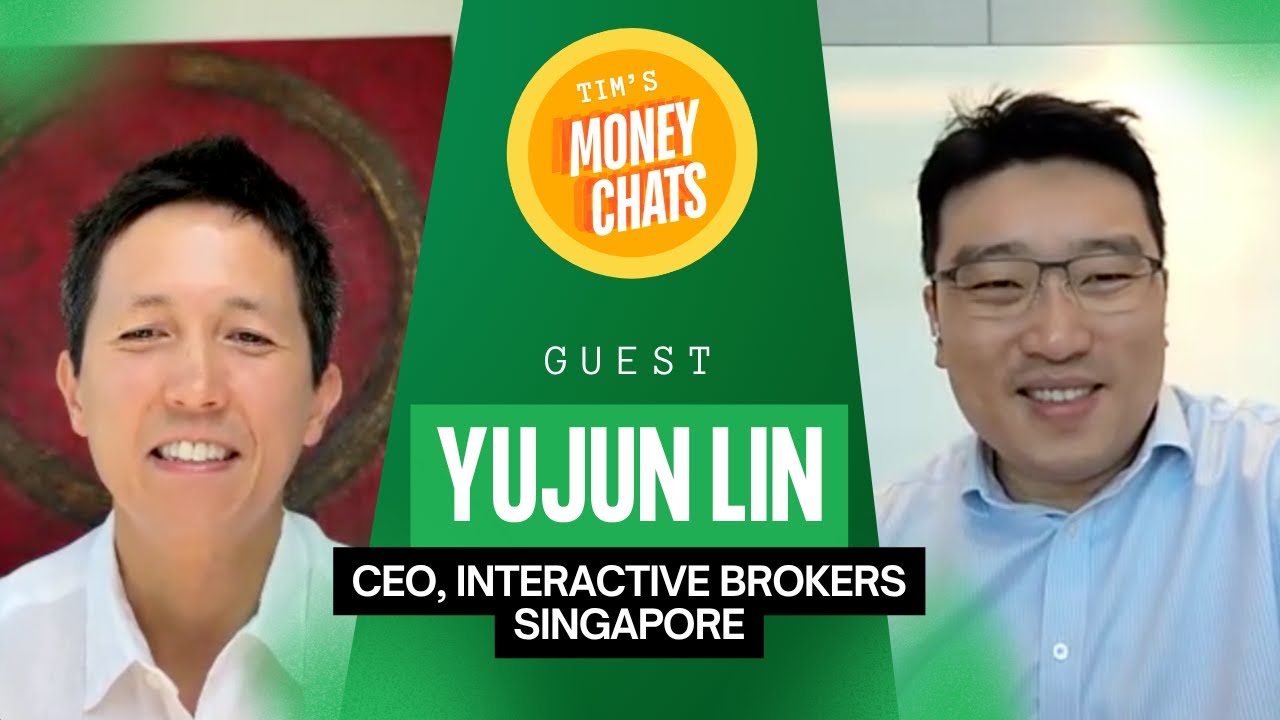 Watch the conversation ↗
A falling market, viewed from the controls
At an independent wealth management forum in April 2025, Lin offered a more granular account of how clients were behaving during volatility. He described continued buying alongside a reduction in margin borrowing in Singapore. Those observations belong to that particular moment; they were not a prediction about how investors would always behave. Their value was in distinguishing activity from leverage.
A busy trading screen can conceal very different decisions. Someone may be adding cash, trimming a loan or changing a position. Lin’s account suggested that looking only at headline prices would miss some of the adjustment happening inside accounts. He also acknowledged the brokerage’s commercial interest in active markets and the difficulty posed by a prolonged retreat in trading.
The theme carries through his educational appearances. In August 2025, he hosted SGX deputy chief risk officer Ivan Han for a discussion of India. Growth was part of the conversation, but so were currency exposure, GIFT Nifty futures and ways to approach the market. Lin was drawing on a relationship with the exchange while asking questions relevant to brokerage clients. The old job and the new one had plenty to discuss.
“Interactive Brokers is here to stay.”
Yujun Lin · October 2023
Zero gets a local address
On 13 August 2025, Interactive Brokers announced the Singapore launch of IBKR Lite. The plan offered commission-free trading in US stocks and exchange-traded funds, without platform or settlement fees or an account minimum. It sat alongside IBKR Pro, between which clients could switch according to their needs. Here was a concrete expression of the low-cost case Lin had been making.
The announcement also described access to more than 160 markets and support for funding and trading in up to 28 currencies. Those were company capabilities reported at the time of the launch, rather than personal accomplishments to be pinned on the chief executive. Lin’s responsibility was leading the Singapore business offering them.
The launch helps explain the continuity in his career. At SGX, the work involved products that connected international investors with Asian exposure. At Interactive Brokers, the direction of travel widened: Singapore investors could look outward through the same platform. The organising concern remained the distance between an investor and a market, including the fees collected along the way.
The door swings both ways
By January 2026, Lin was commenting on another obstacle: attention. Singapore’s market reforms faced investors accustomed to seeing US companies everywhere in their news and social feeds. He pointed to the breadth of American brand names dominating those conversations. A domestic exchange could improve its arrangements and still have to compete for a place in the investor’s imagination.
That month, in a discussion of proposed custody changes, he also challenged the persistence of direct central-depository accounts, calling them a “legacy construct” associated with the era of physical certificates. Custody is hardly a glamorous dinner topic. It does, however, determine how holdings are recorded and managed. For a former exchange product executive now running a broker, the plumbing is part of the point.
On 23 April 2026, the two institutions in his career acquired a fresh connection. SGX welcomed Interactive Brokers Singapore as a trading and clearing member of its derivatives market. Lin framed the admission as a commitment to Singapore and the wider Asia-Pacific region. The broker could strengthen access to the exchange where he had spent much of his working life.
The announcement gives his earlier assurance about staying a practical sequel. A local presence can be expressed through a licence, a pricing plan, an exchange membership and the work of keeping accounts functioning. None has much theatrical appeal. Together they describe Lin’s public career rather well: years spent arranging the conditions under which other people can act. The doors matter. So do the hinges.
Keep the conversation going
- Yujun Lin · LinkedIn
- Interactive Brokers Singapore
- Lin’s podcast appearances
- Tim’s Money Chats · YouTube
- Singapore’s Secret Sauce Revealed · 2023
- The Amazing Singapore Economy · 2023
- Asia’s Market Dynamics · 2024
- Digital wealth forum · 2024
- Wealth management forum · 2025
- India discussion with Ivan Han · 2025
- Singapore Lite launch · August 2025
- Singapore market reforms · January 2026
- Broker custody discussion · January 2026
- SGX membership announcement · April 2026