A trading platform can acquire features the way an old house acquires keys. Each one once solved a problem. Eventually, a newcomer faces the whole jangling collection. In April 2024, Milan Galik offered a remarkably plain account of this predicament: Interactive Brokers had spent more than two decades adding capabilities to Trader Workstation, and some customers found the result overwhelming. The chief executive was discussing software. He was also describing the inheritance he had helped assemble.
Galik had arrived in 1990 as a developer. By the time he became CEO in October 2019, he had worked inside the business for 29 years. That interval gives his story an unusual shape. The apprentice, the builder and the successor occupy the same résumé. His task now includes opening the door wider without making the machinery behind it less useful.
A recommendation, then Frankfurt
The route began with electrical engineering. Galik earned his master’s degree at the Technical University of Budapest in 1990. A connection helped bring him to Thomas Peterffy: László Papp, an associate professor at the university, recommended the graduate to the founder. Peterffy recruited him as a software developer. An academic recommendation had become an introduction to a business where programming and trading were already closely intertwined.
The geographical part of his apprenticeship came quickly. In 1991, after trading European derivatives for the firm, Galik moved to Frankfurt. He helped establish its German operations and ran a derivatives desk on the city’s first electronic exchange. Within a year of joining, he was dealing with the practical business of making an operation work in another country.
He returned to the United States in 1992 and helped build automated market-making systems. Over time, his attention shifted toward electronic brokerage. Those are related businesses with different relationships to a trade: a market maker supplies prices and liquidity; a broker provides a customer’s route to the market. Galik worked on both sides of that distinction before taking charge of the group.
The sequence matters because “technology executive” can be a rather roomy description. His early assignments involved writing software, trading derivatives and starting operations abroad. The systems had to survive use. A clever idea still needed an exchange connection, an operating business and someone willing to trade through it.
- 1990Software developer
- 1991Frankfurt trading desk
- 2014President
- 2019Chief executive
The succession had a long rehearsal
Galik became senior vice president for software development in October 2003. He joined the group’s board in November 2006 and became president in October 2014. His responsibilities grew in stages, with an eleven-year stretch leading software development before the presidency. The career ladder here had room for considerable wear on each rung.
On January 22, 2019, the board appointed him to succeed Peterffy as CEO, effective October 1. The founder remained chairman. The arrangement put a longtime colleague in charge while keeping the person who had recruited him involved in the company. It also left Galik with something more complicated than a ceremonial succession: responsibility for operating a business whose founder remained a consequential presence.
Peterffy later described his successor as “incredibly competent” in a conversation with chief strategist Steve Sosnick. He spoke appreciatively about being able to rely on Galik’s leadership while continuing to contribute himself. For a founder handing over responsibilities accumulated over decades, that is a revealing compliment. Trust is doing much of the work in that sentence.
Galik also served on the Boston Options Exchange board from October 2013 to May 2023. His working world extended beyond the broker’s own screens into the institutions through which trades happen. The connection fits a career spent close to the underlying arrangements of markets, where the interface is only the visible end of a much longer chain.
When another feature becomes a problem
IBKR Desktop arrived in February 2024 with a particular promise: a simpler interface paired with the broker’s trading tools. Its launch included MultiSort, which lets users screen information using several factors, and Option Lattice, a graphical way to examine an options chain. The choice of tools suggests the balancing act. Simplicity still had to leave room for people doing complicated things.
Galik invited customers to help shape the application through feedback. That is a useful detail in a story about a developer becoming a CEO. The finished product was being presented as a starting point for further work. A customer’s difficulty navigating a screen could become a development instruction, rather than a verdict on the customer.
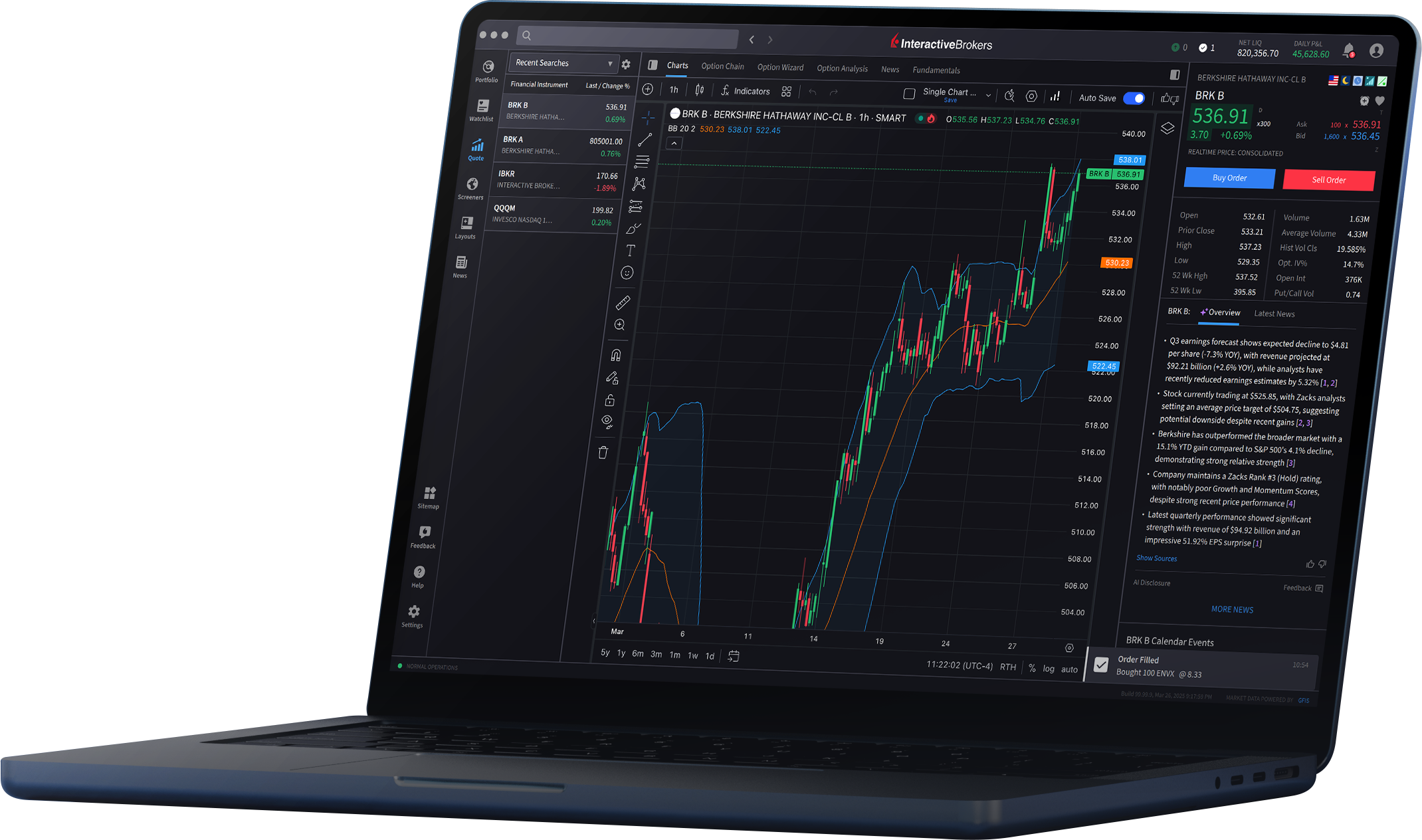
The tension is familiar well beyond finance. Experts want shortcuts, density and precision. Newer users need to understand what they are looking at. Both can be sensible requests. For a broker serving different kinds of customers, deciding how much belongs on the screen is a business decision expressed in pixels.
A broker should open more doors
In April 2025, as markets fell and rebounded, Galik described customers changing what they traded. Options activity gave way in part to futures; fixed income and foreign exchange also drew activity. Margin borrowing fell as customers reduced risk. His explanation returned to the same operational advantage: customers could move among different asset classes from one account.
He resisted treating international investing as a choice between American markets and everything else. The aim, he explained, was to put local markets alongside US markets on the platform. A customer could deploy capital at home or abroad without changing the basic relationship with the broker. The international operation he had helped build in Frankfurt had become a much broader proposition.
This is an aspiration with practical consequences. Adding a market is more than adding its name to a menu. Accounts, permissions and the ability to execute must line up. Galik’s public explanations repeatedly return to that practical layer: what a client can reach, how an account works and what has to be built next.
In July 2026, he applied the same reasoning to prediction markets. Interactive Brokers had added access to Kalshi and CME alongside ForecastEx. He described the broker’s job as providing connectivity to marketplaces around the world. Even ownership of an exchange did not remove the reason to connect customers to other venues.
He also explained the boundaries then in place: the broker was concentrating on events with potential implications for customer portfolios, rather than sports or entertainment contracts. Access came with choices about what belonged in the offering. A bigger catalogue still required an editor.
“We want clients to earn more from the assets they hold.”
Milan Galik, October 2026
The new work sounds surprisingly familiar
By October 2026, the vocabulary included autonomous AI trading. The sequence was more measured than the phrase might suggest. In July, Galik had described an arrangement in which AI could propose an instruction, but the customer needed to approve it before it became an executable order. In October, he said a limited autonomous rollout had begun with approximately 3,000 invited customers who had previously used the earlier connector.
His expectation was that AI could help investors process more information, follow more companies and implement strategies more easily. That was an expectation about future behavior, rather than proof of improved results. The distinction matters in a business where making a decision easier and making a good decision are separate achievements.
The same October discussion included work on easier adviser onboarding and improved connections to platforms that let advisers use multiple custodians. These projects are less theatrical than autonomous trading. They also address a recognizable Galik problem: how to make a complicated service easier to enter and use.
Japan supplied another example. He discussed account migration, margin availability, passkeys and more digital identity checks. The list has little glamour and plenty of consequences for the customer trying to open an account. International expansion, in this telling, consists of many specific pieces of work that must fit local requirements.
The assets already in the account
On October 13, 2026, Interactive Brokers announced cryptocurrency staking for eligible clients, initially involving Ethereum through zerohash. Galik explained it by comparing it with the broker’s Stock Yield Enhancement Program, through which clients can earn income from lending shares. His chosen comparison brought an unfamiliar service back to a familiar question: what else can an asset already in the account do?
That explanation contains a fair amount of his public operating philosophy. Connect more markets. Let assets and services sit together. Reduce the amount of work required to move between them. The ambitions are expressed through the account and its capabilities, rather than a personal mythology built around the chief executive.
The 29-year interval between developer and CEO can look, at first, like the main event. It is better understood as preparation for an ongoing design argument. Every new capability creates another decision about complexity. Every additional kind of customer brings another reason to reconsider how the machinery is presented.
Galik helped build a business for people who knew exactly what they wanted from a trading system. He now leads one that must also make room for people still learning where to look. Somewhere between those customers lies the next screen to design. The old house needs more doors. It would help if the keys were labelled.