Two months was the promise. The customer wanted an expense management platform, complete with invoice handling, integrations and a finished interface. Ten months later, there was still nothing usable in production. The budget had grown; the relationship with the vendor had collapsed. Jeff Kreuser tells this story with the weary precision of someone who has heard variations of it before. A bargain had acquired a rather expensive sense of humor.
For Kreuser, Softjourn’s co-founder and CEO, the episode gets at a problem that starts well before a developer opens an editor. A proposal can look wonderfully efficient when nobody has examined what its promises contain. The awkward questions arrive later, carrying invoices. His argument is straightforward: spend time understanding the work before attaching a number to it.
It is an apt introduction to a software executive whose public work keeps circling the space between an idea and a functioning product. He has written about ticket scanners, application architecture and digital tickets. Across those subjects, the interesting question is often how a technical choice behaves once people have to live with it.
The engineering begins in the conversation
Kreuser holds a bachelor’s degree in Computer Science and Electrical Engineering from the University of Wisconsin. His product specialty is ticketing, where he works with sales to define customer requirements and decide what deserves priority. That puts him near an important junction: the place where somebody’s wish list must become work a development team can actually perform.
There is a particular kind of responsibility in that position. Sales discussions describe a desired future; engineering needs enough detail to build it. A ticketing customer may ask for an easier purchase or a better way to manage entry. Turning that request into a product involves deciding what the words mean, which dependencies matter and what can reasonably happen first.
His account of the failed expense platform, published in 2025, makes the stakes tangible. He identifies inadequate discovery, competitive pressure and underestimated complexity as reasons an estimate becomes implausibly low. His preferred preparation includes examining integrations, identifying risks and allowing for changes. The resulting proposal may be harder to sell at first glance. It has, at least, made room for the job.
A reported project anecdote, not an industry average.
A company assembled across a map
In 2000, Kreuser and Emmy Gengler founded Softjourn in Silicon Valley. The early business worked through a network of partner companies in Ukraine, each bringing its own expertise. This origin matters to the later story: cooperation across locations was part of the company’s construction from the beginning.
In 2005, the founders made their partnership with Bogdan Mykhaylovych and Sergiy Fitsak permanent. Both were working at a Ukrainian software company supplying banking solutions. Softjourn established its Ivano-Frankivsk operation, in the city where the two partners lived. A Polish office followed in Wrocław in 2014; a São Paulo development center opened in 2023.
Those dates describe the company Kreuser helped build, rather than a solo achievement. Gengler, Fitsak and Mykhaylovych belong in the frame. Today, the leadership roster names Gengler chairman emeritus, Fitsak managing director and Mykhaylovych technical director. Kreuser serves as CEO. The business has developed around ticketing, financial technology, payments and media, with colleagues working across national borders.
- 2000Silicon Valley
Softjourn founded - 2005Ivano-Frankivsk
Ukrainian operation - 2014Wrocław
Polish office - 2023São Paulo
Brazilian R&D center
Distance needs a calendar
In a 2019 discussion with Gengler about virtual software development, Kreuser described a working rhythm built around an initial meeting, daily standups, weekly stakeholder conversations and demonstrations. The kickoff was especially important because it established the customer’s challenge and expectations. Choosing technology came after that understanding. An impressive toolbox would have to wait its turn.
“Effective communication isn’t rocket science, but it requires discipline and proactivity.”
Jeff Kreuser
For American clients working with European developers, he described a cycle of review and response across time zones. Clients could examine work during their day and leave comments for developers to address the following day. Direct conversations occupied the overlapping hours. The arrangement needed a reliable cadence, rather than an assumption that everyone would somehow stay aligned.
That is a useful distinction in his working philosophy. A meeting has a purpose beyond taking attendance. A demonstration gives the customer something specific to react to; a question exposes an assumption while it is still cheap to change. In his account, the ordinary habits of communication carry some of the weight people otherwise expect technology to bear.
The ticket has to work at the door
Ticketing offers a particularly clear view of Kreuser’s practical interests. An article he co-authored with solutions architect Lyubomyr Nykyforuk describes Tamtoto Scan, a Softjourn application that lets an iPhone or iPod serve as a ticket scanner. It can read barcodes and QR codes through the device’s camera or Linea Pro hardware.
The workflow is pleasingly concrete: choose an event, select tickets, take payment and verify admission. These are modest verbs with a great deal resting on them. A customer has already decided to attend; now the system must carry that decision through a transaction and into a venue. The technology gets judged by whether those steps work together.
The scanning application could also be customized for a customer’s ticketing system. That detail places the product within a larger operation: the scanner is one component of a purchase and admission process. Kreuser’s article follows the transaction through its steps, giving the reader a view of the work behind a moment that an attendee hopes will be uneventful.
His co-authored writing on dynamic pricing moves to an earlier stage of the same experience. It considers how ticket prices respond to demand, timing and other factors, while acknowledging the possibility of customer frustration and perceived unfairness. The suggested process begins with a commercial objective, then proceeds through strategy, testing and adjustment. The algorithm gets a job description before it gets a welcome party.
In that context, pricing is a product decision with several audiences. Organizers want revenue and attendance; customers want a purchase they can understand. The attraction of a more flexible system has to be weighed against how people experience its results. Kreuser’s technical subject matter repeatedly leads back to those ordinary expectations.
A new tool still needs a reason
The same questioning approach appears in his co-authored examination of NFT tickets. The discussion compares blockchain proposals with other digital ticketing methods across problems such as counterfeit tickets, resale and access. It also considers implementation costs, speed, privacy and reliability. The presence of a fashionable technology does not settle which approach fits a particular problem.
His earlier writing about blockchain adoption looks at obstacles outside the code itself, including uncertainty over rules, trust among participants and agreement across a network. A technically possible transaction still needs an environment in which people accept how it works. In those discussions, a working system includes the arrangements between its users.
Application architecture gets similar treatment. His co-authored microservices article considers independent scaling and deployment alongside the difficulties of communication between services and maintaining consistent data. The appeal of breaking a large application into smaller parts comes with work of its own. Even in software, dividing the household does not automatically simplify the chores.
A case involving IMS Management Services brings this attention back to existing products. Softjourn’s work included studying documentation, clarifying workflows, examining data flows and developing mockups for a replacement application. Kreuser described the value of understanding business requirements and asking what newer technology could improve. The old application contained business knowledge that a rewrite first had to understand.
In the IMS project, two developers reviewed the existing material and asked the client for clarification. A subject-matter expert explained the workflow; a business analyst prepared screen descriptions. These are specific forms of attention, directed at a system people already used. A replacement application has to preserve the useful knowledge inside that system while creating room for improvements. Kreuser’s contribution to the discussion was to connect the definition work with the possibilities of the new application. Understanding the old product gave the team a basis for deciding what should come next.
“The sooner you catch a flaw, the cheaper it is.”
Jeff Kreuser, on quality assurance
His comments on AI coding tools extend that responsibility to how software is produced. He says Softjourn discloses its use of AI coding tools to clients, discusses concerns and explains the reasons for using them. Intellectual property and data questions belong in the conversation. Adoption gives the team another subject to explain to the people commissioning the work.
The bridge and the video call
There is a less technical glimpse of Kreuser in Softjourn’s 2025 anniversary merchandise story. Discussing the Golden Gate Bridge, he connects the structure to possibility and to a team spanning ideas and cultures. “To many of us, it represents possibilities.” It is an engineering landmark serving as a small statement about the company around him. The anniversary designs also drew on symbols from Ukraine, Poland and Brazil. His bridge comment appeared alongside colleagues’ explanations of the images that mattered to them, giving the collection a set of personal associations across the company.
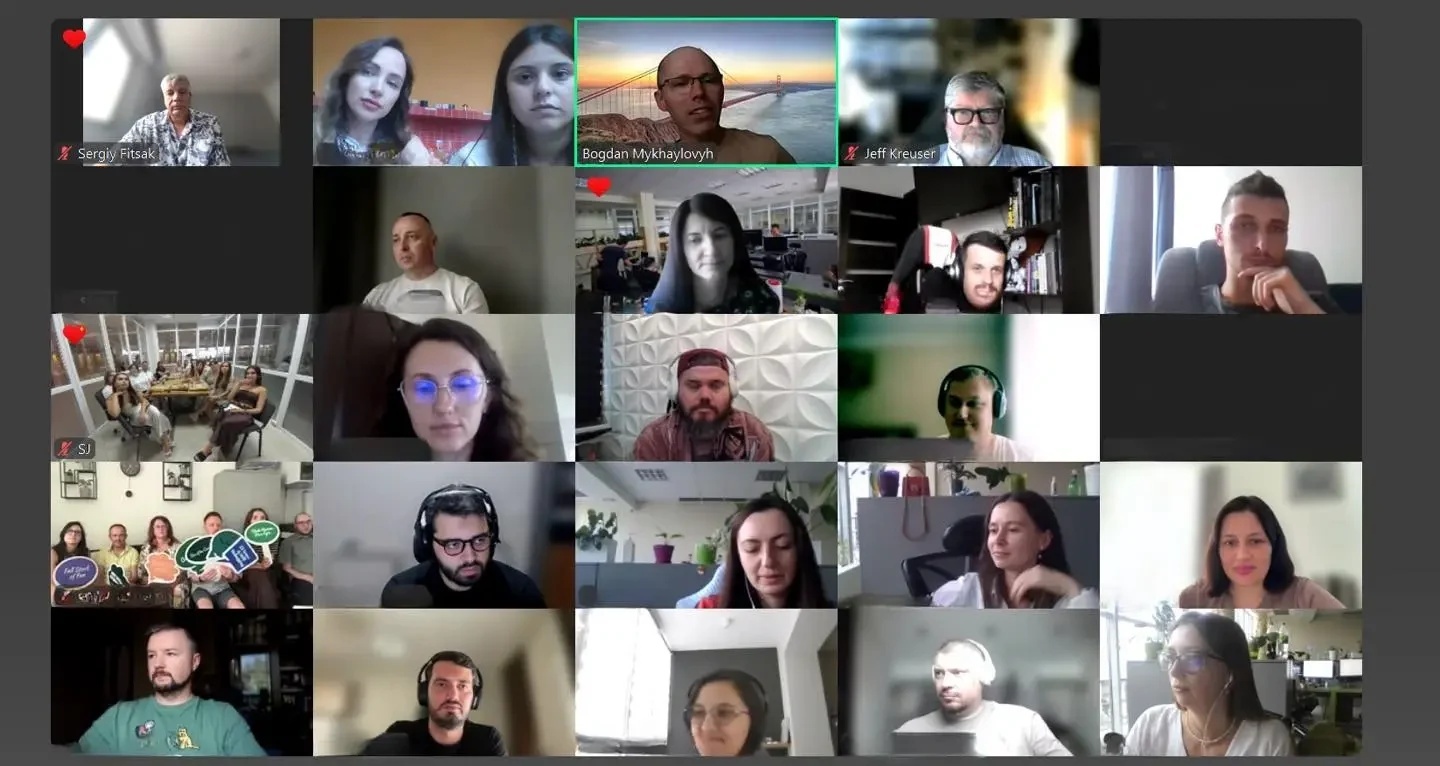
The anniversary itself supplied a more everyday picture. Softjourn turned its monthly Talk With Execs gathering into an international pizza party. Colleagues joined across countries, while local celebrations included a dinner in Tirana and a river outing in Wrocław. Kreuser appears in the video-call photograph among a grid of faces. For once, the agenda could accommodate a quarter-century.
That image sits comfortably beside his working advice. An international software business is made up of people who need to know what others mean, what happens next and whether a promise can be kept. Across Kreuser’s estimates, ticketing discussions and technical writing, those questions recur. Before the deadline appears in a proposal, somebody needs to give them time.