BREAKING
Kevin Hartz co-founded Eventbrite at age ~36 with his wife Julia, nine months after they met Xoom: built on PayPal's first API, sold to PayPal for $1.1B in 2015 A* Capital now puts ~20% of its fund into founders who can't yet legally drive a car Lost an estimated $10B Airbnb return over an "exploding term sheet" - and he talks about it freely Sauron uses self-driving car perception tech to guard homes. Clients include U.S. Special Operations Command He bet virtually 100% of his first exit proceeds on PayPal's seed round in 1999 Kevin Hartz is building an art collection advised by Hollywood legend Michael Ovitz Co-founded Eventbrite with his wife Julia. She became CEO. He stepped back. It IPO'd at $1.8B. Kevin Hartz co-founded Eventbrite at age ~36 with his wife Julia, nine months after they met Xoom: built on PayPal's first API, sold to PayPal for $1.1B in 2015 A* Capital now puts ~20% of its fund into founders who can't yet legally drive a car Lost an estimated $10B Airbnb return over an "exploding term sheet" - and he talks about it freely Sauron uses self-driving car perception tech to guard homes. Clients include U.S. Special Operations Command He bet virtually 100% of his first exit proceeds on PayPal's seed round in 1999 Kevin Hartz is building an art collection advised by Hollywood legend Michael Ovitz Co-founded Eventbrite with his wife Julia. She became CEO. He stepped back. It IPO'd at $1.8B.
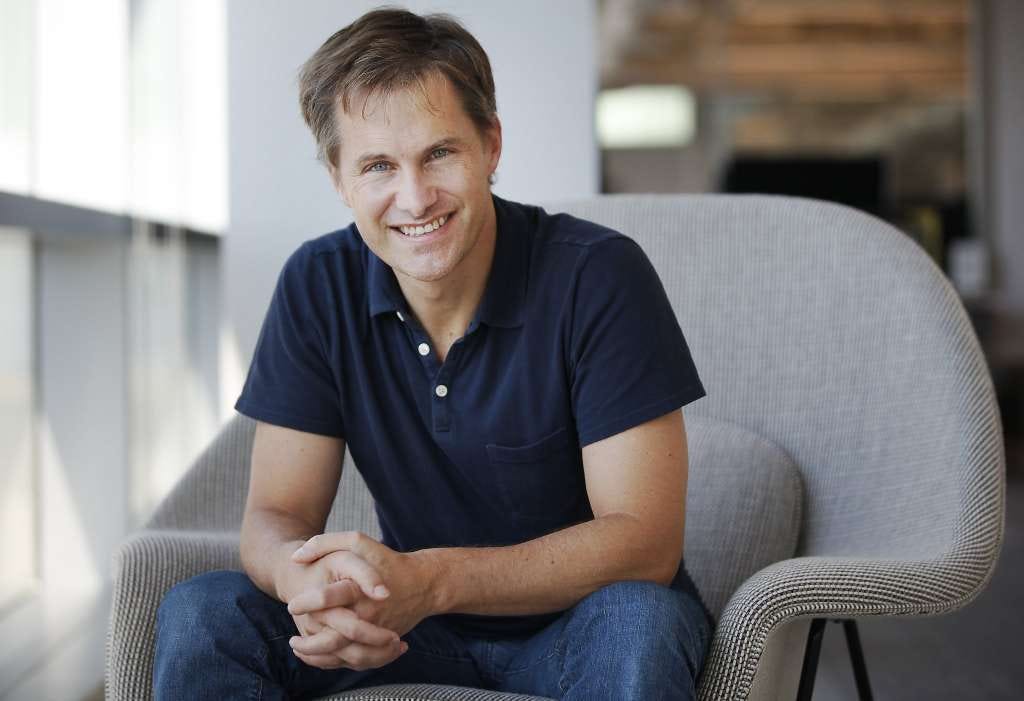
Kevin Hartz, co-founder of Eventbrite and venture investor at A* Capital
Founder / Investor / Builder

Kevin
Hartz

The man who put everything on PayPal in 1999, co-founded Eventbrite with the woman he'd known for nine months, and is now betting on kids who can't drive yet.
Eventbrite Xoom A* Capital Sauron PayPal Mafia Stanford '92
11
Unicorns Backed
2
Companies Founded
$1.1B
Xoom Exit

Kevin Hartz runs A* Capital, a $300M venture fund in San Francisco. He is also chairman of Sauron, a home security startup whose tech roster includes the U.S. Marine Corps and Department of State. He co-founded Eventbrite, the event ticketing platform that went public at $1.8 billion. He co-founded Xoom, the money transfer company PayPal acquired for $1.1 billion. He seeded PayPal, Airbnb, Uber, Pinterest, Palantir, Square, Stripe, and Slack - mostly before anyone had a thesis for why those things would work.

None of this is what makes him interesting. What makes him interesting is the pattern underneath it all. He has a Stanford history degree and an Oxford masters in 18th-century British monarchy, and he talks about both with the same intensity he brings to seed-stage AI companies. He thinks the best investors are the ones who actively seek out what looks ludicrous. He handed the CEO chair at Eventbrite to his wife - the woman he'd met at a wedding nine months before they co-founded the company - and describes the decision as straightforwardly correct. He uses his firm's capital to back founders who are, in some cases, still in high school.

In 1999, after selling his first startup for roughly $10 million, Hartz moved virtually all of his liquid capital into the seed round of a payments company then called FieldLink. The logic was not financial. It was entirely qualitative: he trusted Peter Thiel and Max Levchin. FieldLink became Confinity, then PayPal, then a $1.5 billion acquisition by eBay. The bet paid off. But what's more revealing than the outcome is the reasoning - pure conviction in people, no spreadsheet required.

He has been wrong, too. In the early days of Airbnb, he was positioned to invest at seed stage and lost the deal because he delivered what the industry calls an "exploding term sheet" - an aggressive tactic that gives founders an artificially short deadline to accept. The founders went elsewhere. The company became one of the most valuable consumer businesses in the world. Hartz estimates the miss cost him somewhere around $10 billion in paper returns. He talks about it freely and without apparent bitterness, which says more about his character than most LinkedIn posts ever could.

His firm A* Capital - co-founded with Gautam Gupta (formerly Uber's finance head) and Bennett Siegel (ex-Coatue) - backs companies from pre-seed through Series B, with a sweet spot around $3M checks. The fund's limited partners include Max Levchin and Peter Thiel from the PayPal years. More recently, A* has developed an unusual thesis: approximately 20% of the fund goes into founders who are teenagers. Not twenty-three-year-old prodigies. Actual teenagers. A* invested in one company whose founder was too young to legally drive a car at the time of the check. Hartz describes what he's looking for: "bright kids who are bored in school."

His current operating project is Sauron - named, yes, after the all-seeing villain of Tolkien's Ring cycle - a perceptual home security platform that uses the same sensor fusion and object detection technology developed for autonomous vehicles. Co-founded with Jack Abraham (who also co-founded Hims & Hers), Sauron has built a client list that spans Restoration Hardware, Tesla, Zoom, and the United States Special Operations Command. Hartz calls it "a love letter to my wife, Julia." Whatever you make of that framing, the product is real: a camera system that can distinguish a deer from a person from a package, in the dark, in the rain, continuously.
Current Role
Co-Founder & GP
A* Capital ($300M AUM)
Co-Founder & Chairman
Sauron - Perceptual Home Security
Education
Stanford '92 (History & Applied Earth Science)
Oxford M.St. (British History, 1993)
Location
San Francisco, California
The Number That Matters
11 unicorns and 22 exits across 100+ investments

"Ingenuity comes out of scarce resources."

- Kevin Hartz
$1.1B
Xoom acquired by PayPal
$1.8B
Eventbrite IPO valuation
$300M
A* Capital AUM
~$10B
Airbnb return missed

From Berkeley to the PayPal Mafia

Hartz grew up in Orinda, California, a small town in the East Bay hills. He went to Stanford, where he studied history and applied earth science - not computer science, not economics. He was a member of Phi Delta Theta and, through student politics, met a young Peter Thiel. At the time, neither of them had any idea what that connection would eventually be worth.

After Stanford, he went to Oxford on a masters program and spent a year studying King George III. Not for career leverage. Not for any reason he could articulate cleanly at the time. He calls it "an opportunity to learn how to learn," which is the kind of thing people say when the actual answer is harder to explain. He returned to California in 1993 with a sharper mind and no immediate plans.

His first real job was at Silicon Graphics, where he worked on Cosmo Player, an early virtual reality browser. He described the company as "a Disneyland for research scientists," which means it was brilliant and impractical and fun to work at until it wasn't. He stayed two years and left to build his own thing.

"It was entirely qualitative with PayPal. I just knew that Peter and Max are great, phenomenal people."

ConnectGroup, his first startup, sold high-speed internet to hotels using Linux servers. He co-founded it in early 1998 and sold it to LodgeNet for roughly $10 million before the year ended. Less than ten months, start to exit. He later admitted: "We never built a company. We flipped something." It was a useful distinction to carry forward.

In 1999, with the dot-com bubble at maximum inflation, Hartz took the ConnectGroup proceeds and put them into the seed round of a company that was barely a company yet - a payments startup called FieldLink. His reasoning: Peter Thiel and Max Levchin were the founders. That was enough. The company eventually became PayPal. The PayPal seed investors who held on did extraordinarily well. Hartz was one of them.

Xoom came next. In 2001, Hartz co-founded an international money remittance service with Alan Braverman. The original premise: build the first real application on PayPal's new API. He served as CEO until 2005, when he stepped back to the board. That early departure was something he later described as a mistake - leaving the operating role before the company had a strong enough foundation. He learned the cost of transitioning away from a company before it's ready for you to leave.

Eventbrite began in January 2006, less than a year after Kevin got engaged to Julia Hartz at a Santa Barbara wedding. They co-founded it with a French engineer named Renaud Visage and initially called it a rudimentary ticketing side project built while exploring payment applications. Nine months after founding, Kevin and Julia got married. Two years after that, Eventbrite was a real business. By 2018, it was a public company on the NYSE.

"As we grew, my job really became talent acquisition. Always more than half my time was spent recruiting and finding great people."

The handoff to Julia is worth sitting with. Kevin stepped back as CEO and Julia stepped in. He says he made the decision because it was correct, not because it was gracious. Julia built the company into a billion-dollar enterprise. Kevin went to Founders Fund as a venture partner for two years, then left to co-found A*. The marriage survived and apparently thrives. They have four daughters, they prioritize family dinners five to six nights a week, and they've appeared together on podcasts about genomic embryo screening, which they used for their younger two children. They are, it appears, doing exactly what they want to be doing.

A* Capital launched in 2020 with a first fund backed by Levchin, Thiel, and other founders from the PayPal orbit. The second fund raised exclusively from institutional LPs. Hartz's investment philosophy has crystallized into something specific: find the founders who look like outliers to everyone else, give them real capital at the earliest stage, and get out of the way. He categorizes founders as "Greek" (visionary architects who see the structure before the parts exist) and "Roman" (executors who build the empire the visionaries sketch). He prizes the rare ones who are both.

30 Years of Building & Backing

1988-1992
Graduated Stanford University, History & Applied Earth Science. Met Peter Thiel through student politics.
1992-1993
Masters in British History at University College, Oxford. Thesis: King George III.
1995-1997
Product Manager at Silicon Graphics (SGI) — Cosmo Player VR browser. "A Disneyland for research scientists."
1998
Co-founded ConnectGroup (hotel broadband). Sold to LodgeNet for ~$10M in under 10 months. "We never built a company. We flipped something."
1999
Invested virtually 100% of ConnectGroup exit into PayPal seed round. Reasoning: pure qualitative conviction in Thiel and Levchin.
2001
Co-founded Xoom Corporation with Alan Braverman - the first app built on PayPal's API. International money remittance.
2006
Co-founded Eventbrite with Julia Hartz and Renaud Visage, nine months after meeting Julia at a Santa Barbara wedding.
2013
Xoom IPO'd on NASDAQ. The money remittance company Hartz helped build from a side project went public.
2015
Xoom acquired by PayPal for $1.1 billion. A full circle: the company built on PayPal's first API sold to PayPal itself.
2016-2018
Venture Partner at Founders Fund, Peter Thiel's $3B+ venture firm. Left after two years.
2018
Eventbrite IPO'd on NYSE at approximately $1.8B valuation. Julia Hartz as CEO. Kevin as Chairman.
2020
Co-founded A* Capital with Gautam Gupta and Bennett Siegel. Fund I backed by Levchin, Thiel, and founder alumni.
2024
Co-founded Sauron with Jack Abraham — perceptual home security using self-driving car tech. Clients: USSOCOM, Dept. of State, Tesla, RH.
2025-2026
A* Capital's teen founder thesis reaches ~20% of fund. Spoke at TechCrunch Disrupt. Fund II fully institutional. Latest investment: Arthos (Feb 2026).

The Investment Principles

01
People Before Everything
He invested in PayPal because of Thiel and Levchin, full stop. No market analysis, no financial model. "It was entirely qualitative." He categorizes founders as Greek (visionary architects) or Roman (executors) and prizes the rare ones who are both.
02
Seek the Odd Ducklings
"I look for the real odd ducklings that are in a very odd category and run by brilliant people." When something looks non-standard, don't turn away. Understand it. The best investments are the ones that look ludicrous at first - and for good reason, until they don't.
03
Capital Efficiency as Religion
"Don't become reliant on the addictive drug of investment capital." He built Eventbrite scrappily. He admires founders who treat money as a scarce resource. Ingenuity, in his view, is a function of constraint, not abundance.
04
Counterintuitively Greedy
He invests during terrible times by design. When capital is scarce and sentiment is negative, the founders who press forward are self-selected for the right reasons. The market's fear is his signal to pay attention.
05
Talent IS the Strategy
"Always more than half my time was spent recruiting and finding great people." At Eventbrite, his job title was CEO. His actual job was talent acquisition. The insight transferred directly to venture: the right people attract more right people.
06
Bet on Bored Teenagers
A* now puts ~20% of its fund into teenage founders. His thesis: "bright kids who are bored in school." Stanford freshmen who dropped out. Sometimes younger. He backed one company whose founder couldn't legally drive at the time of the term sheet.

"I look for the real odd ducklings that are in a very odd category and run by brilliant people."

- Kevin Hartz, on what he looks for in founders

Notable Investments

💸
PayPal
Seed · Acquired $1.5B
🏠
Airbnb
Seed · IPO 2020
🚗
Uber
Early · IPO 2019
📌
Pinterest
Early · IPO 2019
💬
Slack
Early · Acq. $27.7B
Stripe
Early · Private
Square
Early · IPO 2015
🔮
Palantir
Early · IPO 2020
🛡
Anduril
Early · Defense
🚀
SpaceX
Early · Private
📣
Reddit
Early · IPO 2024
💰
Gusto
Early · Unicorn
🏦
Ramp
Seed · Unicorn
💎
Affirm
Early · IPO NASDAQ
📞
Skype
Early · Acq. $8.5B
🤖
Decagon
A* · AI Customer Service
🏠
Multiply
A* · AI Mortgages
📊
Mercury
A* · Fintech
Dark card = unicorn or major exit
Light = portfolio company

How Kevin Talks

Stay very lean, don't become reliant on the addictive drug of investment capital, really focus on building a sustainable business.

When focusing on talent, great things happen.

Typically when you see something that is non-standard, instead of kind of turning away or rejecting it, really try to understand.

Product and engineering as a core part of the business is critically important. Don't outsource it.

I went overseas and got a Masters in British history at Oxford. It was an opportunity to learn how to learn.

I get extremely frustrated when somebody is not really tackling a problem that matches their intellect and skill.

My theory is not to listen to your parents - or do exactly the opposite - because parents have this need to protect their children.

[AI is] the Mother of All Bubbles. But the market is still underhyped relative to the long-term opportunity - especially at the application layer.

[Sauron is] a love letter to my wife, Julia.

Things That Actually Happened

01
In 1999, he moved virtually all his liquid capital into a payments startup called FieldLink. It became PayPal. He was right for the right reasons.
02
He wrote his Oxford masters thesis on King George III - not because it was useful, but because he wanted to learn how to learn.
03
He estimates missing Airbnb at seed cost him around $10 billion. He discusses it in interviews without apparent bitterness.
04
Sauron - his home security company - uses the same sensor fusion tech developed for self-driving cars to guard residential properties.
05
A* backed a company whose founder was too young to legally drive a car. The investment thesis was still sound.
06
He met Peter Thiel through Stanford student politics in the early 1990s. Twenty-five years later, Thiel backed his venture fund.
07
He handed the Eventbrite CEO role to his wife. She took the company public on the NYSE. He calls the decision correct, not gracious.
08
He used whole-genome embryo screening for his younger two daughters - and is also an investor in the company that built the technology.
09
He is building an art collection with Michael Ovitz - the legendary Hollywood agent - focusing on Yale MFA figurative painters like John Currin.
10
He co-founded ConnectGroup in early 1998 and sold it for ~$10M before the year ended. His takeaway: "We never built a company. We flipped something."

Where He Learned to Think

B.A. / B.Sc. · 1988-1992
Stanford University
History & Applied Earth Science
Phi Delta Theta fraternity - recognized as "Famous Phi"

Where he met Peter Thiel through student politics. His unusual dual major - humanities plus hard science - mirrors the way he thinks about companies: narrative and data, people and systems.

M.St. · 1992-1993
University College, Oxford
British History - George III Period
University of Oxford, England

He went to Oxford with no career plan. "An opportunity to learn how to learn." His thesis subject - a monarch who presided over both the American Revolution and the loss of the colonies - was chosen for its complexity, not its relevance to Silicon Valley.

"When focusing on talent, great things happen."

- Kevin Hartz on building Eventbrite