An accountant can spend a career making sure the numbers add up. Stephanie Ferris has reached the stage where she must decide which numbers belong in the same company. That is a rather different examination. The working is public, the sums run into billions, and changing an answer requires considerably more than an eraser.
Consider Worldpay. Ferris was its chief financial officer before FIS acquired it in 2019. As FIS chief operating officer, she helped integrate the payments business. As chief executive, she subsequently led FIS through selling a majority stake and, eventually, its remaining interest. Few careers offer quite such a complete education in the verbs of corporate life: build, buy, combine, separate.
The apparent reversal is the interesting part. A company can be useful, valuable and full of familiar colleagues while still belonging under different ownership. Ferris’s recent work asks a question that business tends to postpone until it becomes expensive: what, exactly, should this company be doing?
The accountant leaves the ledger
Her route began in Ohio. Ferris grew up in Cincinnati, put herself through Miami University and graduated in 1995. As a child she liked playing office. She has since joked with her husband that her competence in corporate America does not necessarily extend to practical survival skills. One suspects the imaginary office had unusually satisfactory filing arrangements.
Public accounting supplied the first professional training. At PricewaterhouseCoopers, where she worked from 1995 to 2001, Ferris became an audit manager. She then moved to Fifth Third, accumulating financial responsibilities across different parts of the bank. The progression matters because her eventual specialty, payments, sits between disciplines: technology, bank relationships, operational reliability and financial arithmetic.
At Fifth Third’s processing division, she became CFO. In 2009 the business was sold to outside private equity investors and became Vantiv. The financial crisis was an uncomfortable moment to exchange the apparent shelter of a bank for a newly independent business. Ferris went with it. Safety, in that particular market, was a relative concept.
Her responsibilities broadened beyond accounting. She worked in financial planning and analysis and corporate strategy, then took a general management role serving financial institutions. A 2014 description of that job counted more than 1,400 bank clients. The remit included card issuing and processing, merchant services, ATMs and fraud mitigation. There is a useful distance between producing a forecast and being responsible for the customers expected to fulfil it.
- 1995Miami University graduate; begins in public accounting.
- 2009Fifth Third’s processing business becomes independent.
- 2016Becomes CFO of the business that develops into Worldpay.
- 2019Moves to FIS as chief operating officer.
- 2022President in February; CEO in December.
- 2026FIS exits Worldpay and adds issuer processing.
She also helped establish women’s business networks at Vantiv and Fifth Third. Before she became the first woman to lead FIS, there was already a record of organizing connections inside the places where she worked. The institution-building happened alongside the financial work.
That customer-facing interval helps explain the operator who followed. Ferris’s career was acquiring a second language alongside finance: the language of clients who need a service to work. A processing contract is ultimately a promise about the next transaction. A splendid spreadsheet cannot authorize a card payment.
A promotion with an instruction to reconsider
Ferris became deputy CFO in 2015 and CFO in 2016. Vantiv’s acquisition of Worldpay brought another expansion of scope, followed by FIS’s acquisition in 2019. She arrived at FIS through that transaction and accepted the COO job, taking responsibility in areas including technology, operations, strategy and acquisitions. She has described it as a role she had not previously imagined taking.
By February 2022, she was FIS president. Her previous administrative remit had covered an unusually broad collection of functions: enterprise strategy, finance, acquisitions, legal, marketing, communications, risk, information security and compliance. It was a close view of how a large organization holds together, including the places where the joins become troublesome.
The CEO succession was initially announced for January 2023, then accelerated to December 16, 2022. Gary Norcross departed and Jeffrey Goldstein became independent chairman. Ferris became the first woman to lead FIS. Alongside the leadership changes came a comprehensive assessment of the company’s strategy, operations, business structure and assets.
The assignment was explicit. Revenue opportunities, margins, costs and the configuration of the portfolio were all open to examination. This was a promotion with homework attached. Having learned the organization from the inside, Ferris now had to ask which parts should remain inside it.
The business she helped combine, then separate
The first decisive answer arrived with the sale of 55% of Worldpay to funds managed by GTCR. It closed on January 31, 2024. FIS retained 45%, while the businesses established commercial arrangements to keep selling relevant services through each other’s client relationships. Ownership and cooperation, in other words, could be negotiated separately.
The transaction valued Worldpay at $18.5 billion, including $1 billion of contingent consideration. FIS received more than $12 billion in upfront net cash proceeds. Those figures describe the deal at the time; they should not be confused with the value of the later transaction or treated as interchangeable measures of success.
For Ferris, the stated purpose was simplification and a stronger focus on financial technology and software for clients. The useful detail is that separation did not require pretending the old relationship had no value. The commercial agreements preserved access between FIS’s financial institutions and Worldpay’s merchant relationships. A corporate divorce can occasionally have unusually sensible visiting arrangements.
In January 2026, FIS completed the next step: selling its remaining Worldpay interest to Global Payments while acquiring Global Payments’ Issuer Solutions business, formerly known as TSYS. The issuer acquisition had an enterprise value of $13.5 billion. Its net purchase price was $12 billion including the benefit of $1.5 billion in tax assets, measured at net present value.
Two different sides of a card payment: serving the merchant and serving the issuer.
The acquired portfolio brought credit processing, fraud services and loyalty capabilities alongside FIS’s existing debit and banking offerings. At announcement of completion, it processed more than 40 billion transactions annually and had clients in over 75 countries. The strategic distinction is straightforward: a merchant needs to accept payment; an issuer needs to manage the card account and its processing. Both touch the same purchase. They involve different customers and responsibilities.
Analysis, a walk, and a decision
How does Ferris decide on something this large? “I analyze everything,” she says. She examines customers, markets, finances and investors, consults her board and leadership team, and takes long walks to work through the decision. The accountant remains in the room. She has simply acquired a larger set of questions.
There is also a less corporate detail from the negotiations. During the final days of the 2025 deal process, Ferris was on a promised mother-daughter trip to Cancun. She kept the trip. The episode is a reminder that a transaction can occupy the calendar without being granted possession of every person on it.
“The higher up you go, the more listening you do.”
Stephanie Ferris
Her account of leadership makes room for competitive ambition and collective work. In a March 2026 conversation, she said she had not spent childhood planning to become a CEO. She wanted to be part of a team attempting difficult things. Across the decade before joining FIS, she recalled eight acquisitions. Experience with repeated change helps explain her willingness to take another unfamiliar job; it also explains why she talks about the people doing the work.
Making a large company easier to use
The restructuring has a product counterpart. In May 2024 FIS launched Atelio, a platform intended to let banks, businesses and software developers embed financial services into their own offerings. Existing capabilities were presented as components that other organizations could use. Behind that proposition is a practical question: how much work must a customer do before a technology supplier becomes useful?
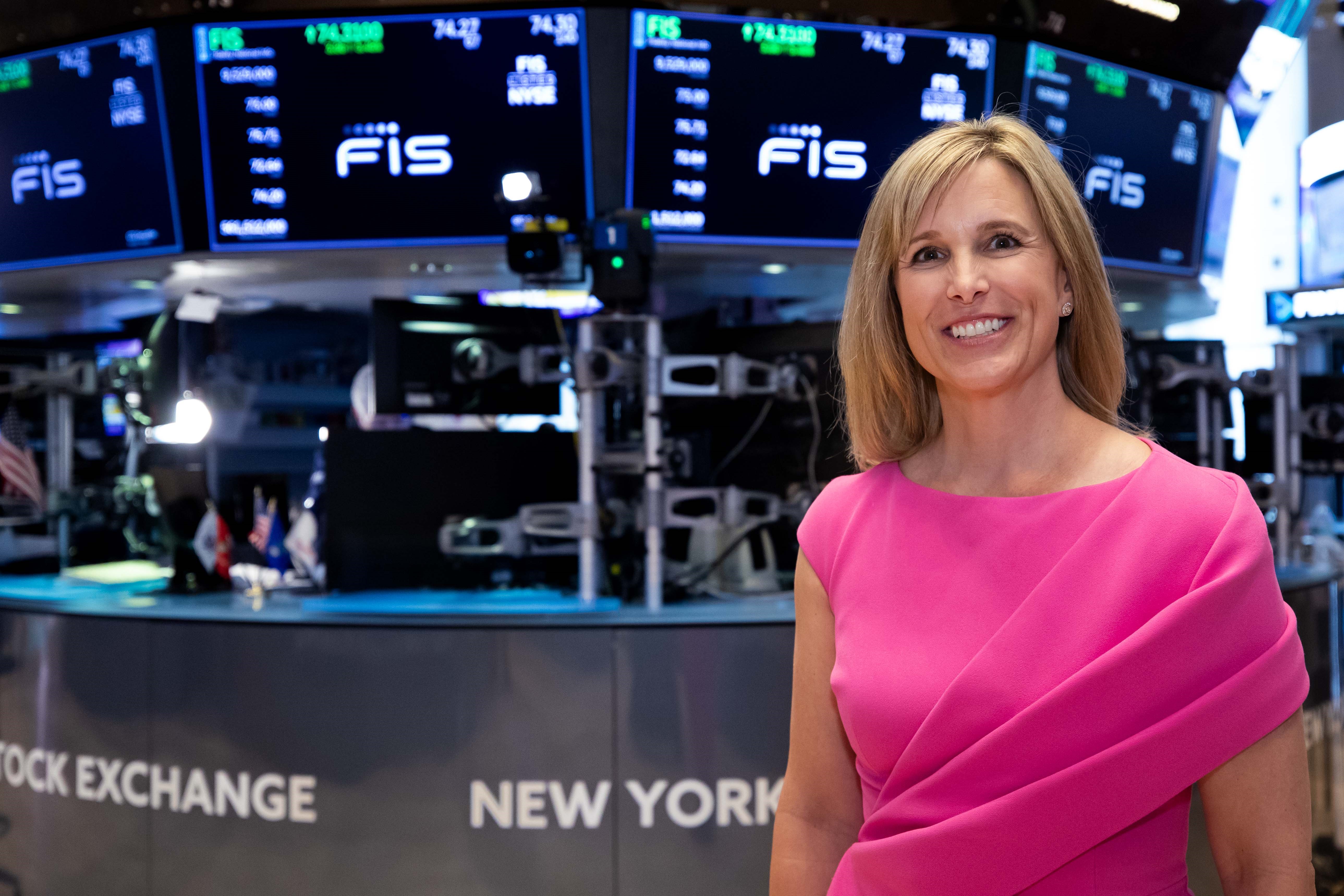
Atelio’s launch coincided with FIS’s investor day at the New York Stock Exchange. Ferris rang the closing bell for the occasion. There is a pleasingly visible ritual for a company whose everyday work usually happens behind somebody else’s bank account or application. For a few seconds, the infrastructure gets the stage.
At that investor day, Ferris and CFO James Kehoe presented the company’s growth plans and capital priorities. FIS outlined an expectation of 9% to 12% annual adjusted earnings-per-share growth over the medium term. It was a forecast, with all the uncertainty that word entails, but it gave investors a stated ambition against which to measure subsequent performance.
The financial results provide another checkpoint. FIS reported $10.7 billion in 2025 revenue, up 5% on a GAAP basis, and $2.6 billion in operating cash flow. Those are company results, rather than personal accomplishments to be tucked into a CEO’s pocket. They are nevertheless part of the public record against which her decisions can be judged.
In October 2026, FIS ranked first in IDC’s FinTech Rankings Top 100, a ranking based on financial technology providers’ revenues. Ferris’s response emphasized the trust banks place in the company’s infrastructure. It is an apt emphasis for her present position: a supplier can change its own shape, but customers still expect their systems to function while the furniture moves.
That leaves Ferris with an ongoing test rather than a finished transformation. Combining credit and debit capabilities, making products accessible, and keeping institutional clients confident are operational tasks that continue after the announcement. Her career has repeatedly carried her from reviewing a business to running it, then to reconsidering its boundaries. The next transaction will still have to work on an ordinary Tuesday. Even a childhood enthusiast for playing office could appreciate the difference.