Lin Han went looking for graphics cards and found a different line of work. He was developing software for optoelectronics when he noticed that Bitcoin miners wanted the same hardware. A shortage became a question. The question led him to Bitcoin’s white paper, then to an attempt to buy coins on an online forum. That transaction went badly. His next experiment was an exchange.
Gate launched in April 2013. Thirteen years later, its founder is entertaining a proposition that sounds peculiar coming from someone who runs a trading platform: a customer who trades less might still be good for business. People have other things to do with money. Han would like his software to be there when they do them.
There is a useful distance between those two moments. At one end sits a researcher trying to complete a purchase. At the other sits a chief executive trying to make an exchange useful to people with little interest in trading. Between them is a career spent discovering how much work hides inside an apparently simple transaction.
A laboratory education, with an unexpected exit
Han studied electronics before pursuing a doctorate in optoelectronics in Canada. His earlier undergraduate and graduate studies were at Shandong University. He subsequently spent a year doing postdoctoral work in Canada, then returned to China to develop optoelectronic simulation software. High-performance computing was part of that work. Bitcoin arrived through an engineering problem he already had.
His early involvement extended to mining hardware. In 2013, he and collaborators bought Avalon chips and attempted to design mining machines. He found the supply chain frustrating: procurement and production imposed long lead times and uncertainty. An exchange offered a different arrangement. Wallets, matching, deposits and withdrawals could be implemented in software. More of the work was within his control.
The attraction is understandable. A delayed component can make an excellent design quite useless. Software offered Han a shorter route from an idea to something he could change himself. The business he chose still depended on other people, of course. An exchange is full of other people. They are rather the point.
April launch
program begins
October 7
The buyer becomes the builder
Han’s account of his failed Bitcoin purchase is unusually concrete. He arranged to buy 100 BTC through a forum. In one telling, the seller delivered just one coin. The missing balance gave him a practical reason to build a place where buyers and sellers could transact with more confidence.
He wrote much of Gate’s early software himself, including its website and API. This gives the familiar founder phrase “built from scratch” some actual content: there were pages to serve, interfaces to expose and transactions to handle. Before the international events and commercial partnerships, there was code that had to work.
By 2025, he described a different allocation of his time. A larger technical team had taken over development responsibilities. His work had shifted toward management, strategy and checking the quality of execution. The founder could no longer improve the whole organization simply by finishing another piece of software himself.
“I am mainly a technical person.”
Lin Han, in a 2025 interview
It is an economical self-description for someone whose job now includes explaining a business across languages, markets and audiences. It also suggests why the early story remains useful. A buyer encounters a problem; an engineer tries to make the transaction work. You need very little cryptocurrency vocabulary to follow it.
Trust needs something to inspect
Gate’s reserve-verification program began in 2020. Its underlying question is plain enough: does the exchange hold the assets corresponding to its customers’ balances? The implementation uses a Merkle tree, a structure that allows individual records to be checked as part of a larger set, together with zero-knowledge proofs.
The technical language can make this sound remote from ordinary account keeping. The purpose is close to home. A customer wants evidence that an account balance corresponds to assets held by the platform. Gate publishes verification tools and describes how users can check inclusion in its reserve data. The code is available for inspection.
A reserve snapshot answers a defined question at a particular moment. It should be read on those terms. The existence of a verification process does not settle every question about a business, but it gives a customer something more specific to examine than an executive’s reassurance. For a founder whose first purchase went wrong, that distinction has an obvious relevance.
Han has also said that he financed Gate’s growth himself, a constraint that pushed the company toward profitability early. His account connects the financial discipline of running the business with the technical discipline of maintaining it. An outside balance sheet was unavailable as a convenient answer to an awkward problem.
Learning to take the microphone
The public-speaking version of Han has become easier to find. In August 2024, he joined a WebX fireside conversation with the event’s founder, Makoto Aoki. That October, Gate began releasing a personal interview series, “Dr. Han, What Do You Think?” Its subjects included motivation, difficult choices, wealth and his outlook for the next five to ten years.
These appearances extended the work beyond product explanations. People were being invited to hear how the founder thought. An exchange can publish a feature list without requiring its chief executive to say much about himself. A series of personal interviews demands a rather different kind of participation.
There is some welcome comedy in his account of a football match during Singapore’s 2024 conference week. He expected casual recreation at the event co-hosted by Gate and LTP. Instead, he encountered players of a surprisingly high standard. His side lost. He remembered enjoying the interaction anyway. Even the exchange business occasionally produces a result that cannot be improved by adding another trading pair.
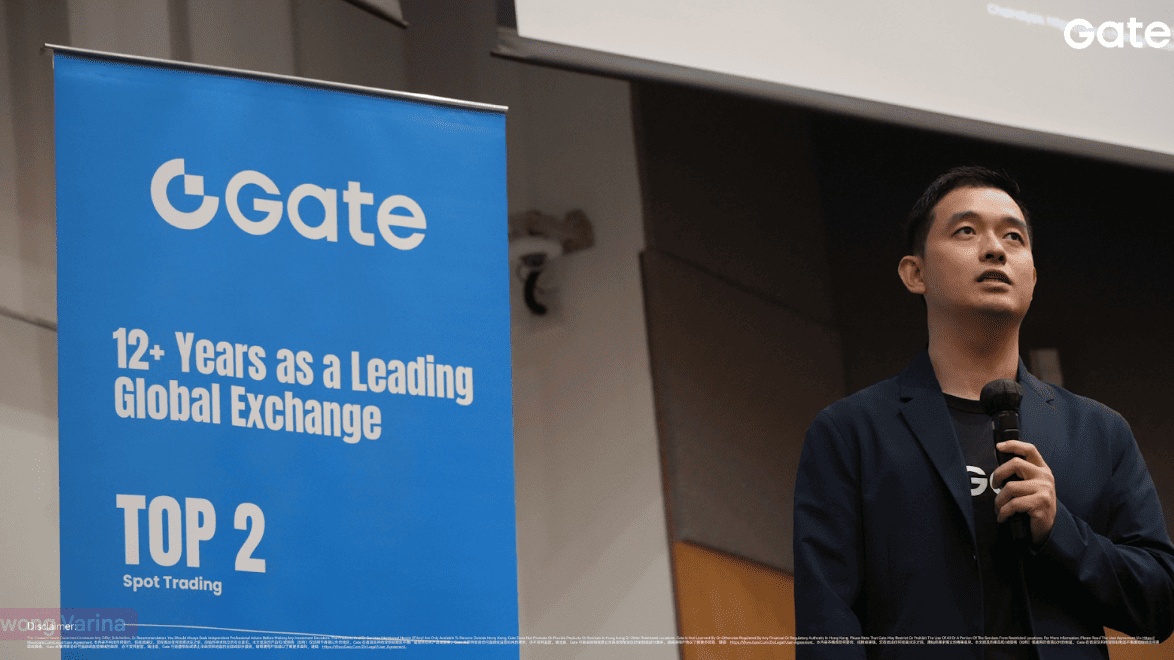
In November 2025, Han spoke at the Hong Kong University of Science and Technology and joined a fireside discussion. The audience included students and young entrepreneurs. A former researcher was explaining what he had learned after leaving academic work. The setting made the distance travelled quite literal.
The business beyond the buy button
At Consensus Hong Kong in February 2026, Han argued that cryptocurrency markets had become closely connected to the wider economy and US equities. He questioned the usefulness of treating Bitcoin’s four-year halving cycle as a dependable timetable. His attention was turning toward financial assets moving onto blockchain infrastructure, including stocks, metals and commodities.
He also described stablecoins as useful payment infrastructure for banks. That is a revealing choice of emphasis. The interesting work, in this account, happens when money moves more efficiently through a service people already need. The machinery can be new while the errand remains familiar.
Gate Money brought that idea into a named product in October 2026. Han announced it at TOKEN2049 in Singapore on October 7. Gate presented the service as a way to connect asset holding, transfers, payments and conversion within one account. Eligible users could access banking-account features, with availability depending on market and product terms.
The proposed customer is easier to picture than an abstract mass market: someone receiving money, sending it elsewhere, holding assets or paying for something. Those tasks give Han’s next phase an everyday scale. They also give it an unforgiving standard. A payment service gets judged in the interval between wanting to pay and being able to leave the shop.
“I think it’s a better business.”
Han on serving users who hold and spend rather than trade frequently, October 2026
He has been clear that trading still supplies most of Gate’s revenue and that payments remain a small share. The larger payments business is an aspiration. The distinction matters: a launch can establish a product, while changing the habits of its intended customers takes considerably longer.
Still taking the machine apart
In his thirteenth-anniversary letter, Han recalled getting his first computer in middle school, teaching himself programming and repeatedly disassembling and rebuilding machines. He described laboratory work as a cycle of designing, debugging and validating. These are his own recollections of the habits that preceded Gate.
He also remembered the company’s first small gathering on a cold winter day, with an uncertain set of ideas and no formal agenda. Later came a much larger organization and colleagues joking that his late working hours belonged to another time zone. The anecdotes give some texture to a career otherwise easily reduced to product names and dates.
In December 2025, discussing Gate’s largely remote workforce, Han acknowledged the intensity of combining technology, finance and an operation that runs around the clock. He said newcomers needed a clearer explanation of that working style. The software may be continuously available; the people making it still have to agree on how the work gets done.
That is where his story becomes more interesting than a tale of an engineer finding a market. Han started with the parts he could control: software, interfaces, transaction systems. His current ambitions involve more institutions, more kinds of assets and more ordinary uses of money. Each addition brings another relationship to manage. The next version of his original experiment will be judged by customers who simply want their purchase to go through.
Follow the work
- Visit Gate ↗
- Follow Lin Han on X ↗
- Gate company profile ↗
- Watch: Lin Han in conversation with WuBlockchain ↗
- Read the October 2026 conversation about everyday finance ↗
- Read the conversation about Gate’s early code ↗
- Read the conversation about research and mining hardware ↗
- Read Han’s thirteenth-anniversary letter ↗
- Explore the Gate Money launch announcement ↗
- Inspect Gate’s reserve-verification method ↗