Somewhere between a patient, a courier, a central lab, a specialty lab and a freezer, a vial becomes data. The journey sounds orderly when reduced to arrows on a protocol. In practice, the vial acquires a thicket of identifiers, timestamps, consent restrictions, testing instructions and assay files. One system says it was expected. Another says it arrived. A spreadsheet says it was tested. The result may sit under a different label altogether. QuartzBio has spent more than a decade making this bureaucratic relay visible.
The Frederick, Maryland-based company sells a cloud platform to clinical-stage biotechnology and pharmaceutical sponsors. Its software does not run an experiment or invent a molecule. It gives operations and research teams a common account of the materials and evidence a trial has already produced: what should have been collected, what actually was collected, where it traveled, whether the participant consented, what happened in the lab and which biomarker result belongs to which patient and time point.
That sounds like record keeping because it is. It is also the infrastructure under precision medicine. If a tumor biopsy expires before testing, if blood is drawn outside the protocol window, or if a genomic file cannot be joined to clinical outcomes, the scientific question gets smaller. The data may exist and still be unusable.
A control room for the sample journey
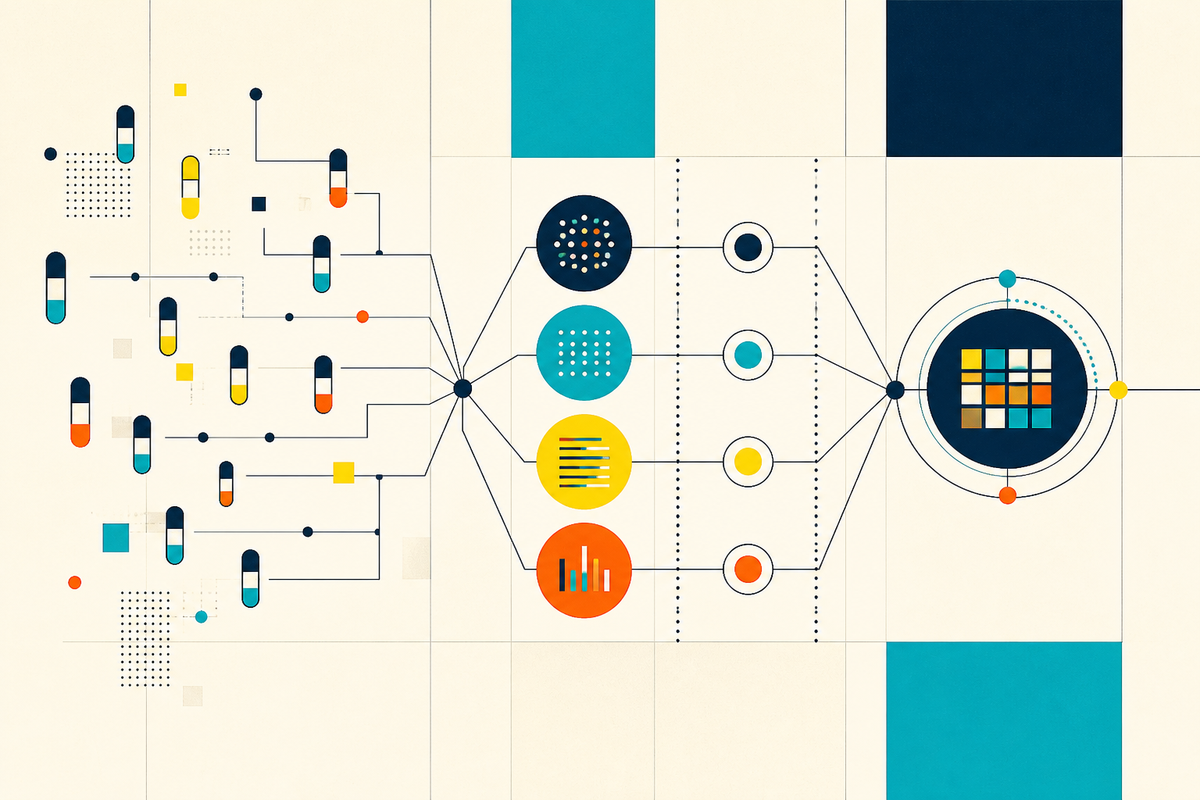
QuartzBio divides the job into three connected products. Sample Intelligence builds a master inventory across studies, vendors and repositories. It compares expected collections with actual ones, spots out-of-protocol events, monitors shipments and testing, tracks stability windows and ties sample records to consent. Biomarker Intelligence picks up downstream: it ingests raw and processed assay files, maps inconsistent fields into a common model, runs configurable quality checks, and lets researchers search, analyze and visualize the resulting data.
Agent Intelligence is the conversational layer. Domain-specific agents can answer natural-language questions over the governed data underneath, surface exceptions and help automate recurring tasks. A translational scientist might ask for baseline biopsy samples from responders with a particular expression profile. An operations lead might ask which shipments are late or which samples are about to move outside a stability window. The interface matters, but the difficult work comes first: connecting the right sources and preserving their context.
QuartzBio is vendor-agnostic. It is designed to accept the formats supplied by labs, electronic data-capture systems and other partners instead of demanding that every contributor adopt a new schema at the door. Data can enter through files, APIs and configured pipelines. Users can work through the web interface or connect the governed data asset to other tools. This places QuartzBio above individual laboratories and systems: less a replacement for every source than a translation and oversight layer across them.
“At the end of the trial, the samples and the data are all that is left.”Katie Berola, QuartzBio employee, on respecting trial participants' contributionThe customer
Built for teams that cannot afford spreadsheet archaeology
The buyers are biopharma sponsors running clinical trials, especially programs rich in biomarkers and dependent on many labs. The daily users span biospecimen operations, biomarker operations, clinical operations, translational science, bioinformatics and R&D IT. Each group sees a different failure mode. Operations needs to know why a collection is missing. A scientist needs to know whether paired pre- and post-treatment samples exist. IT needs security, interoperability and an audit trail. An executive wants to know whether a portfolio can grow without adding another layer of manual review.
QuartzBio says its customer base includes multiple Top 10 pharmaceutical companies, and that its platform is used by 25 percent of top pharma companies and 20 percent of top biotech companies. Those figures come from its own operations data, so they are best read as company-reported reach rather than an independent market census. Client names are usually withheld, which is normal in this corner of regulated enterprise software.
Its clearest proof point is a 2026 case study involving a Top 5 pharmaceutical company managing more than 100 concurrent trials. QuartzBio reports that the client's team cut sample data-management effort by 85 percent and doubled trial capacity without adding headcount. Using the client's assumed fully loaded labor cost, QuartzBio calculated a midpoint of roughly $239,000 saved per study. These are case-study economics, not a guarantee. They nevertheless reveal the business model: sell subscription software and implementation against the cost of manual reconciliation, late discoveries and wasted scientific material.
The wedgeThe exception is the product
Most clinical samples are probably fine. That is exactly why reviewing every row by hand is so wasteful. QuartzBio's practical value is to automate the ordinary comparisons and pull the exceptions forward: expected but not collected, collected but not expected, received without valid consent, shipped but not received, ready for testing, nearing expiration, missing a field, or inconsistent across a lab and the clinical database.
This is a strong setting for narrowly applied AI. The questions are domain-specific, the underlying records are structured and the cost of an overlooked discrepancy is legible. QuartzBio says customer data remains inside its controlled environment, is segregated from other customers and is not used to train public large language models. Its platform is SOC 2 Type II audited and supports GDPR, HIPAA, relevant provisions of 21 CFR Part 11 and GxP validation. In a regulated workflow, the ability to show where an answer came from matters at least as much as producing it quickly.
Point solutions
- Own one lab or workflow
- Keep local identifiers
- Hand off files downstream
- Leave reconciliation to sponsors
QuartzBio's layer
- Spans vendors and studies
- Maps records into a shared model
- Checks exceptions continuously
- Links sample status to results
Not quite a LIMS, not merely a data lake
QuartzBio lives between familiar software categories. Laboratory information management systems such as STARLIMS and Thermo Fisher's SampleManager organize work inside laboratories. Platforms such as Benchling, Labguru and Sapio Sciences manage broader R&D processes. TetraScience concentrates scientific data in a cloud layer. Biomarker and clinical-data specialists attack other slices of the same landscape. A sponsor can also assemble its own stack from warehouses, pipelines, dashboards and armies of spreadsheets.
QuartzBio's claim to difference is the combination: sample operations and biomarker data, across a clinical portfolio, with regulated infrastructure and agents trained on the workflow. The platform follows the precision-medicine value chain from physical collection through analytical result. That makes it narrower than a general data cloud, but broader than a sample tracker. Its moat, if it develops one, will come from the mappings, business rules and operational knowledge accumulated in deployments - not from access to a generic language model.
The historyA Swiss spinout with a Maryland second act
Quartz Bio began in Geneva in 2012 through Merck Serono's Entrepreneur Partnership Program. Founder Jérôme Wojcik positioned it as a clinical bioinformatics company for exploratory biomarker analysis. The first version of the platform launched in 2014. In 2018 the company became part of Precision Medicine Group, where QuartzBio grew as Precision for Medicine's biomarker data and translational informatics platform.
Two acquisitions widened the aperture. Precision for Medicine bought SimplicityBio in 2019, adding multi-omics AI technology. QuartzBio acquired SolveBio in 2023, bringing in an enterprise data platform and joining sample inventory with biomarker management. SolveBio co-founders Mark Kaganovich and David Caplan described the deal as a chance to build a more complete system for biopharma. The combined product moved QuartzBio closer to the full sample-to-result chain it sells today.
In May 2026, health-tech investor Eir Partners took a controlling interest through a growth investment whose terms were not disclosed. QuartzBio said the capital would fund deeper automation, portfolio-scale interoperability, analytics, security and implementation capacity. The company now lists Scott Marshall as CEO and co-founder and Tobias Guennel as CTO and co-founder, with a multidisciplinary leadership team across operations, commercial and marketing functions. LinkedIn places its workforce in the 51-to-200 band; the supplied company dataset estimates 63 employees.
The defensible outcome begins long before the chart. It begins when a vial, a permission and a result remain attached to one another.What comes next
Making the system notice first
QuartzBio's 2025 and 2026 releases show the direction. Version 13 added Snowflake integration, shareable workspaces, role-based training and dashboards for non-compliant collections. Release 26R1 added stability monitoring, faster data movement, richer mutation access and natural-language search for customers that enable AI features. The investment plan points toward agents that do more than wait for a question - monitoring expected events, detecting risk and recommending an action.
The test will be whether automation reduces work without turning a transparent reconciliation process into an opaque one. Clinical teams do not need an eloquent guess about a sample. They need the right answer, the underlying record and enough warning to act. QuartzBio has chosen a market in which reliability is not decorative. That may limit the theatrics, but it sharpens the value.
The company's most interesting idea is also its plainest: precision medicine depends on precision logistics. A biomarker program can be scientifically ambitious and still be defeated by a mislabeled tube, a missed draw or a result marooned in the wrong system. QuartzBio makes those small seams visible. In drug development, small seams have a way of opening into very large costs.