In early 2008, Beam Global Spirits & Wine had a problem that would sound familiar to anyone who has ever watched a spreadsheet become a department. The company saw opportunities to improve pricing and distributor margins. Its Excel-based system, however, limited its ability to put those changes into practice. The arithmetic could be right while the organization remained wrong-footed.
- What it does: connects enterprise pricing, quotes, promotions, and rebates.
- Who buys: manufacturers, distributors, consumer goods suppliers, and retailers with complicated commercial rules.
- The useful distinction: follows a price from the initial plan to the margin actually retained.
- What to borrow: test one slice of your business before attempting a wholesale pricing transformation.
01 / The spreadsheet that lost the plot
Beam assembled a cross-functional team and began a pricing improvement initiative. Vistaar became the software behind segmented prices across the portfolio, with pricing staff making recommendations, sales negotiating with distributors, and finance monitoring and approving changes. In Vistaar’s historical account, the combined effort captured an additional 2 to 4 points in gross margin.
Reported in Vistaar’s historical Beam case study. A result from a coordinated pricing initiative, not a promise for every deployment.
The intervention deserves attention because it was so unglamorous. A spirits business has to make its commercial plans work through distributors and state-specific rules. A revised price cannot improve profitability if it gets lost in negotiations, reimbursement calculations, or competing versions of the truth. The spreadsheet’s first weakness was execution: getting the intended decision into everyone’s hands.
That is the territory Vistaar occupies. It sells software for enterprises where pricing has acquired enough exceptions to become an occupation. The company’s customers include organizations making things, distributing things, and selling them to consumers. Its product is the machinery between a commercial intention and a commercial outcome.
02 / A price is a journey
A list price looks wonderfully decisive. It sits on a screen, wearing a currency symbol, and suggests that someone is in charge. Then come the negotiated discount, the promotion, the rebate, and the distributor reimbursement. The amount retained can be rather less decisive. Pricing teams call this progression a price waterfall.
Vistaar connects those stages. A pricing manager can prepare a change; a salesperson can see deal guidance; finance can account for incentives that will be paid later. The problem it solves is partly analytical and partly social. A beautifully modeled price is of limited use if the sales organization cannot apply it or the finance team cannot reconcile it.
Brown-Forman’s 2017 selection announcement focused on connecting price planning, reimbursement calculations, and cash settlement. RNDC expanded its Vistaar partnership in 2020 to improve pricing and chargeback reimbursement analytics and collaboration. These historical announcements put a name to the work: suppliers and distributors need an agreed view of what happened, and who owes whom.
03 / The planners behind the pricing

Founded in 2001 by Sandeep “Sandy” Tungare and Ravi Reddy, Vistaar followed an earlier software venture. The pair had co-founded Think Systems, a demand-planning business sold in 1997. That background makes the pricing focus intelligible: forecasting demand and deciding what to charge both require a business to turn imperfect information into repeatable decisions.
Today, Vistaar’s stated values include customer collaboration, ownership of mistakes, and advance warning when deadlines might slip. Its design ambition is neatly expressed in one sentence: “If it’s powerful but painful to use, we haven’t finished the job.” Enterprise software rarely gets invited to be charming. Being usable is an adequate social achievement.
“If it’s powerful but painful to use, we haven’t finished the job.”
Vistaar / company-stated design principle
The company pairs its platform with pricing-science and implementation services. Specialists help assess data, configure models, and maintain them as the business changes. Its Center of Excellence offering describes phased rollouts and continuing support. A pricing model needs tending; yesterday’s buying behavior is useful evidence, but it does not sign a contract to remain tomorrow’s.
04 / Give the negotiation a floor
The product names are plain enough to be useful. SmartPricing manages list prices and their execution. SmartOptimizer supplies segmentation, forecasts, and price recommendations. SmartQuote, also described as SmartCPQ on its product page, handles configuration, pricing, and quoting. SmartRebates follows incentive programs through calculations and settlement. SmartPromotions handles promotion planning and performance.
The distinction between a recommendation and a usable recommendation becomes clear in SmartQuote’s Start-Target-Floor framework. A salesperson gets an opening position, an internal target, and a lower boundary. Exceptions route through approval workflows. That turns an abstract margin objective into a negotiating corridor, while preserving a record of why someone departed from it.
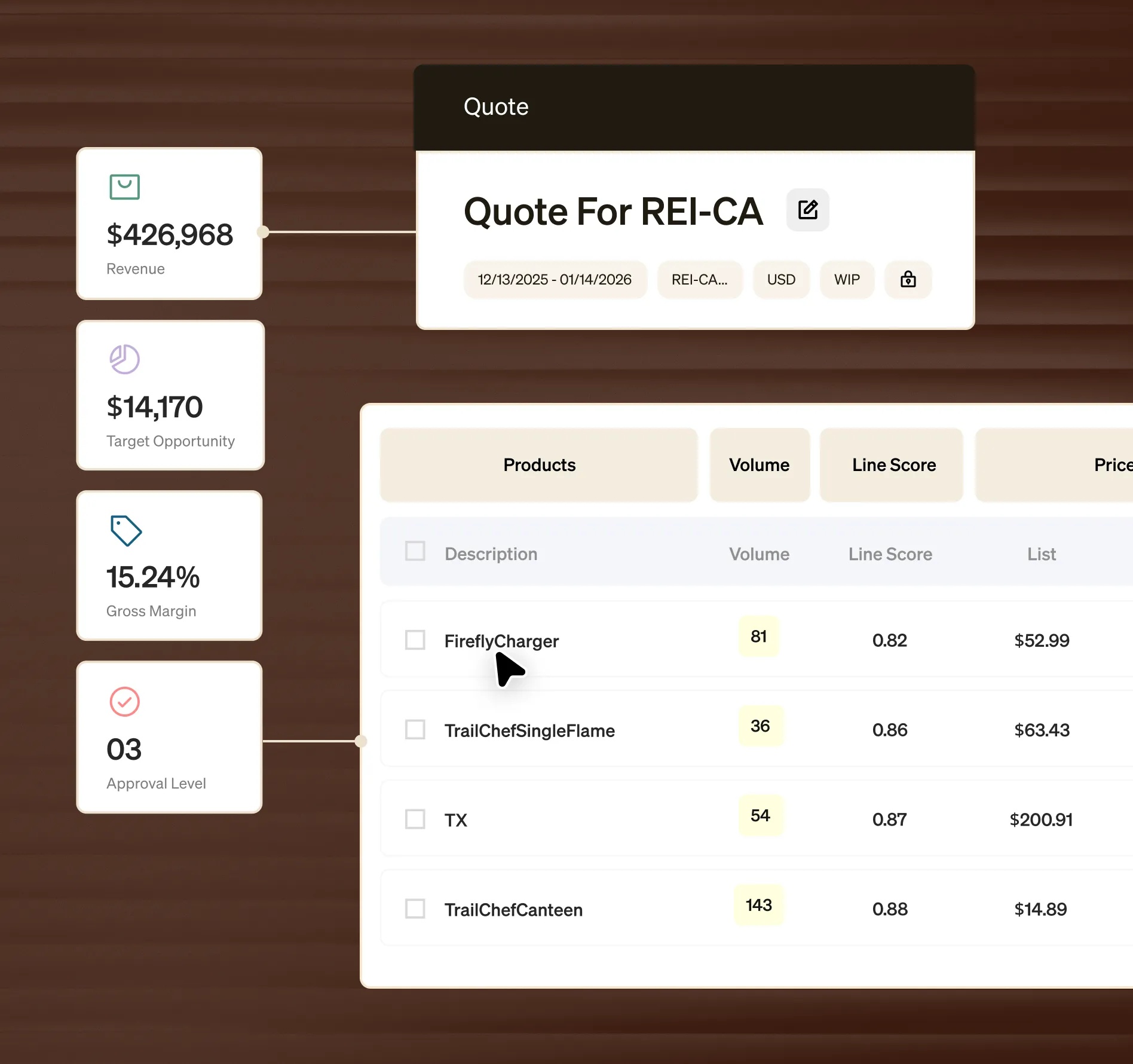
A manufacturing case study published on Vistaar’s site describes millions of configurable products serving more than 15,000 customers. Inconsistent discounting and cumbersome manual approvals were hurting the quoting process. Vistaar’s response included CRM and distributor-quote integration, segment-level price guidance, simulations, and configurable approval rules. The case is useful for its operating detail, rather than an imagined overnight transformation.
Industry expertise changes the calculation. A steel producer deals with moving commodity inputs. A pharmacy chain faces insurance reimbursement contracts alongside cash-paying customers and discount-card competition. Vistaar’s pharmacy offering models those different economics. The common platform has to accommodate the local commercial problem; a universal percentage increase would be a very expensive shortcut.
05 / SherloQ gets permission to act
Vistaar’s newer AI proposition is SherloQ, a native layer for asking pricing questions and executing workflows in ordinary language. The product description separates predictive models, generative explanations, and agentic actions. A user can request scenarios across products or initiate analysis and approval work without navigating every screen personally.
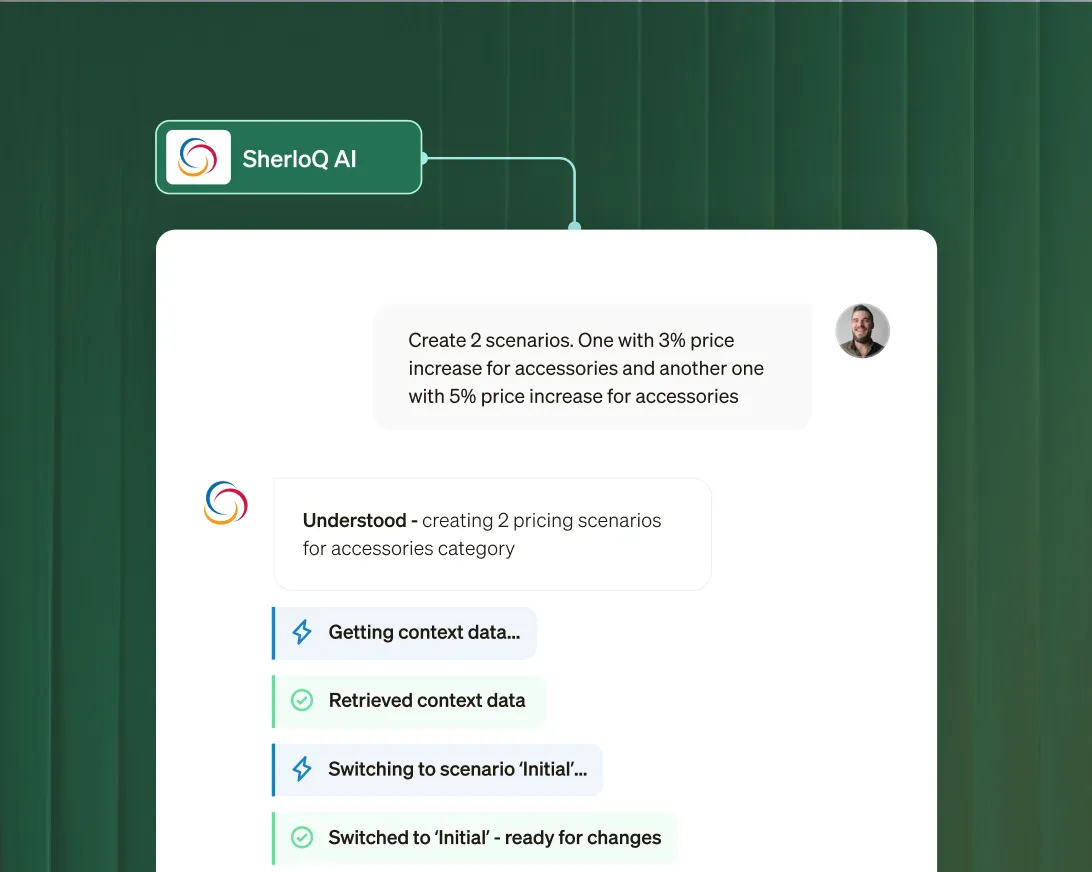
For a buyer, those controls deserve as much attention as the conversation. Who can see the underlying data? Which approval rules apply? Can a reviewer trace the action afterward? Vistaar says SherloQ inherits the platform’s permissions and records suggestions and decisions. The attraction is shortening the work between a question and an authorized action.
AI itself is no exclusive calling card. Vendavo and Pricefx also offer overlapping pricing and rebate capabilities. Vistaar’s more specific pitch combines configurable commercial workflows, sector expertise, and implementation by its own teams. Its announced Leader placements in the December 2025 IDC assessment and April 2026 Gartner report provide market context; they do not settle an individual buyer’s fit.
06 / Buy the evidence, then the software
Vistaar sells enterprise SaaS through custom quotes, with modules and services selected around the deployment. Its SmartOptimizer Quick Start offers a free pilot using historical transaction extracts. That creates a sensible first question: what can a focused slice of the business reveal before the organization takes on a larger implementation?
The method is worth copying even without buying Vistaar. Choose a product group or customer segment. Map its discounts and later incentives. Agree on the objective and the approval boundaries. Compare proposed prices with actual realized outcomes, and examine exceptions rather than admiring an average. A recommendation should survive both the sales conversation and the financial close.
Follow one deal to settlement. List price, discount, rebate, reimbursement, retained margin. Then ask which team owns each transition.
That approach depends on usable transaction data, explicit commercial objectives, and people willing to use the process. If historical records are patchy, or incentives live outside the model, greater automation may simply distribute a mistaken assumption faster. A business with a small, straightforward catalog should weigh whether enterprise integration and governance justify their effort. These are practical buying judgments, not universal rules.
The Beam story leaves a pleasingly concrete idea behind. A price can be calculated in one place and lost in several others. Vistaar’s business is built around making those places visible to one another. Before debating the next price increase, it may be worth discovering how much of the last one arrived.