A tissue slide has a peculiar kind of modesty. It is small, flat and easy to overlook. Yet a diagnosis, a trial enrollment decision or a judgment about whether a medicine is working can depend on what a pathologist sees inside it. PathAI has spent a decade trying to make that act of looking more reproducible. Along the way, it discovered how much business there is in everything surrounding the look.
- The work: digital slide management plus AI-assisted tissue analysis.
- The buyers: pathology laboratories, health systems and biopharma companies.
- The distinction: research tools, diagnostic software and trial-qualified tools carry different permissions.
- The big transaction: Roche’s 2026 agreement specifies $750 million upfront, with up to $300 million more in milestones.
The computer needed a reading room
PathAI’s business occupies two neighboring rooms in medicine. In one, a pathologist needs to review a case, find the right slide, annotate it and consult a colleague. In the other, a drug developer wants measurements from tissue: how a tumor is organized, which cells express a biomarker, or whether liver disease has changed during a trial. The company supplies software and services to both.
Its image management platform, AISight, provides a common workspace for slides, cases and AI applications. Its biopharma offering includes research, custom algorithm development, laboratory services, clinical-trial support and diagnostic development. This is enterprise selling: software licenses and contracted scientific work for organizations with laboratories, trials and integration requirements. A patient does not download PathAI and diagnose a troublesome mole.
A good result that could not leave the lab
Co-founder Andrew Beck came to the problem through medicine. He trained in pathology and biomedical informatics at Stanford and worked on the Harvard Medical School faculty. Aditya Khosla brought computer-vision expertise, including doctoral work at MIT. They founded PathAI in 2016. The pairing matters: an elegant image-recognition answer is useful only if it answers a worthwhile pathology question.
Beck’s account of the years before PathAI contains a useful admission. Early neural-network approaches required laborious segmentation and handcrafted features. They could produce an interesting publication, but engineering and automation stood between that publication and a usable product. As he put it, “the engineering and automation challenges meant it would not make it.”
“the engineering and automation challenges meant it would not make it”
Andrew Beck, on the research that preceded PathAI
Deep learning changed what the team thought was feasible. Beck recalls a 2016 pathology challenge win as evidence that the newer methods could outperform older image-analysis approaches. The researchers moved toward full-time company building. His first software engineer, Ryan McLoughlin, joined from Google before there was an office, working out of Beck’s basement. Even a company concerned with microscopic architecture has to begin somewhere.

The slide becomes a shared workspace
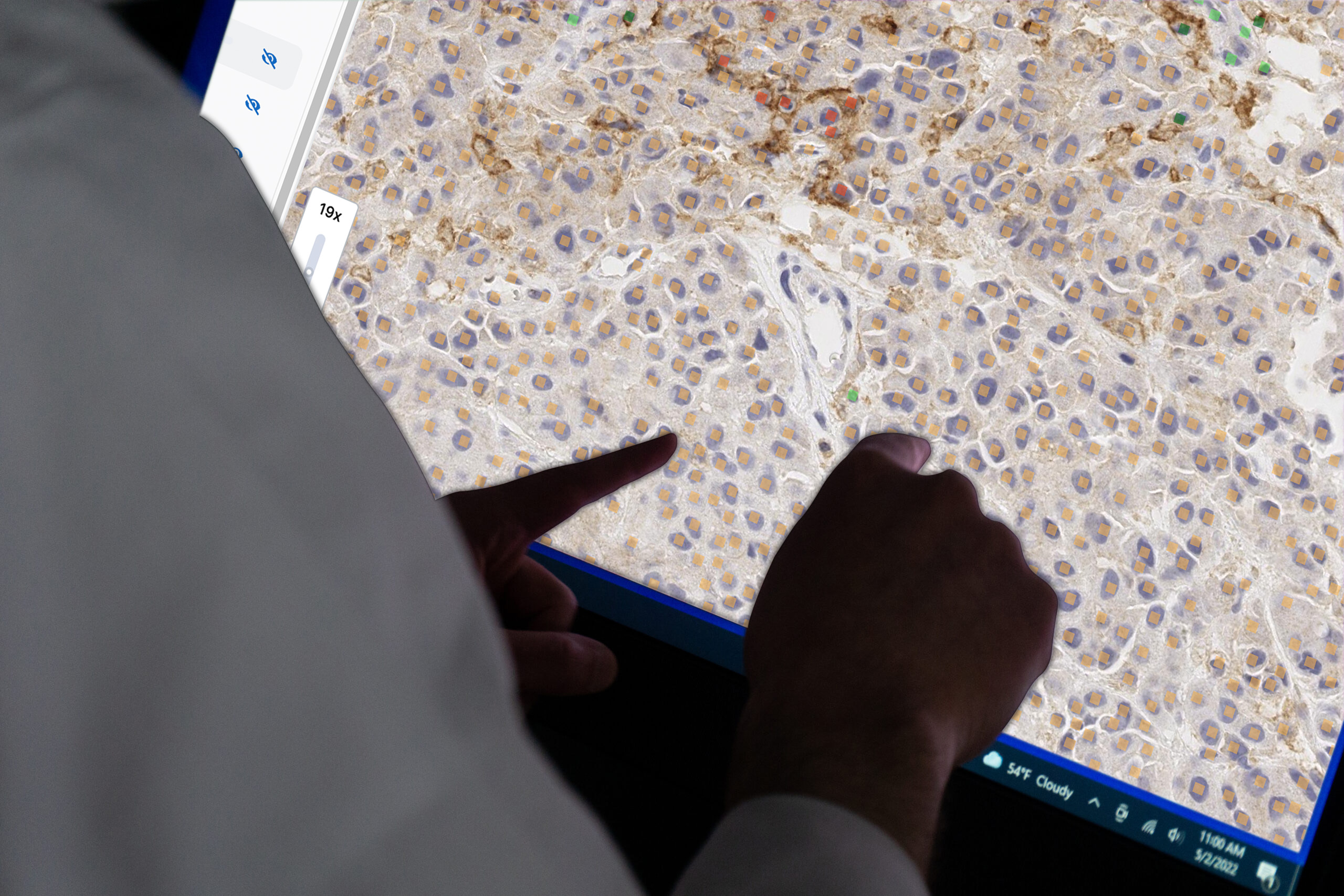
The practical proposition is easy to picture. A laboratory digitizes tissue slides. A pathologist opens the case in a browser, moves between images and marks regions of interest. A colleague can join a collaborative review. An integrated application can add an analysis. The case, the image and the measurement remain connected instead of becoming separate administrative errands.
The diagnostic version, AISight Dx, received FDA clearance for its evolved platform in June 2025, following an initial clearance in 2022. The newer decision included a Predetermined Change Control Plan for specified future changes. In August 2025, PathAI announced support for Roche’s VENTANA DP 200 and DP 600 scanners through that plan. That is a concrete answer to a recurring software problem: how to improve a regulated product without starting every permitted change from scratch.
- 01ScanDigitize the tissue slide
- 02OrganizeConnect image and case
- 03ReviewAnnotate and use eligible tools
- 04InterpretApply expert judgment
Illustrative workflow. The permitted use depends on the platform, components and application.
Those permissions deserve attention. AISight is a research-use platform in the United States. AISight Dx’s clearance concerns the diagnostic image management system with compatible components. It does not turn every research algorithm in the portfolio into an authorized diagnostic device. A laboratory must choose the appropriate configuration and intended use. Fine print has an unusually productive career in medical software.
PathAI also allows other developers into the room. Its multi-partner portfolio lists applications from companies including Paige, DeepBio and Visiopharm; further partnerships added Mindpeak, Stratipath and Primaa. Proscia’s Concentriq is an alternative spanning slide management and life-sciences workflows. PathAI’s particular combination is its own tissue-analysis products, scientific services and a platform that hosts outside applications. Openness alone is no monopoly.
The trial has a measurement problem
For drug developers, the attraction is sometimes less theatrical than finding a cancer. It is getting a dependable measurement. PathExplore characterizes the tumor microenvironment spatially. AIM-HI UC supports histological scoring in ulcerative colitis, while IBDExplore describes the inflammatory microenvironment. These are ways of turning tissue architecture into quantities researchers can examine.
Liver disease offers a particularly clear example. In MASH clinical trials, experts assess biopsies to score disease activity and fibrosis. Readers can vary in their judgments. That makes the measurement process part of the trial’s difficulty: a changing score must be interpreted alongside how the score was obtained.
In December 2025, the FDA qualified the tool it calls AIM-NASH, marketed by PathAI as AIM-MASH AI Assist, for a defined clinical-trial context. It helps assess fat infiltration, inflammation and scarring. The FDA described validation showing that AI-assisted comparisons with expert consensus were similar to individual pathologists’ comparisons with that consensus. The pathologist reviews the slide and outputs, then accepts or rejects the generated scores. Qualification gives trial developers a defined tool; it does not establish an autonomous physician.
The laboratory changes hands
PathAI’s route into everyday pathology included buying a laboratory business. In July 2021 it acquired Poplar’s management services organization, extending into clinical diagnostics. In June 2024, Quest completed its purchase of select PathAI Diagnostics laboratory assets. Quest’s filing puts the cash price at $100 million.
The shape of the transaction is revealing. The Memphis diagnostics laboratory became part of Quest’s AmeriPath operation. PathAI retained a separate research laboratory at the site for biopharma clients. Quest also entered a separate agreement to license AISight. Experience gained in a laboratory was followed by a relationship with a much larger laboratory operator. The asset sale and the software relationship served different purposes.
Labcorp followed another route. Its relationship with PathAI began with a strategic investment in 2019; in February 2026 it announced an expanded collaboration to deploy AISight Dx across its national anatomic pathology laboratories and hospital collaborations. MedStar Health announced its own partnership in April. These announcements show where the company sells and how it distributes its technology. They are commitments to deployment, rather than a count of completed installations or proven patient benefits.
The price of getting into the workflow
Building the business took substantial capital. PathAI announced an $11 million Series A in 2017, completed a $75 million Series B in 2019 and raised $165 million in 2021. The Series C was co-led by D1 Capital Partners and Kaiser Permanente. Drugmakers and laboratory companies also participated. Funding bought room to develop products and expand the commercial business; it should not be confused with revenue or a customer’s cost of installation.
Up to $1.05 billion in total consideration. Closing subject to customary conditions; the announcement expected the second half of 2026.
Roche’s acquisition agreement extends a relationship that began in 2021 and expanded into exclusive companion diagnostic development in 2024. The buyer’s stated rationale combines laboratory workflow with biomarker discovery, clinical-trial support and companion diagnostics. PathAI brings capabilities that sit between tissue and treatment; Roche brings an existing diagnostics business through which they could travel.
The transferable lesson is a matter of product discipline. Build around the work people must finish. Make the image accessible, the measurement reviewable and the application usable in the case being handled. PathAI’s July 2026 release illustrates the point with customizable dashboards, bulk annotation deletion, editable measurement endpoints and archiving support. These features are mundane enough to be believable, and practical enough to matter.
That approach needs digitized slides, compatible systems, validated uses and people prepared to change their workflow. Research-use tools cannot simply be pressed into routine diagnosis; software cannot supply a missing tissue sample. PathAI’s story rewards an interest in those constraints. The humble slide acquired a digital address, a set of tools and a way to invite a colleague over. That is a considerable amount of company to build around something so small.
Keep looking
Explore the products, watch the conversation, or follow the next release.