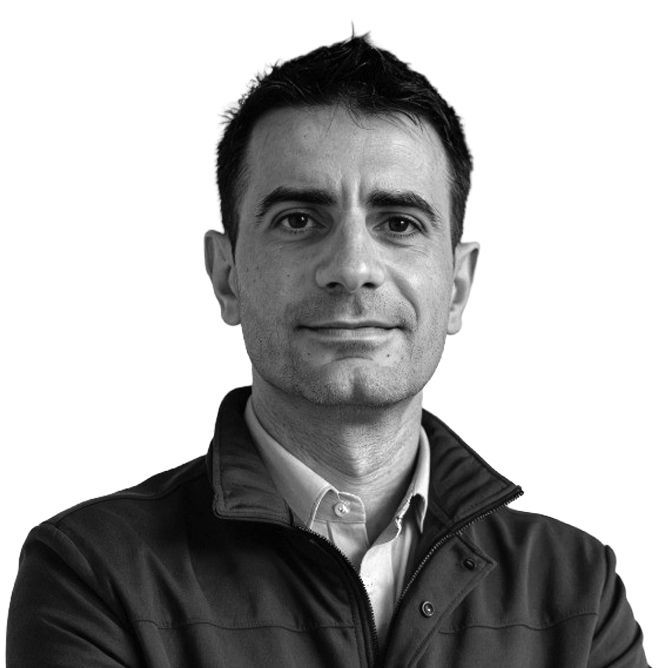
A Data Scientist Takes the Helm
Iker Huerga runs Pathos AI, and the job he has given himself is not a small one: change the odds on cancer drugs. In May 2025 he was named chief executive of the New York- and Chicago-based biotechnology company, stepping in from interim leader and co-founder Ryan Fukushima. Days later, Pathos announced it had closed a $365 million Series D financing that valued the company at roughly $1.6 billion. Huerga arrived with a simple line for what the company is for. "Get the right treatments to the right patients, faster."
What makes that line more than a slogan is the person saying it. Huerga is not a career executive who wandered into biotech. He is a data scientist who has spent more than two decades where machine learning meets oncology, first as a founder, then inside two of the most data-driven organizations in the field. Before Pathos he was Chief Data Scientist for Oncology R&D at AstraZeneca, one of the largest cancer-drug developers in the world. Before that he was an Executive Vice President at Tempus Labs, the precision-medicine company built on molecular and clinical data. Along the way he founded three oncology companies and exited two of them.
Why the Odds Need Changing
The reason a company like Pathos exists comes down to a brutal statistic. Only about 5 percent of cancer drugs that enter clinical trials ultimately win approval from the U.S. Food and Drug Administration. The other 95 percent fail - not always because the science was wrong, but often because the trial enrolled the wrong patients, tested the wrong dose, or read out a signal too late to matter. Every one of those failures represents years of work and, more importantly, patients who ran out of time.
Huerga's argument is that a failed compound is not always a dead compound. Some of them were simply never matched to the patients they could have helped. That is the thesis he keeps returning to when he talks about Pathos: the company's job is to find the biology, the patient, and the trial design that turn an overlooked molecule into a medicine. "Pathos has the potential to dramatically accelerate oncology drug development and bring new life to promising compounds that have been overlooked," he has said.
The MachineHow Pathos Works
Pathos was founded in 2022 by Eric Lefkofsky, the entrepreneur behind Groupon and Tempus, together with Ryan Fukushima. Its scientific leadership includes Chief Scientific Officer Eric Schadt, a computational biologist who was founding CEO of Sema4, and Chief Operating Officer Matt De Silva, who founded Notable Labs. It is, in other words, a company assembled around data and the people who know how to use it.
The platform combines millions of patient records with proprietary AI to do three things: identify the right candidates for a trial, design adaptive trials around them, and run those programs with smaller, AI-enabled teams. The company's stated ambition is to build the largest multimodal foundation model in oncology - a system that learns from every program it touches. In the company's own framing, each program teaches the model, making the next one faster and more precise. Huerga describes the goal for drug development in three words that sit at the center of Pathos's vision: data-guided, patient-centered, and repeatable, instead of speculative.
Pathos AI - Funding at a Glance
From Mondragon to the Frontier
Huerga's roots are in the Basque Country. He studied at Mondragon University, an institution woven into one of the world's largest worker cooperatives - a place where engineering and enterprise sit close together. That background shows in his profile: he is as comfortable with the technical detail of a foundation model as he is with the business of running a venture-backed company. His research history is public; he has peer-reviewed work in machine learning and optimization indexed on Google Scholar, a reminder that before he was a CEO he was a practitioner.
The company also describes Huerga as a cancer survivor, and it lists empathy - "informed by lived cancer experience" - among its core values alongside integrity, innovation, collaboration, and resilience. For a leader whose entire mission is getting therapies to patients sooner, that is not incidental framing. It is the difference between treating drug development as an optimization problem and treating it as a personal one.
What He Is Really Wagering
The crossover profile is the interesting part. Most people in Huerga's position come from one side of the fence - either the pharmaceutical companies that own the compounds, or the technology companies that own the data. Huerga has stood on both. At AstraZeneca he was inside a machine that runs oncology R&D at global scale. At Tempus he was inside a machine that turns patient data into product. Pathos is a bet that putting those two things together - big pharma's compounds and a data platform's models - beats either one alone.
He took the CEO role at a moment when the company had capital, a founding network among biotech's most closely watched investors, and a clear enemy in that 5 percent approval rate. The Series D gives him room to build the foundation model and prove that AI-enabled programs can be run leaner and faster than the industry standard. Whether the model delivers is the open question that the next few years will answer. For now, Huerga has staked his reputation - and a good deal of investor conviction - on a straightforward proposition: that the path from molecule to medicine can be made shorter, and that the tools finally exist to do it.
It is an ambitious claim in a field that has humbled ambitious people before. But Huerga is not promising a cure. He is promising a better process - one where the right patient and the right therapy find each other before the clock runs out. If Pathos gets even part of the way there, the case he makes today will look less like a pitch and more like a turning point.