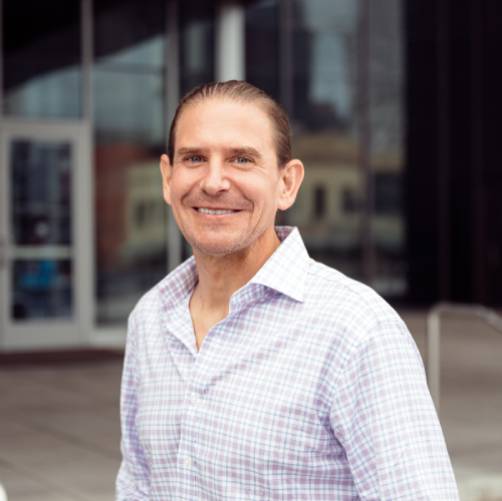
The operator who read every page
A cancer patient arrives at a new oncologist with a decade of treatment history - scans, pathology reports, clinical notes, medication lists - distributed across seven different hospitals. Nobody has time to read it all. Nobody knows what's missing. The oncologist makes decisions with incomplete information because there is no other option.
This is the specific failure that Mika Newton built xCures to address. Not AI in the abstract. Not a dashboard with charts. A system that goes and gets those records, reads them, structures them, and surfaces the parts that matter - within minutes, verified back to the source documents, readable by both the physician and the patient.
Newton came to this problem with an unusual kind of preparation. She spent more than two decades moving through almost every layer of the life sciences industry: pharmaceutical sales at Quintiles, software at Tripos, research tools at Invitrogen, evidence synthesis at Evidera, cardiovascular biomarkers at diaDexus, clinical evidence at Doctor Evidence. Each stop was a different angle on the same question - why does clinical data so rarely reach the people who need it?
"The increasing complexity and volume of patient data are quickly surpassing physicians' ability to process information manually."
- Mika NewtonBy the time she became CEO of xCures in 2018, she wasn't theorizing. She had watched the failure happen at multiple organizational levels, in multiple clinical contexts, across two decades. xCures was the accumulated answer.
The company started with an audacious premise: what if every cancer patient had a structured, complete, clinician-readable summary of their entire treatment history - automatically, without anyone having to chase fax machines? And what if that same infrastructure could power regulatory-grade real-world evidence for researchers and drug developers at the same time?
xCures: where the records go to become useful
xCures retrieves medical records from any US care site. It doesn't ask the patient to collect and upload them. It goes and gets them - through HIE connections, QHIN participation, and direct integrations. In October 2024, xCures was formally activated as a Qualified Health Information Network participant, an official designation that gives it the technical and regulatory standing to access clinical data at scale.
Once the records arrive, the platform's NLP and AI stack goes to work. Unstructured clinical notes become structured data. Diagnoses, treatments, biomarkers, and timelines get extracted, verified, and linked back to source documents. The result looks like a complete, readable patient summary - but underneath it is a structured database precise enough for regulatory submissions.
xINFORM
A direct-to-patient portal for accessing, understanding, and sharing personal health information. Puts patients in control of their own clinical story.
xACCESS
Guides treatment decisions, matches patients to clinical trials, and supports tumor board case reviews. Built for oncologists working through complexity.
The company's most quietly radical product is XCELSIOR - an IRB-approved, patient-centric real-world data and outcomes registry. Newton calls the underlying model a "perpetual clinical trial." The registry never stops collecting. As long as a patient is receiving care, their outcomes feed into a continuously updated, regulatory-grade dataset. For researchers studying cancer treatments, this is evidence that traditional retrospective studies cannot produce.
"The near-term wins for AI in healthcare aren't about replacing clinical judgment. They're in summarizing records, reducing documentation burden, and helping clinicians navigate complexity. Unglamorous, but genuinely transformative."
- Mika Newton, MedCity NewsSupporting this operation: a team of 50+ engineers, data scientists, clinical operations staff, and customer success managers. Twelve oncologists serve as medical advisors - clinical judgment is structurally embedded in the platform, not consulted occasionally. A data and clinical operations hub runs from Raleigh, North Carolina alongside the Oakland headquarters.
Why trust is the only problem that matters
Newton's most pointed public positions have been about what AI in healthcare gets wrong. In March 2026, she published a piece in MedCity News titled "ChatGPT Health Exposes the Hard Truth About AI in Healthcare." The argument: AI that generates clinical-sounding outputs without source traceability, validation metrics, or auditability isn't a healthcare solution - it's a liability.
This isn't caution for its own sake. xCures is built around the specific properties that make AI trustworthy in clinical settings: every output links to a source document, every extraction is verifiable, every summary can be audited. The company calls this "source document traceability" - a dry phrase for something with real stakes when the document is a pathology report and the reader is an oncologist.
In an April 2024 MedCity News piece, she identified what she calls the "digital dilemma" - health systems that want to innovate but face interoperability chaos, data silos, and validation requirements that generic AI tools are not built to satisfy. xCures' answer to that dilemma is not a better chatbot. It's infrastructure.
The long way around to the right problem
Newton's career reads like a deliberate apprenticeship in the life sciences supply chain. She started in sales and operations - at Quintiles (now IQVIA), one of the world's largest clinical research organizations, and at Tripos, a computational chemistry software company that was ahead of its time. She moved into marketing at Archimedes, a simulation modeling company later acquired by Kaiser Permanente.
At Evidera, she rose to Senior Vice President of Client and Market Development, working in outcomes research and evidence synthesis for pharmaceutical clients. Evidence synthesis - the rigorous aggregation of clinical data to support regulatory and payer decisions - became a recurring theme. At diaDexus, she managed clinical development for cardiovascular biomarker diagnostics. At Doctor Evidence, she served as Chief Commercial Officer, scaling a platform that structured clinical evidence from published literature.
Each role added a layer: regulatory context, evidence standards, commercial reality, clinical operations, data structure. When she arrived at xCures as CEO, she carried the full stack. The company's technical team had the AI capabilities; Newton brought the understanding of what the healthcare system would actually accept.
Building the infrastructure, not the headline
In June 2021, xCures announced a $12.69 million Series A round led by Boehringer Ingelheim Venture Fund, the venture arm of one of the world's largest pharmaceutical companies. Co-investors included Vanedge Capital, Harmonix Fund, and Metaplanet. The round validated not just the platform but the specific clinical thesis - Boehringer Ingelheim's participation signaled that a major pharma player saw real-world evidence infrastructure as a strategic asset.
A December 2023 Convertible Note round extended the runway as the platform entered its next expansion phase - QHIN activation, next-generation AI features, and a growing network of health system and patient advocacy partnerships.
The network effect of trust
Newton has built xCures by signing partnerships that extend the platform's clinical and data reach. Each one adds a dimension - patient access, genomic data, clinical decision support, or advocacy reach.
The December 2024 NeoGenomics deal gave xCures access to genomic testing data through HIE/QHIN integration - adding molecular profiling to an already rich clinical picture. The Atropos Health partnership, announced January 2025, layers in a health outcomes research platform to deepen the clinical decision support capability. The Kidney Cancer Association deal, from May 2024, followed the Cancer Commons model: patient advocacy organizations become data partners, creating consent pathways that serve both patients and researchers simultaneously.
These aren't distribution deals. Each partnership represents a data or validation layer that makes the platform more clinically credible - and harder to replicate from scratch.
In her own words
"The near-term wins for AI in healthcare aren't about replacing clinical judgment. They're in summarizing records, reducing documentation burden, and helping clinicians navigate complexity. Unglamorous, but genuinely transformative."
"Intelligence is the easy part. Trust is the hard part. And in healthcare, it's the only currency that matters."
"The increasing complexity and volume of patient data are quickly surpassing physicians' ability to process information manually."
"By integrating AI, we are setting new standards in personalized and guideline-driven care."
What she's built
- Led xCures to $12.69M Series A led by Boehringer Ingelheim Venture Fund, with co-investors Vanedge Capital, Harmonix Fund, and Metaplanet
- Accepted into Forbes Technology Council - invitation-only community for world-class CIOs, CTOs, and technology executives
- Built xCures into a 50+ person team with 12 oncologist medical advisors embedded in platform development
- Established xCures as a QHIN-activated network participant, enabling automated medical record retrieval from any US care site
- Launched XCELSIOR - an IRB-approved, patient-centric real-world data registry running as a perpetual clinical trial
- Secured strategic partnerships with NeoGenomics, Kidney Cancer Association, Cancer Commons, Atropos Health, and Huntsman Cancer Institute at University of Utah
- Speaker at PMWC Precision Medicine World Conference (2020 and 2024), HLTH US 2024, ATA Nexus Conference, and World Bio Group Digital Health Summit