A clinical-trial sample has a talent for accumulating aliases. It begins as something a protocol expects at a particular visit. A site collects it, a courier labels it, a central laboratory receives it, a specialty laboratory tests it, and a repository may store what remains. Each stop can add an identifier, a timestamp, a status and a fresh opportunity for the sample to become estranged from its own biography.
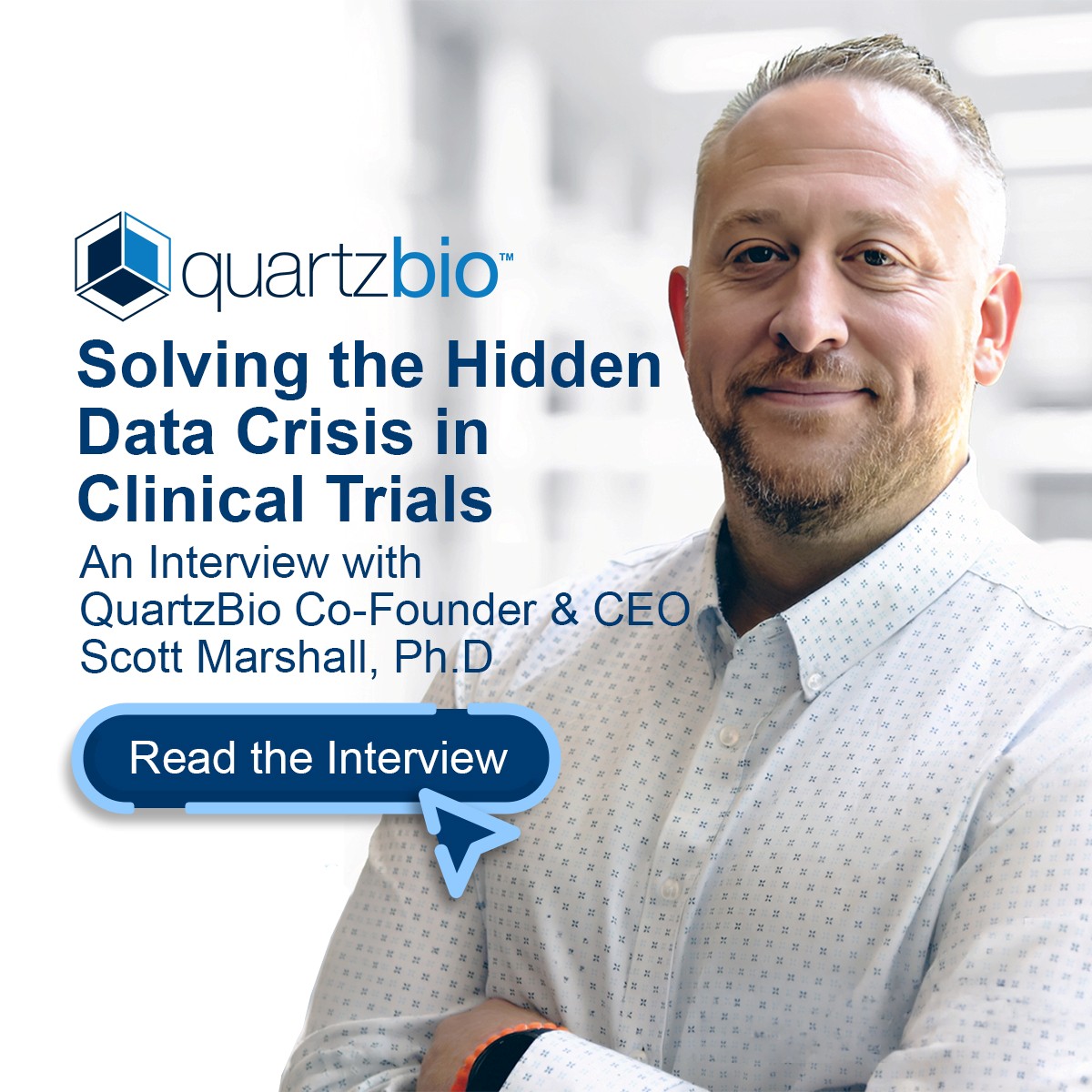
Scott Marshall has built his professional life around that estrangement. He is a PhD biostatistician, the CEO and co-founder of QuartzBio, and a patient observer of the places where technically competent systems fail to introduce themselves. One application knows what should have happened. Another knows what arrived. A third holds the assay result. A spreadsheet is asked to perform the diplomatic service.
Marshall calls the weekly reconciliation ritual the “Excel Olympics.” The line is funny because it is recognizable. Teams stay late copying files, matching codes and asking whether a missing time point is truly absent or merely hiding beneath a different label. There are no medals. The prize is learning, before an analysis is due, that the trial still possesses the evidence everyone assumed it had.
The business between the boxes
The software industry likes to draw orderly diagrams. Boxes hold systems; arrows carry data. The trouble usually lives in the arrows. A sample order sits in one place, collection in another, shipment and storage elsewhere, and the final laboratory file arrives with its own vocabulary. Each product can perform its assigned job and still leave the wider journey invisible.
QuartzBio is Marshall's answer to the gaps. Based in Frederick, Maryland, the company sells connected sample and biomarker intelligence software to clinical-stage biotechnology and pharmaceutical teams. Its platform is vendor-agnostic: it is designed to sit across existing labs, clinical systems and data environments rather than demand that a sponsor replace every piece. The ambition is a common account of what was expected, what happened, what can legally be used and what the resulting data says.
That account matters because a sample is not valuable merely because it exists. It must remain linked to the right participant, visit, handling conditions, permissions and assay output. Break enough of those connections and the scientific question gets smaller. The result may be delayed, manually reconstructed or excluded. The physical object has completed its trip while its context has missed the connection.
A statistician enters operations
Marshall's route to software leadership began with applied mathematics at the University of Tennessee at Chattanooga, continued through a master's degree in biostatistics at the University of Alabama at Birmingham, and led to doctoral work at Virginia Commonwealth University. His 2010 dissertation examined “sufficient similarity,” a statistical problem concerned with deciding when complex mixtures are alike enough to support a common inference.
It is tempting to read his later career backward into that title, but the continuity is real and modest. His early work asked how evidence with many components could be compared defensibly. His later work in pharmacogenomics and biomarker analytics asked how varied laboratory and clinical datasets could be made analysis-ready. QuartzBio asks how those records can stay connected across an operating system that includes people, vendors, instruments and software.
By the early 2010s, Marshall was publishing and presenting statistical work while affiliated with BioStat Solutions. His research included mixture toxicology, pharmacogenetic study design, treatment-specific subgroup identification and genetic association methods. By 2017, as a managing director at Precision for Medicine, he was writing publicly about biomarker-data harmonization with Jared Kohler, now QuartzBio's chief operating officer.
The company Marshall now leads did not emerge from a weekend brainstorm about artificial intelligence. Its public lineage stretches through years of biomarker informatics and data operations. Marshall's professional profile associates his leadership with the business since 2014. Over time, the remit widened from analytics toward the whole sample-and-data lifecycle. The cast around him reflects that blend: co-founder and CTO Tobias Guennel brings the technology; Kohler brings translational informatics and operations; commercial and marketing leaders translate the platform for the teams expected to live with it.
One source of truth is a social project
Data integration sounds like plumbing until one notices how many human agreements it contains. What counts as the canonical identifier? Which laboratory status should trigger attention? Who can see a consent restriction? When does a discrepancy require action rather than another note in a tracker? Software can move a field from left to right. It cannot make the field meaningful without domain knowledge and shared rules.
Marshall's public language returns to this social layer. He describes operations, translational research and R&D technology teams working from a unified foundation. He frames sample and biomarker data as connective tissue, a useful phrase because connective tissue is valuable precisely for what it joins. QuartzBio's product thesis is that the whole journey should be visible without forcing every stakeholder to become a data scientist.
The practical promise is early warning. A missed collection, delayed shipment, temperature problem, consent gap or mismatched identifier is cheaper to address while the trial is running than after a database lock or planned analysis. QuartzBio says customers using its platform have sharply reduced collection-monitoring effort and saved money on Phase II and III studies. Those figures belong to the company's own reported outcomes, but they point to an uncomplicated mechanism: find exceptions sooner, and ask skilled people to investigate the exceptions rather than inspect every row.
AI, with a clipboard
QuartzBio now describes its platform as powered by domain-specific AI agents. Marshall's version of the AI story is unusually operational. The agents are meant to monitor data, identify missing or inconsistent records, surface risks and let users ask questions in natural language. The job is less oracle than vigilant colleague: watch the handoffs, remember the rules, point to the suspicious gap.
That distinction matters in a regulated environment. A charming answer is useless if nobody can defend the underlying record. QuartzBio's platform pitch rests on data harmonization, permissions, traceability and security before conversation. The language model is an interface and an automation layer; the connected data foundation does the quieter work of ensuring that the answer refers to the right sample in the right context.
Marshall has been writing about this progression for years. In 2020 he published essays about centralizing pharmacokinetic, clinical and exploratory data, making biomarker data “talk,” and building multi-layered processing pipelines. In 2025 he presented connected precision medicine intelligence as an AI-agent platform. The vocabulary evolved from pipelines to agents, but the governing concern stayed put: information becomes useful when its relationships survive.
Capital for the unglamorous work
In May 2026, QuartzBio announced a strategic growth investment and controlling interest from Eir Partners. The terms were not disclosed. The stated plan was concrete: expand interoperability across laboratories and clinical systems, deepen automation, improve portfolio analytics, strengthen enterprise security and compliance, and add implementation and customer support capacity.
It was a milestone that fit Marshall's chosen problem. Enterprise software rarely succeeds by arriving alone. It must be mapped into workflows, validated, secured, adopted and maintained. A platform that promises a common view across a portfolio has to earn the confidence of each team contributing a slice of that view. More product capacity matters; so do the people who help a sponsor define the rules and connect the pipes.
Marshall said the investment would let QuartzBio reduce manual oversight, protect scientific integrity and cut trial cost and duration. The aspiration is large, but his examples stay agreeably small: a time point caught before it vanishes, a consent status visible when needed, a team spared a night of copying files. He explains a platform through the chores it removes.
The elegance of remembering
There is a particular kind of founder who wants to invent a new object. Marshall is working on the integrity of objects that already exist. The vial has been collected. The laboratory has done the assay. The clinical system has recorded the visit. The task is to make their stories agree while there is still time to act.
That can sound clerical beside the drama of drug discovery. It is also where good science acquires a memory. A result without lineage is a rumor with decimal places. A sample without permission or context is merely cold inventory. Connecting the two is not decorative work. It is how evidence becomes defensible.
Marshall's career has moved from measuring similarity to managing continuity, from statistical models to an enterprise platform. The common thread is a preference for evidence that can survive inspection. QuartzBio's wager is that clinical teams will pay to see across the seams, and that AI will be most useful when it watches those seams without getting bored.
Somewhere tonight, a spreadsheet is still being pasted together. Marshall would like its exhausted author to be the last competitor in the Excel Olympics. It is a suitably human ambition for a data company: fewer heroic rescues, fewer mysterious aliases, and a sample that arrives at the final analysis with its whole story attached.